You Already Know.
So Why Aren't Things Changing?
Knowledge is the first step — but not the decisive one. On the gap between insight and behaviour, and the five-step process that closes it.
You know you should sleep earlier. That movement matters. That you should eat less sugar, drink more water, build up less stress. You've read it, heard it, at some point even believed it. And yet — nothing changes. Or hardly anything. Or for a while, then not anymore.
That's not failure. That's a gap. And it has a name.
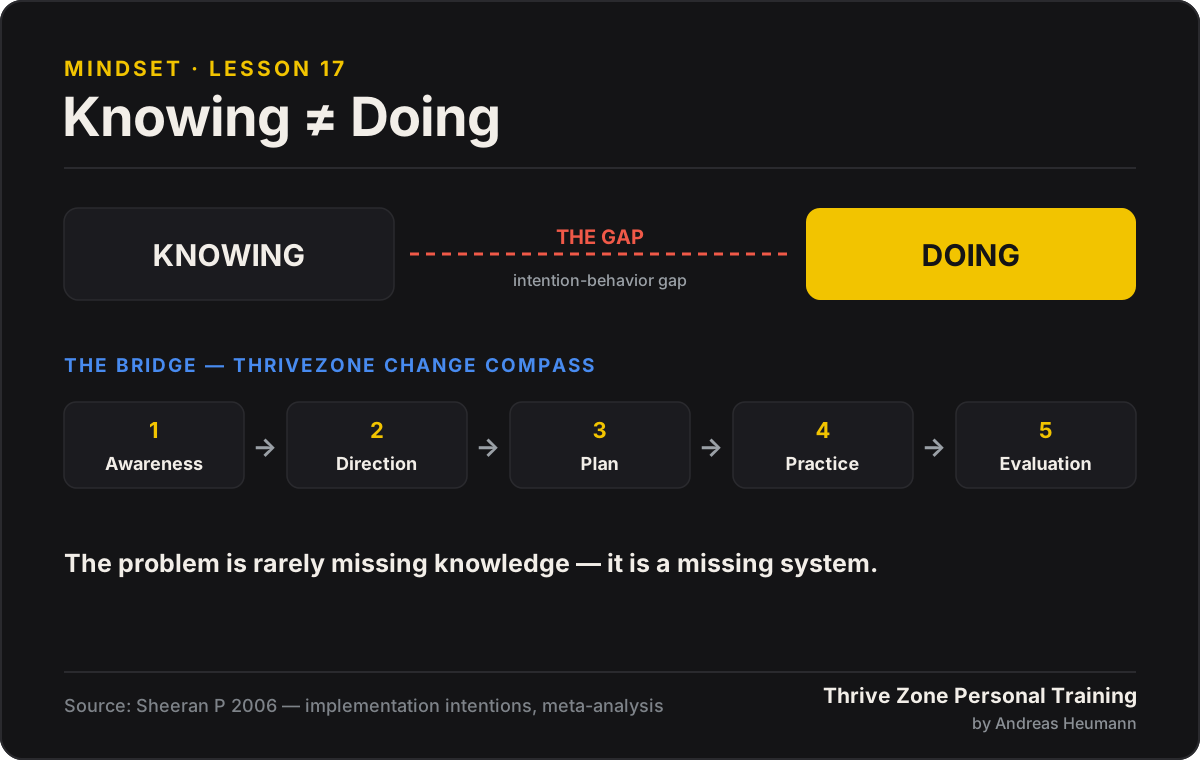
The Gap Between Knowing and Doing
Behavioural research calls it the intention-behaviour gap — the chasm between what we intend to do and what we actually do. It's well documented: people with excellent health knowledge aren't automatically healthier than people without it. Nutritionists struggle with the same eating habits as their clients. Sports physicians who know every harm that sedentary behaviour causes — still sit too much.
Knowledge is necessary. But not sufficient.
What's needed instead? A process. One that doesn't rely on willpower — which fluctuates, runs dry, depends on sleep and stress. But on method. On a sequence you can apply again and again, regardless of the topic.
The ThriveZone Change Compass: Five Steps
In the ThriveZone system we call this process TZCC — ThriveZone Change Compass. It's not a motivation model and not a promise. It's a working structure I developed and refined in practice with clients. Five steps, always in this order.
Step 1 — Awareness: What's Really Going On?
Not what you think is going on. What's actually going on. Most people skip this step because they think they already know. They sleep badly — obvious. They drink too little water — clear. But awareness means: looking precisely.
When exactly do you sleep badly? What precedes it? Is it the light, the phone, the coffee at 4 pm, the circular thinking? Without a precise assessment we treat symptoms rather than causes. Awareness isn't the knowledge that something is off — it's the precise understanding of what is off and why.
Step 2 — Direction: Where Do You Really Want to Go?
Many people have goals but no direction. Goals are endpoints — "lose 10 kg", "get fitter", "less stress". Direction is what's underneath: Why do you want that? What does it really mean to you? What does your life look like when you've arrived there?
This step might sound like self-help rhetoric. It isn't. Research on goal intention shows: people who have a clear sense of meaning behind their goal show significantly higher behavioural consistency than people who only have the result in view. The reason: when the day gets hard — and it will — you don't need discipline. You need a reason that's bigger than the current situation.
Step 3 — Plan: What Exactly, When, How?
The most common mistake after a motivating moment: no concrete plan. "I'll start tomorrow" is not a plan. "I train on Mondays, Wednesdays and Fridays at 7 am, 45 minutes, after breakfast" is a plan. The difference isn't just precision — it's neurobiological.
Concrete if-then plans — "When X happens, I do Y" — activate implicit action triggers. That means: the behaviour doesn't have to be decided anew each time. It gets triggered by context. This reduces cognitive load, bypasses willpower, and makes behaviour significantly more stable.
In coaching this means: we don't plan vaguely ("move more"), but concretely ("Tuesday 6 pm, 30-minute walk, shoes standing at the door the night before"). The more specific the plan, the lower the friction between intention and action.
Step 4 — Practice: Repetition Makes It Real
This is where the actual work happens. And here it's important to calibrate expectations.
Habits aren't formed through decisions, but through repetition. Repetition in a stable context. And that takes time — more time than most people expect.
66 days on average. Simple habits faster, complex ones significantly longer. That means: someone who after three weeks feels "it's not quite working yet" is in the normal range — not failing.
Practice is also the hardest step because it delivers no new information. No aha moment, no motivational boost. Just quiet, consistent repetition. Which is exactly why the next step isn't optional.
Step 5 — Evaluation: What's Actually Working?
Evaluation isn't self-criticism. Evaluation is data management. You look back at a defined period — a week, a month — and ask: What worked? What didn't? What needs to be adjusted?
Without evaluation you run blind. With evaluation, a learning process emerges that improves itself. The plan from step 3 gets sharper. The awareness from step 1 gets more precise. The cycle begins again — but at a higher level.
Why Method Beats Willpower
Between a stimulus and a response there is a space. In that space lies the freedom to decide differently. That's a good idea — and it's true. But it overlooks something: that space is narrow when you're tired. Narrow when you're stressed. Narrow when you're hungry.
Willpower is a limited resource. It's reduced by decision load, stress and exhaustion. A system — a process — bypasses this limitation. Because good habits don't have to be decided in the moment when the decision is hard. They're already decided. The context triggers them.
That's the real value of TZCC: not generating motivation, but reducing the need for motivation.
How to Start Right Now
Take one thing — just one — where you know what should be done, but you're not doing it. No big goal. Something manageable.
Ask yourself: What's really going on? (Awareness). Why does this matter to me? (Direction). What exactly will I do, when, how often? (Plan). How long will I give myself before evaluating? (Evaluation). And then: start. Not with the result in view, but with the next step.
TZCC isn't a promise of quick transformation. It's a method that works — when you apply it consistently. Slowly, steadily, reliably. Like all things that actually last.
If you want to go deeper: Lesson 09 — The Resistance Principle explains why difficulty isn't a sign of doing something wrong, but of growth. And Lesson 14 — Attention shows how to sharpen your mental focus so the process becomes easier.
New lessons every two weeks in your inbox
Practical, evidence-based, no noise. Straight from the trainer.
To the newsletterSources
Gollwitzer, P. M., & Sheeran, P. (2006). Implementation intentions and goal achievement: A meta-analysis of effects and processes. Advances in Experimental Social Psychology, 38, 69–119.
Lally, P., van Jaarsveld, C. H. M., Potts, H. W. W., & Wardle, J. (2010). How are habits formed: Modelling habit formation in the real world. European Journal of Social Psychology, 40(6), 998–1009. DOI: 10.1002/ejsp.674