Why Your Neck Tightens
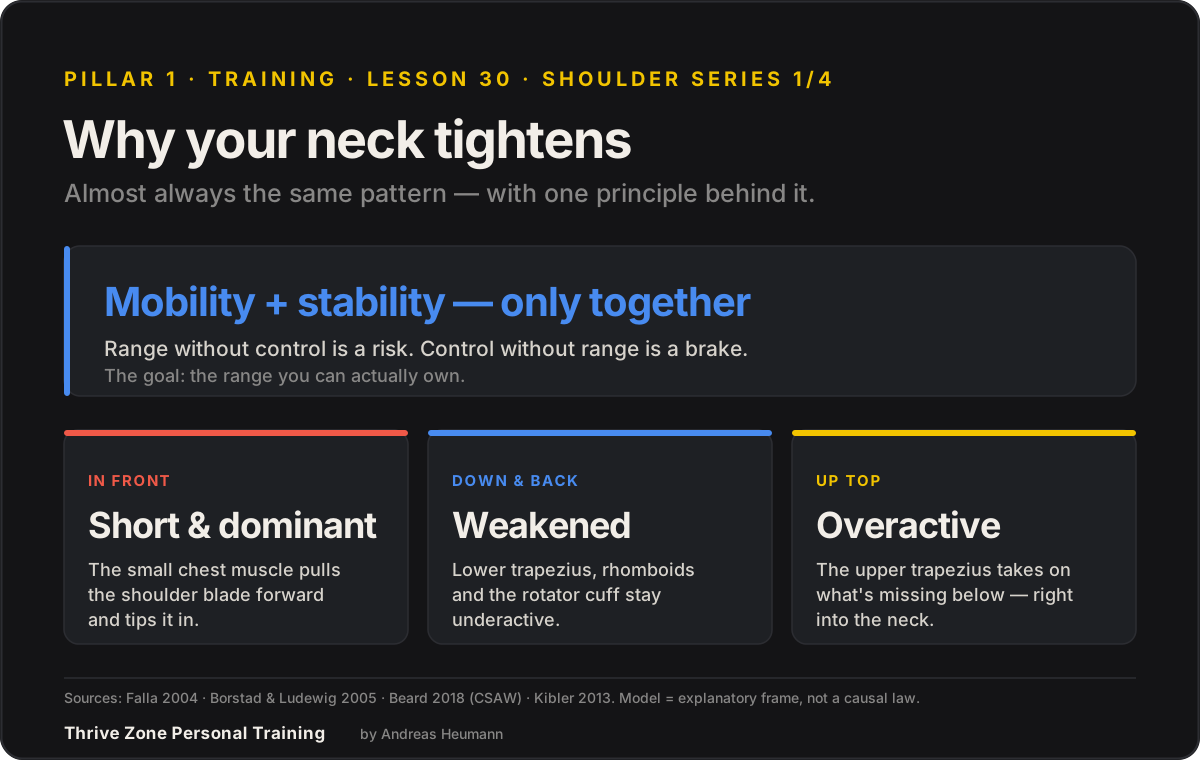
Almost every client who comes to me — into training or a workshop — with a tight neck shows the same pattern: short and dominant in front, weak down and back, overactive up top. Before we get to exercises, it pays to understand what's really going on — and why correcting posture alone isn't enough.
The overarching trigger is modern everyday life — and the way we deal with technology. Computer, smartphone, sitting in the car, the workplace: almost all of it pulls us into the same body positions. Head forward toward the screen, shoulders forward and up, eyes down on your hands. I'm sitting in one of those positions right now, typing this on my laptop out on the terrace.
Hours a day, year after year, and it turns into a pattern. What's constantly pulled together shortens in front. What's barely used weakens down and back. And up top, the upper trapezius stays active to make up for the work that's lacking below — until it pulls by evening, into the back of your head, for some into the cervical spine, with those familiar trigger points in the trapezius.
The surprising part: this hits people who train hard, too. It's rarely "not enough movement." It's an imbalance — and an imbalance can be understood and undone. That's what this is about.
The shoulder is the most mobile joint in your body — and the least secured by bone. What holds it together is muscle work. So one principle shows up here in its purest form: mobility and stability only work together, in the right ratio. Range without control is a risk. Control without range is a brake. The goal is the range you can actually own.
How the shoulder actually works
When you lift your arm, it isn't "the shoulder" that moves but a piece of teamwork. The head of the upper arm sits in a shallow socket that covers only a small part of the joint surface — nothing like the deep hip socket. That build gives the shoulder its huge range and, at the same time, means it relies on active control. Three parts carry that:
- The shoulder blade is the moving base. For roughly every two degrees of arm lift, the blade rotates about one. Without a blade that rotates along cleanly, the arm never gets freely overhead.
- The rotator cuff is the stabiliser. Four small muscles pull the head into the socket and keep it there while the big motors move the arm. Their job isn't power — it's control.
- A force couple lifts the arm. Upper trapezius, lower trapezius and serratus anterior work together so the blade rotates upward. If one drops out, another takes over — usually the upper trapezius, which already tends to stay switched on.
That's the crux. When one part of this teamwork weakens or is poorly recruited, the work shifts onto the parts that already do too much. The result is a recurring pattern.
The pattern that keeps coming back
Shoulders pulled forward. Often reinforced by more pushing than pulling in training. Anatomically, a shortened pectoralis minor (the small chest muscle underneath) often sits behind it, tugging the shoulder blade forward and tipping it down at the front.
A shortened pectoralis minor measurably changes how the shoulder blade moves: less posterior tilt, more internal rotation — exactly the position that narrows the space under the acromion.
Borstad JD, Ludewig PM (2005). The effect of long versus short pectoralis minor resting length on scapular kinematics in healthy individuals. J Orthop Sports Phys Ther 35(4):227–238. DOI: 10.2519/jospt.2005.35.4.227 · Kinematics study.
Too much up top, too little down low. The upper trapezius is overactive while the lower and middle trapezius and the rhomboids stay weak and poorly recruited. In chronic neck tightness, that overactivity shows up even during simple everyday movements.
People with chronic neck pain show greater upper trapezius activation than pain-free people during a repeated arm movement — an altered recruitment pattern that helps explain the constant tension.
Falla D, Bilenkij G, Jull G (2004). Patients with chronic neck pain demonstrate altered patterns of muscle activation during performance of a functional upper limb task. Spine 29(13):1436–1440. DOI: 10.1097/01.BRS.0000128759.02487.BF · EMG observational study.
Limited reach overhead. The arms won't reach freely back to a wall behind your head, and one side is often clearly worse than the other. And the head drifts forward — the classic desk posture. How much that has to do with the symptoms is worth pinning down precisely:
In adults there's an association between a pronounced forward head position and neck pain, and it grows stronger with age. The key caveat: the studies are cross-sectional — they show a link, not proof of cause and effect. In adolescents, no association was found at all.
Mahmoud NF, et al. (2019). The Relationship Between Forward Head Posture and Neck Pain: a Systematic Review and Meta-Analysis. Curr Rev Musculoskelet Med 12(4):562–577. DOI: 10.1007/s12178-019-09594-y · Systematic review (cross-sectional data, no causality).
Put it together: short and dominant in front, lengthened and weak down and back, overactive up top, range cut short. That lines up with the classic clinical model of the "upper crossed pattern." One thing to be precise about: that's a useful explanatory model, not a proven law of cause and effect — and the way out is built on something else entirely, as you'll see next.

I speak from my own experience here. Despite training consistently, I carried tension and blockages for years that pulled into my cervical spine, with trigger points in the trapezius. It taught me this: the answer isn't more movement, it's the right ratio — plus the building blocks that regular strength and everyday training often leave out.
Why correcting posture alone isn't enough
Working on your posture has its place — but on its own it isn't enough. Posture is meant to move and change; it can't be forced into one fixed "right" position. What really holds up is a shoulder that has control and strength across its full range — one that carries everyday life. And on that, the evidence is clear.
Loaded, progressively increased training is the best-supported non-surgical treatment for shoulder-related pain. The catch: it has to carry resistance and be progressed — unloaded, non-progressive exercise barely beats doing nothing.
The Efficacy of Exercise Therapy for Rotator Cuff–Related Shoulder Pain According to the FITT Principle: A Systematic Review With Meta-analyses (2024). J Orthop Sports Phys Ther. DOI: 10.2519/jospt.2024.12453 · Systematic review with meta-analyses.
And the flip side: for shoulder impingement pain, surgically widening the space under the acromion offered no clinically meaningful advantage over conservative care in a large, placebo-controlled trial. A strong case for training properly and consistently first.
Beard DJ, et al. (2018). Arthroscopic subacromial decompression for subacromial shoulder pain (CSAW). The Lancet 391(10118):329–338. DOI: 10.1016/S0140-6736(17)32457-1 · Randomised, placebo-controlled trial.
The much-cited "scapular dyskinesis" (altered shoulder-blade movement) is also common with shoulder trouble — but by current consensus it's not a proven sole cause. It's a companion, often an accomplice, rarely the single culprit. That doesn't weaken the training approach — it strengthens it: it's exactly why we build control, strength and range instead of correcting a picture.
Scapular dyskinesis is common in shoulder injuries, but whether it's cause or consequence isn't settled — it's not a proven independent risk factor on its own.
Kibler WB, et al. (2013). Clinical implications of scapular dyskinesis in shoulder injury: the 2013 consensus statement from the "Scapular Summit". Br J Sports Med 47(14):877–885. DOI: 10.1136/bjsports-2013-092425 · Expert consensus.
First find out what's holding you back
This is where the ratio principle earns its keep. Before you start drilling exercises, a quick self-check pays off: is your shoulder more mobility-limited (it won't come freely overhead) or more stability-limited (it gets up there, but without control)? The answer shifts the emphasis of your programme.
| Test | What you see | What it means |
|---|---|---|
| Back against the wall, arms sweeping up into a "W" (wall angel) | arms peel off, low back arches | range/mobility is the gap |
| Raise one arm slowly overhead, in a mirror | shoulder hikes up, movement is jerky | control/stability is the gap |
| Compare both sides | one side clearly stiffer | address the side difference on purpose |
A starting point, not a full assessment — it shows you where your emphasis sits. Needing both at once is completely normal; then you weight toward whatever is clearly tighter.
The through-line: don't straighten posture, build function — open range and fill it with control, centre the rotator cuff, bring the back chain back into play. All of it in the balance of mobility and stability. The concrete exercises come in Parts 2 and 3.
Part 2 — Centre and open: the rotator cuff, the front side, and shoulder-blade control (coming soon).
Part 3 — Learn to pull: the pulling progression from the shoulder blade to a strong shoulder overhead (coming soon).
Part 4 — Defuse your day: what actually helps against a sedentary, tech-driven day — and how the same technology becomes a lever (coming soon).
- Mobility — what it actually is, and what you can do yourself (Lesson 01) — why mobility is a continuum with stability.
- Strength Training — the base that carries everything (Lesson 13) — why progressive loading is the core of every adaptation.
Shown right isn't the same as done right
You can work through this whole series — the practical part is all here. But here's what I see in training again and again: I demonstrate a movement cleanly and explain it well, and in that same moment it still isn't right in the other person's body. If you have little movement experience, you're just starting out, you've had a long break, or you bring a specific limitation, you need a real person giving you feedback in the moment — answering your questions and reading your situation.
In a world where almost everything runs through a screen, that's my deliberate counterpoint: the workshop and personal training are the safest, fastest and most human way to actually get this into your body.
See the workshopParts 2 to 4 are on the way — the newsletter keeps you posted.
Sources
Pattern & neck
Borstad JD, Ludewig PM (2005). J Orthop Sports Phys Ther 35(4):227–238. DOI: 10.2519/jospt.2005.35.4.227 — a short pectoralis minor changes shoulder-blade mechanics.
Falla D, Bilenkij G, Jull G (2004). Spine 29(13):1436–1440. DOI: 10.1097/01.BRS.0000128759.02487.BF — upper trapezius overactivity in chronic neck pain (EMG).
Mahmoud NF, et al. (2019). Curr Rev Musculoskelet Med 12(4):562–577. DOI: 10.1007/s12178-019-09594-y — forward head position ↔ neck pain (cross-sectional, no causality).
Treatment & model
The Efficacy of Exercise Therapy for Rotator Cuff–Related Shoulder Pain According to the FITT Principle (2024). J Orthop Sports Phys Ther. DOI: 10.2519/jospt.2024.12453 — progressive resistance training works; non-progressive barely does.
Beard DJ, et al. (2018). The Lancet 391(10118):329–338. DOI: 10.1016/S0140-6736(17)32457-1 — surgery (subacromial decompression) offered no clinically meaningful advantage over conservative care (CSAW, RCT).
Kibler WB, et al. (2013). Br J Sports Med 47(14):877–885. DOI: 10.1136/bjsports-2013-092425 — scapular dyskinesis: common, but not a proven sole cause.
A note on interpretation: the "upper crossed pattern" and the ratio principle are explanatory models, not laws of cause and effect. Observed associations (such as head position) are not causal proof. With persistent or severe pain, numbness or loss of strength, see a doctor.