You sweat more than you think
60% of your body is water — and what you do with that fact decides your performance, recovery and concentration. Why hydration is far more than “just drink more”.
Imagine your blood getting a little thicker with every minute of training. That sounds dramatic — but it's literally what happens when you lose more fluid in an intense session than you replace.
Sweat isn't a waste product — it's your cooling system: water and electrolytes your body releases through the sweat glands to shed heat. If you lose more fluid than you replace over time, your plasma volume drops — the liquid part of your blood. Your heart then has to work faster to keep up oxygen transport and heat loss. Your muscles get less, your concentration slips, the sets feel heavier than they are.
60% of your body is water. It's distributed across several compartments: inside the cells, between the cells, and in the blood plasma. When you sweat, fluid shifts between these spaces — what matters for performance is mainly that heavy sweating can lower your plasma volume. Then your heart has to work harder, skin blood flow becomes more difficult, and cooling suffers.
This is the applied summer lesson — protocols, timing, a recipe to get started. If you want to understand the whole system behind it (the physiology, the research and a brand comparison), you'll find it in the foundations lesson "How much water do you really need?".
What happens when you sweat
Sports science divides dehydration into percentages of body weight. What these numbers mean in practice is shown below — calculated for 80 kg of body weight:
| Loss | Amount (80 kg) | What happens |
|---|---|---|
| 1% | ~800 ml | Mild thirst, minimal effect on short efforts |
| 2% | ~1.6 L | Measurable performance drop · pulse rises · concentration fades |
| 3–4% | ~2.4–3.2 L | Dizziness · cardiovascular stress · impaired thermoregulation |
| over 5% | over 4 L | Critical range · act immediately |
The decisive threshold is 2% fluid loss. Anyone who only drinks when thirsty is usually already just below it — because thirst kicks in with a delay, after the loss has already begun.
Sawka MN et al. (2007). ACSM Position Stand: Exercise and Fluid Replacement. Med Sci Sports Exerc, 39(2):377–390. DOI: 10.1249/mss.0b013e31802ca597
Evidence type: position stand / guideline
Savoie FA et al. (2015). Effect of Hypohydration on Muscle Endurance, Strength, Anaerobic Power and Capacity and Vertical Jumping Ability: A Meta-Analysis. Sports Med, 45(8):1207–1227. DOI: 10.1007/s40279-015-0349-0
Evidence type: meta-analysis
The lever is called sodium
Most people draw the right conclusion from the dehydration numbers: drink more. And in doing so overlook the most important lever.
Sweat is salt water. If you sweat a lot and only top up with pure water, you dilute the sodium concentration in your blood. The key factor is the amount relative to your loss: drink considerably more than you lose over a longer period — usually pure water — and you can dilute your blood sodium so far that water flows into the cells by osmotic pressure and they swell. Doctors call that hyponatremia — not a theoretical construct, but a well-documented mechanism from sports medicine, studied above all in marathon runners who drank more over hours than they sweated out.
Almond CS et al. (2005). Hyponatremia among Runners in the Boston Marathon. NEJM, 352(15):1550–1556. DOI: 10.1056/NEJMoa043901
Hew-Butler T et al. (2015). Statement of the Third International Exercise-Associated Hyponatremia Consensus Development Conference. Clin J Sport Med, 25(4):303–320. DOI: 10.1097/JSM.0000000000000221
Evidence type: observational study (Almond) · consensus paper / guideline (Hew-Butler)
How fluid is really absorbed
Not every fluid is absorbed equally fast. One mechanism in the small intestine is called the sodium-glucose cotransporter: when sodium and glucose arrive together, they're actively transported, and water follows osmotically. That's the principle behind the oral rehydration solution used in illness — and the reason sports drinks contain salt and carbohydrates.
Some context belongs here: for the training context the added benefit is smaller than often sold. The ACSM considers the effect of added sodium on pure water absorption to be small, as long as enough sodium from the meal is available — salt in the drink works mainly through better tolerability, fluid retention and protection against hyponatremia. The mechanism becomes genuinely critical with illness and very long efforts, less so during your hour in the studio.
A second factor is osmolality — the concentration of dissolved substances in the drink relative to your blood:
| Tonicity | Value | Effect |
|---|---|---|
| Isotonic | 270–330 mOsm/kg | Optimal absorption speed ✓ |
| Hypotonic | < 270 mOsm/kg | Quickly absorbed, less nutrient delivery |
| Hypertonic | > 330 mOsm/kg | Delays gastric emptying · can trigger cramps |
Shi X, Passe DH (2010). Water and Solute Absorption from Carbohydrate-Electrolyte Solutions in the Human Proximal Small Intestine. Exerc Sport Sci Rev, 38(3):93–100. DOI: 10.1097/JES.0b013e3181e94e76
Leiper JB (2015). Gastric emptying of fluids in humans. Sports Med, 45(1):33–46. DOI: 10.1007/s40279-014-0256-9
Evidence type: review (both)
How much do you really lose?
Sweat rate is individual — and varies considerably with sport, intensity and outdoor temperature:
| Effort | Sweat rate / hr | Note |
|---|---|---|
| Strength training (air-conditioned) | 0.3–0.8 L | Significant even in a cooled room |
| Running / cycling (moderate) | 0.8–1.2 L | Rises sharply in heat |
| Marathon / endurance outdoors | 1.2–1.8 L | Highest hydration demands |
| Walking / yoga | 0.2–0.4 L | Low, but relevant in summer |
Your personal sweat-rate test: weigh yourself before training — without clothes. Weigh yourself again afterwards (towel off briefly, don't shower). 1 kg of weight loss corresponds to about 1 litre of sweat. Add the amount you drank during the session — that gives your personal sweat rate under those conditions.
Maughan RJ, Shirreffs SM (2004). Exercise and fluid replacement: current evidence and practical recommendations. J Sports Sci, 22(1):39–55. DOI: 10.1080/0264041031000140577
Evidence type: review
Timing: before · during · after training
The question how much to drink? is only half the story. The other half is: when?
Before training
2–3 hours before: 400–600 ml of water or a light isotonic drink. That gives the body time to distribute the fluid and build a buffer. You don't start in a deficit.
15–20 minutes before: another 200–300 ml. This gets the gastrointestinal tract and circulation ready for the effort.
During training
Drink early and regularly rather than waiting for thirst — it sets in with a delay. Use a rough plan as a guide, without drinking stubbornly beyond what you need. Recommended amounts:
- Short sessions (under 60 min): 150–200 ml every 15–20 minutes, water is enough
- Long sessions or heat: 200–300 ml every 15–20 minutes, with electrolytes
Small, frequent sips are better than large gulps spaced far apart — the stomach processes about 20–30 ml per minute optimally. Drink a lot at once and you lose time to gastric emptying and risk discomfort.
On temperature: cold drinks (10–15 °C) help cool the body in the heat. If you have a sensitive stomach, room temperature is better.
After training
The 30-minute window after training is one of the most effective hydration windows of the day. 500–1000 ml with sodium and carbohydrates together — this combination keeps the fluid in the body instead of excreting it straight away. The sodium can just as well come from a salty meal.
For full rehydration: 150% of the weight lost over the next 3–4 hours. Example: you lost 1.5 kg → the target is 2.25 litres over 4 hours. The extra 50% offsets ongoing urine losses while you rehydrate.
Casa DJ et al. (2000). National Athletic Trainers' Association Position Statement: Fluid Replacement for Athletes. J Athl Train, 35(2):212–224.
Evidence type: position statement / guideline
The three building blocks for everyday life
Science is the foundation — but what you do daily decides. I've used these three building blocks with clients for years, because they work without needing extra infrastructure.
1. The morning anchor
Right after getting up: 300–500 ml of water. Overnight you lose half to a whole litre just through breathing and sweating. The morning anchor compensates for that before the day begins — and at the same time gives your circadian rhythm a clear activation signal. Those who do this consistently regularly report better concentration in the morning and a reduced afternoon slump.
2. The urine check
A simple everyday marker for your hydration status — not a lab value, but available any time, with no device and no effort. Often you see it before you feel it:
| Colour | Status | What to do? |
|---|---|---|
| Light yellow / clear | Well supplied ✓ | Keep it up |
| Yellow | Adequate | Watch, drink a little |
| Dark yellow | Mild dehydration | Drink now |
| Amber / orange | Moderate dehydration | Act now, electrolytes |
| Dark brown | Critical | Rehydrate immediately, end training |
The first urine in the morning is usually more concentrated than the daily average — that's normal. Read the colour in context, too: B vitamins, some medications or certain foods can change it without a fluid deficit behind it. Most telling is the combination of urine colour, thirst, body weight before and after long sessions, and how you feel performing — plus how the colour develops over the course of the day.
3. The DIY electrolyte drink
For sessions over 60 minutes, training in heat or when you sweat heavily. No sports drink needed:
250 ml water (or coconut water)
250 ml fruit juice (apple, grape or orange)
⅛ tsp salt (~300 mg sodium → ~600 mg/L)
Optional: a dash of lemon juice for flavour
With roughly equal parts juice and water you land around 4–8% carbohydrates — the exact value depends on the juice (grape sits higher than orange or apple). The juice provides the carbohydrates the sodium needs to be absorbed quickly via the sodium-glucose cotransporter. The result lands roughly in the range of an isotonic sports drink — without additives, without plastic packaging, for a few cents. If you have a sensitive stomach or prefer it lighter, use more water and less juice; the drink then becomes more hypotonic and sits a little easier in the stomach.
Hydration through the day — and at night
The morning anchor starts the day. What comes after decides your balance in the evening. Hydration isn't a one-off act but a steady stream — spread across the day, your body absorbs fluid better than if you tip it back in two big portions.
- Morning & afternoon: 150–200 ml every 60–90 minutes. That keeps concentration up and catches the classic afternoon slump — which is often simply mild dehydration.
- With meals: 200–300 ml. Fluid with food supports digestion and absorption, and the sodium from the meal helps you hold the fluid.
- In the evening: keep drinking normally until about 1–2 hours before sleep, then reduce to small sips. That keeps you fully supplied and lets you sleep through, instead of having to get up at night.
This rhythm has a second effect: drinking in the morning signals "day, be active" to your body, easing off in the evening signals "time to wind down". Consistent hydration times thus anchor the same circadian rhythm that also carries your sleep.
Sports drink, water or DIY — when to use what?
The mechanics are clear — that leaves the everyday question: what do you reach for in which situation? I use this matrix with clients as a simple decision aid:
| Situation | Best choice | Why |
|---|---|---|
| Session under 60 min, normal temperature | Water | Sweat and sodium loss stay low |
| Over 60 min, heavy sweating or heat | DIY electrolyte drink | Sodium + carbohydrates, close to the isotonic range, full control over the ingredients |
| On the go, no equipment, long effort | Commercial iso drink | Practical — watch for the right profile (see below) |
| After training | Water + sodium from food | Bone broth, feta, olives deliver the salt in the 30-minute window |
With a commercial sports drink it's worth a look at the label. The validated ACSM standard is isotonic with 4–8% carbohydrates and 500–700 mg sodium per litre. Many supermarket drinks and classic soft drinks sit above it on sugar — they're hypertonic and then delay gastric emptying. At the other end are sugar- and calorie-free "zero" variants: without carbohydrates the partner for the sodium-glucose cotransport is missing. Which product lands where — Gatorade, LMNT, Liquid IV & co. in detail — is shown by the full brand comparison in the foundations lesson "How much water do you really need?".
Shi X, Passe DH (2010). Water and Solute Absorption from Carbohydrate-Electrolyte Solutions. Exerc Sport Sci Rev, 38(3):93–100. DOI: 10.1097/JES.0b013e3181e94e76
Leiper JB (2015). Gastric emptying of fluids in humans. Sports Med, 45(1):33–46. DOI: 10.1007/s40279-014-0256-9
Evidence type: review (both)
The right bottle — stainless steel as standard
One thing that often gets lost in the hydration discussion: the vessel itself. The bottle helps decide whether you drink at all — because what you have in sight, you pick up. And the material decides what stays in your water.
| Material | Strength | Use |
|---|---|---|
| Stainless steel ✓ | Taste-neutral, insulated, lasts for years | The ThriveZone standard — keeps your water at the recommended 10–15 °C |
| Glass | Taste-neutral, easy to clean, fill level visible | Ideal for home and the studio |
| BPA-free reusable plastic | Light, robust, cheap | A solid entry option — best replaced regularly |
A good reusable bottle accompanies you for years, saves real money compared to bought water and keeps the plastic out of the sea. Stainless steel is my standard — for the insulation that makes the decisive difference in the heat, and because it simply lasts a lifetime.
What comes from food
An underrated contribution to your daily fluid balance is the food itself. Fresh fruit and vegetables deliver fluid — slower and more evenly than drinks, but precisely for that reason more sustainably spread across the day.
| Food | Water content | Sodium / 100 g | Role |
|---|---|---|---|
| Cucumber | ~96% | < 10 mg | Hydration base, no sodium |
| Tomato | ~94% | ~5 mg | Hydration + antioxidants |
| Watermelon | ~92% | < 5 mg | Hydration + fast carbohydrates |
| Orange | ~87% | ~1 mg | Hydration + vitamin C |
| Bone broth (1 cup) | ~95% | 500–1000 mg ✓ | Hydration and sodium |
| Feta (30 g) | ~55% | 450–500 mg ✓ | Sodium source (combine with water) |
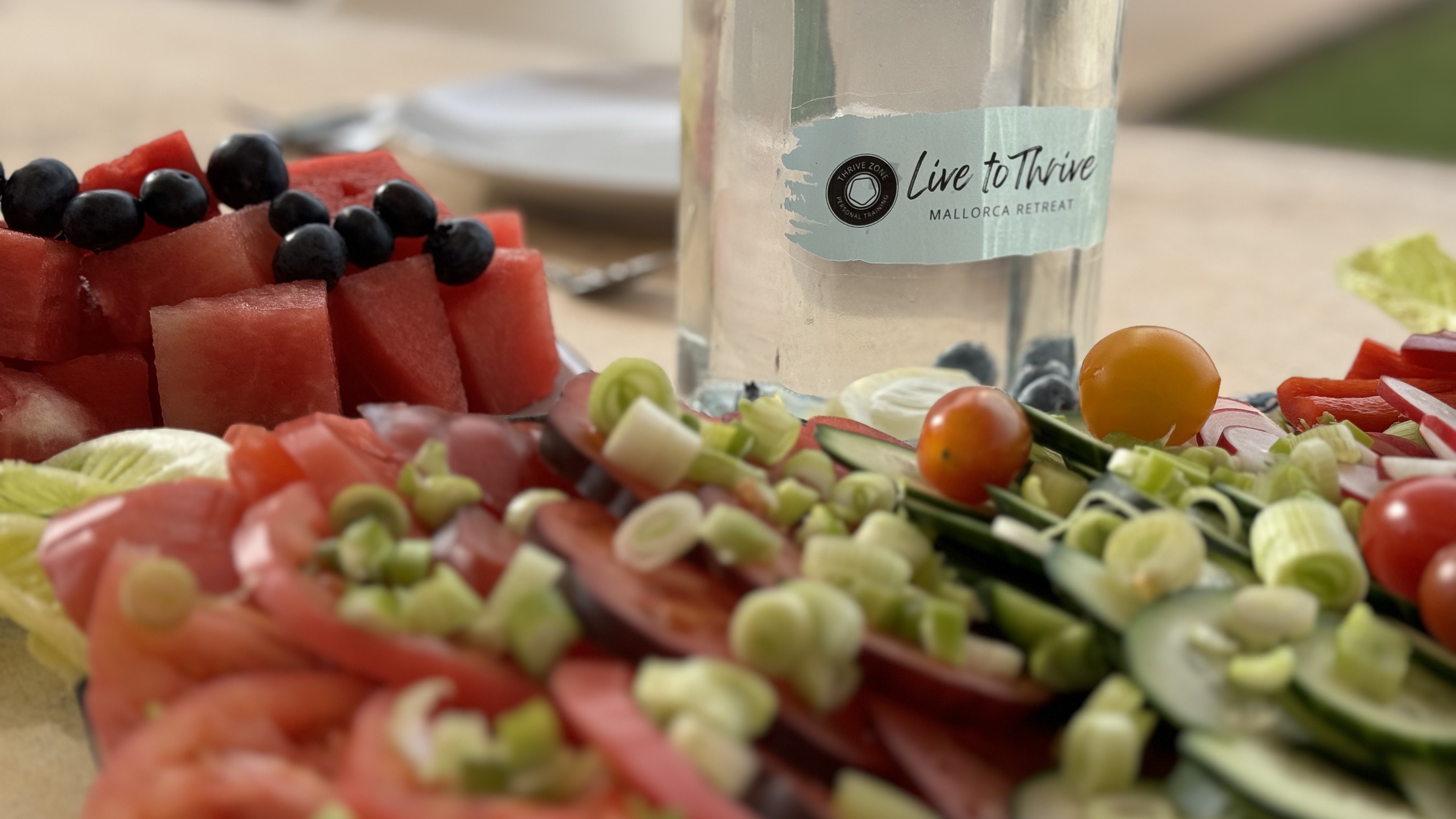
That's what we experienced daily at the ThriveZone Retreat in Mallorca on long outdoor tours: those who had fresh vegetables and fruit as snacks drank less from the bottle — because the food had already taken on part of the fluid intake. It tastes better, it feels lighter, and at the same time it delivers micronutrients a sports drink doesn't have.
A summer classic from the ThriveZone kitchen: watermelon with feta and fresh mint. The watermelon brings 92% water and fast carbohydrates, the feta delivers the sodium — together they make this snack a natural sodium-carbohydrate combination and the ideal post-training meal on hot days. A dash of lime rounds it off.
One thing to keep in mind: water-rich vegetables and fruit contain hardly any sodium. They contribute to your overall fluid balance — but don't replace the salt you lose when sweating. The solution is combination: water-rich food and natural sodium sources together.
You'll find more recipes with water-rich vegetables and refreshing summer ingredients in the ThriveZone recipe collection.
USDA FoodData Central. National Nutrient Database. fdc.nal.usda.gov
Evidence type: nutrient database
Sodium sources from the kitchen
If you manage your sodium balance through food, you don't need a commercial sports drink in most everyday scenarios. The following foods deliver sodium in food form — combined with enough fluid:
| Food | Sodium | Practical use |
|---|---|---|
| Olives (10–12) | ~300–500 mg | Snack before or after training |
| Feta (30 g) | ~450–500 mg | In salad, with watermelon, with vegetables |
| Miso soup (1 cup) | ~800–1200 mg | Post-training warm, even in summer |
| Bone broth (1 cup) | ~500–1000 mg | Hydration + sodium + minerals |
| Smoked salmon (30 g) | ~400–600 mg | Post-training meal |
| Salted nuts (handful) | ~200–400 mg | Portable snack for tours |
Summer and heat: what changes
In summer your fluid needs don't change gradually — they jump. Higher outdoor temperature, direct sun and humidity push the sweat rate up by 20–50%. All protocols in this lesson apply correspondingly more aggressively.
Timing: if you train outdoors, put the session before 9 a.m. or after 7 p.m. Between 11 a.m. and 4 p.m. heat load peaks — not just air temperature, but also the radiant heat from asphalt and buildings. Your cardiovascular system works under considerably more stress in this window, at the same subjective intensity.
Acclimatisation: your body needs 7–10 days to adapt to heat. During this time it optimises sweat rate, sodium retention and heart rate. Before adaptation is complete: reduce intensity by ~20%, drink noticeably more, keep sessions shorter. After full adaptation, sodium loss in sweat falls — your body becomes more efficient with fluid.
Nielsen B et al. (1997). Heat acclimation in humans — a review. Scand J Med Sci Sports, 7(1):20–29. DOI: 10.1111/j.1600-0838.1997.tb00122.x
Evidence type: review
And outside summer?
Heat makes hydration visible — but it stays relevant all year. In winter the sensation of thirst is dampened by the cold, yet you keep losing fluid through dry heated air and breathing. Here it helps to follow a rough plan rather than waiting on thirst alone — without drinking beyond what you need. In the transitional seasons the standard protocol from this lesson is enough, and the urine check stays your simple companion.
Warning signs you should know
Your body gives you clear signals — learn to read them before performance breaks down:
Early signs: dark urine (even before you get thirsty) · slight head pressure · concentration fading · sets feeling heavier than usual · a slight dip in mood
Advanced signs: dizziness on standing up · a clear rise in pulse without a change in intensity · muscle cramps (often a combination of fluid and sodium deficit) · headache · marked irritability
Emergency signs — act immediately: confusion or disorientation · collapse · sweating that suddenly stops despite heat (a warning sign that core temperature is too high). In that case: stop the effort immediately, into the shade, fluid with sodium — for severe symptoms call emergency services.
A readily accessible early indicator remains the urine check — because it requires no precise self-perception. Best read alongside thirst, how your body feels, and your performance. Check regularly and you tend to act early.
Common questions
Can I drink too much water? Yes. Exercise-associated hyponatremia arises mainly when you drink more than you lose over a longer period — that dilutes your blood sodium, in very large amounts into a dangerous range. Sodium in the drink can help on long sessions, but it doesn't replace a sensible drinking plan. The goal isn't to drink as much as possible, but to replace fluid and sodium to match duration, heat, sweat rate and tolerance. So don't drink litres beyond your needs — and with symptoms like headache, confusion, nausea or swelling, don't simply keep drinking.
Does coffee count toward fluid balance? Yes. In habitual coffee drinkers, a moderate amount — about 3–4 cups across the day — hydrates comparably well to the same amount of water. The often-cited "dehydrating" effect doesn't show at this scale.
When electrolytes instead of plain water? From about 60 minutes of effort, in heat or when you sweat visibly hard. Below that, at normal temperatures, water is enough.
My stomach reacts sensitively to sports drinks. Start with half strength (more water, less juice) or use the DIY version. Small, frequent sips are tolerated better than large amounts at once. Over time the stomach adapts.
Killer SC, Blannin AK, Jeukendrup AE (2014). No Evidence of Dehydration with Moderate Daily Coffee Intake. PLoS ONE, 9(1):e84154. DOI: 10.1371/journal.pone.0084154
Evidence type: randomised cross-over study
Your hydration checklist
☐ After getting up: 300–500 ml (morning anchor)
☐ With every meal: 200–300 ml
☐ During the day: a few sips every 60–90 min
☐ Ease off 1–2 hrs before sleep
☐ Urine check: light yellow = good
On training days, additionally
☐ 2–3 hrs before: 400–600 ml
☐ 15–20 min before: 200–300 ml
☐ During: small sips every 15–20 min
☐ First 30 min after: 500–1000 ml with sodium
☐ Weigh before/after → your sweat rate
On hot days
☐ Increase all amounts by 20–30%
☐ Electrolytes as standard, not exception
☐ Put the session before 9 a.m. or after 7 p.m.
☐ Watch for warning signs more often
New lessons in your inbox every two weeks
The next lesson in the Nutrition pillar: meal timing around training — when eating really makes a difference. Sign up so it comes straight to you.
To the newsletterSources
Sawka MN et al. (2007). ACSM Position Stand: Exercise and Fluid Replacement. Med Sci Sports Exerc, 39(2):377–390. DOI: 10.1249/mss.0b013e31802ca597 — position stand
Maughan RJ, Shirreffs SM (2004). Exercise and fluid replacement. J Sports Sci, 22(1):39–55. DOI: 10.1080/0264041031000140577 — review
Casa DJ et al. (2000). NATA Position Statement: Fluid Replacement for Athletes. J Athl Train, 35(2):212–224 — position statement
Almond CS et al. (2005). Hyponatremia among Runners in the Boston Marathon. NEJM, 352(15):1550–1556. DOI: 10.1056/NEJMoa043901 — observational study
Hew-Butler T et al. (2015). Third International Exercise-Associated Hyponatremia Consensus Conference. Clin J Sport Med, 25(4):303–320. DOI: 10.1097/JSM.0000000000000221 — guideline
Shi X, Passe DH (2010). Water and Solute Absorption from Carbohydrate-Electrolyte Solutions. Exerc Sport Sci Rev, 38(3):93–100. DOI: 10.1097/JES.0b013e3181e94e76 — review
Leiper JB (2015). Gastric emptying of fluids in humans. Sports Med, 45(1):33–46. DOI: 10.1007/s40279-014-0256-9 — review
Nielsen B et al. (1997). Heat acclimation in humans. Scand J Med Sci Sports, 7(1):20–29. DOI: 10.1111/j.1600-0838.1997.tb00122.x — review
Savoie FA et al. (2015). Effect of Hypohydration on Muscle Endurance, Strength, Anaerobic Power and Capacity and Vertical Jumping Ability: A Meta-Analysis. Sports Med, 45(8):1207–1227. DOI: 10.1007/s40279-015-0349-0 — meta-analysis
Killer SC, Blannin AK, Jeukendrup AE (2014). No Evidence of Dehydration with Moderate Daily Coffee Intake. PLoS ONE, 9(1):e84154. DOI: 10.1371/journal.pone.0084154 — cross-over study
USDA FoodData Central. National Nutrient Database. fdc.nal.usda.gov — nutrient database