Banded External Rotation + Elevation
A mini band around your wrists, elbows in at your sides, rotate out — and hold. Once you can hold that, the arms go up as well. It builds mobility and stability together.
Shoulder mobility holds up when stability comes with it. This exercise builds both in one position: the external rotation keeps the rotator cuff under tension, and the elevation takes the work where it belongs — between the shoulder blades, to the lower trapezius.
One thing tells you whether it's working: if the shoulder stays down, you've got it. If it rides up, take a lighter band. It also shows you where you stand straight away — if one side rotates inwards, that's the weaker one. Then you train with a lighter band until it keeps up.
Starting position
Mini band around both wrists, standing. Chest up, chin tucked slightly. Your elbows stay pinned to your sides at a right angle — from there you rotate your forearms out until they are parallel to each other. For the elevation you will often need a lighter band than for the rotation on its own.
The set-up, step by step
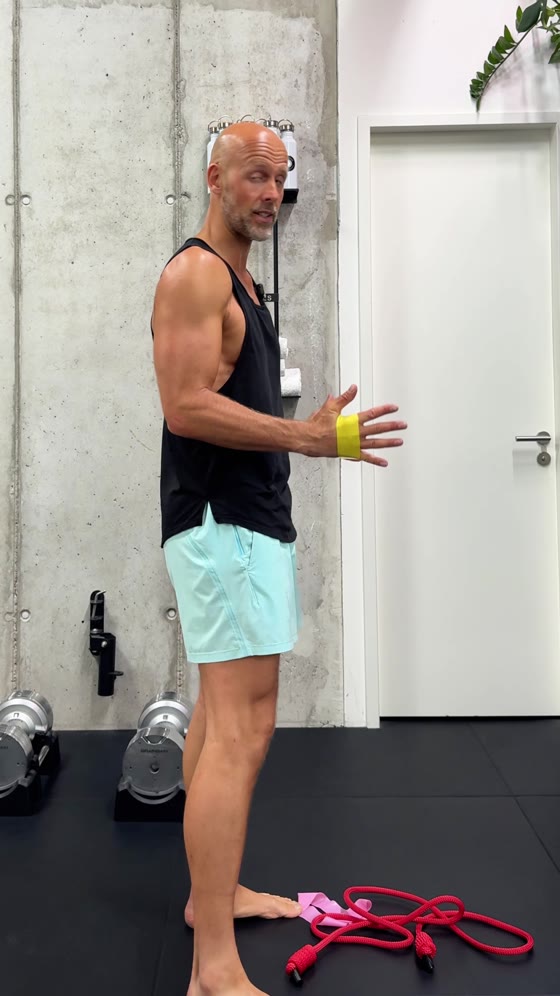
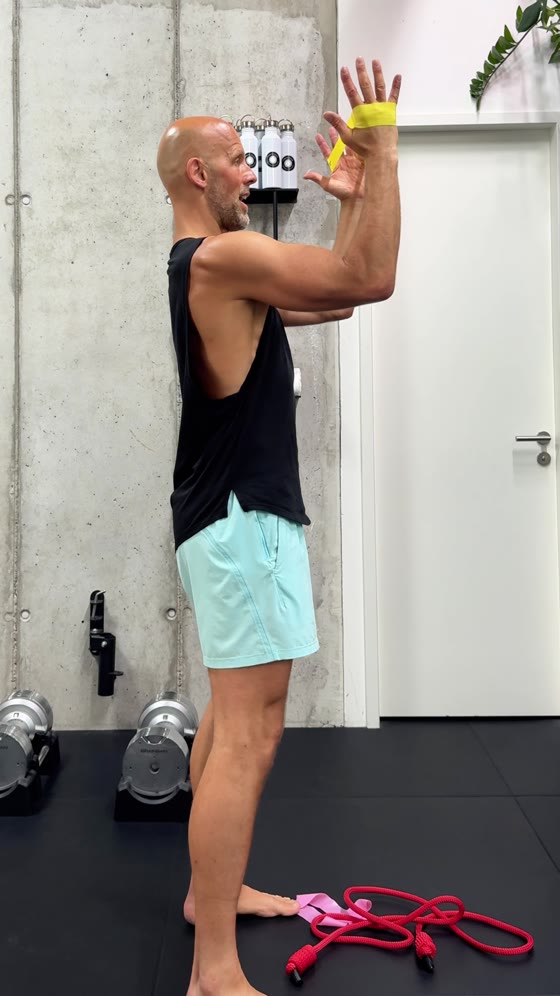
The three cues
- Chest up, chin tucked slightly
- Pin your elbows to your sides — only then rotate out until your forearms are parallel to each other
- Arms go up, shoulders stay down
Common faults
| Fault | How to fix it |
|---|---|
| One side rotates inwards | That is exactly how you spot the weaker side. Go lighter on the band and train until the weaker side matches the other. |
| The shoulders creep up as the arms rise | Lighter band. The moment your shoulders travel up with your arms, the neck is doing the work again instead of the area between your shoulder blades. |
| Adding the elevation too early | Hold the rotation on its own for 15 seconds first. Until you can, there's no point adding the second half. |
| Your elbows drift away from your sides | Keep them pinned. The moment they lift off, the front of the shoulder takes over. |
| Coming back down without control | Lower with the same control you went up with — coming down is part of the exercise. |
Variations
| Variation | When to use it |
|---|---|
| Hold the rotation only | Target: 15 seconds steady, without either side rotating in |
| Rotation plus elevation | Once you can hold that — arms up, shoulders stay down |
| Hold at the top | 5 to 10 seconds up there, then lower under control |
| Heavier band | Only once both sides hold equally well and the shoulders stay down |
Reps and load
The first target is a hold, not a rep count: 15 seconds of steady external rotation with neither side rotating in. Once you can hold that, add the elevation — and for that you will often need a lighter band, so your shoulders can stay down. The next target is 5 to 10 seconds at the top and a controlled return. Do this at least three times a week.
Which muscles do the work
| Muscle | Role | What it does here |
|---|---|---|
| Infraspinatus M. infraspinatus | Prime mover | Rotates the upper arm out and holds it there — the main work |
| Teres minor M. teres minor | Prime mover | Works with the infraspinatus, secures the back of the shoulder |
| Supraspinatus M. supraspinatus | Synergist | Starts the lift and supports it through the range |
| Lower traps M. trapezius, lower | Synergist | Keeps the shoulder blade down while the arms go up |
| Mid traps and rhomboids M. trapezius (middle), Mm. rhomboidei | Synergist | Draw the shoulder blade towards the spine — where the work should land |
| Serratus anterior M. serratus anterior | Stabiliser | Rotates the shoulder blade up and keeps it on the ribcage |
| Upper traps M. trapezius, upper | Stabiliser | Always involved — but shouldn't lead here |
The rotator cuff holds the position; the muscles around the shoulder blade lead. There's one thing to watch: if the shoulder stays down, the lower trapezius is holding it there — if it rides up, the neck has taken over and the band is too strong.
Explained in full
How long to hold, why the elevation often needs a lighter band, and how to tell when the work is landing in your neck instead of between your shoulder blades. · 1:58
Seeing it done right is not the same as doing it right
Video, cues and variations take you a long way. What they cannot give you is an outside eye at the moment the movement isn't quite there yet. That is what training with me is for — in the studio or in a workshop.
See the workshopsNew exercise pages are added all the time — the newsletter keeps you posted.
Sources
Reinold MM, et al. (2004). J Orthop Sports Phys Ther 34(7):385–394. DOI: 10.2519/jospt.2004.34.7.385 — Side-lying external rotation produced the highest infraspinatus (62% MVIC) and teres minor (67% MVIC) activity of the seven external rotation exercises compared (fine-wire EMG, n = 10 healthy participants). What they measured was a dynamic dumbbell variation, not an isometric hold against a band. (Evidence type: EMG)
Cools AM, et al. (2007). Am J Sports Med 35(10):1744–1751. DOI: 10.1177/0363546507303560 — External rotation ranked among the three exercises with the most favourable lower-to-upper trapezius ratio, and the isometric hold gave the best ratio of any phase of the movement (n = 45 healthy participants). The version tested was side-lying, and part of the advantage comes from that position. (Evidence type: EMG)
Andersen CH, et al. (2014). J Occup Rehabil 24(2):316–324. DOI: 10.1007/s10926-013-9441-1 — Ten weeks of lower trapezius and serratus anterior training, with minimal direct loading of the upper trapezius, reduced pain intensity and increased shoulder strength in 47 office workers with chronic neck and shoulder pain. What worked was the programme as a whole, not any single exercise. (Evidence type: RCT)
A note on context: EMG studies show which muscles an exercise recruits — that is a good reason to pick it, but it does not replace adjusting things to the person in front of you. See a doctor for persistent or severe pain.