Centre and open
Part 1 gave you the pattern. Now comes the first half of the work: centre the rotator cuff, open the front, control the shoulder blade — plus the two often-overlooked building blocks most people are missing.
In Part 1 we saw what's really going on: short and dominant in front, weak down and back, overactive up top. And why it isn't enough to just work on posture — you need control and strength across the full range. Now we train — in an order that makes the difference.
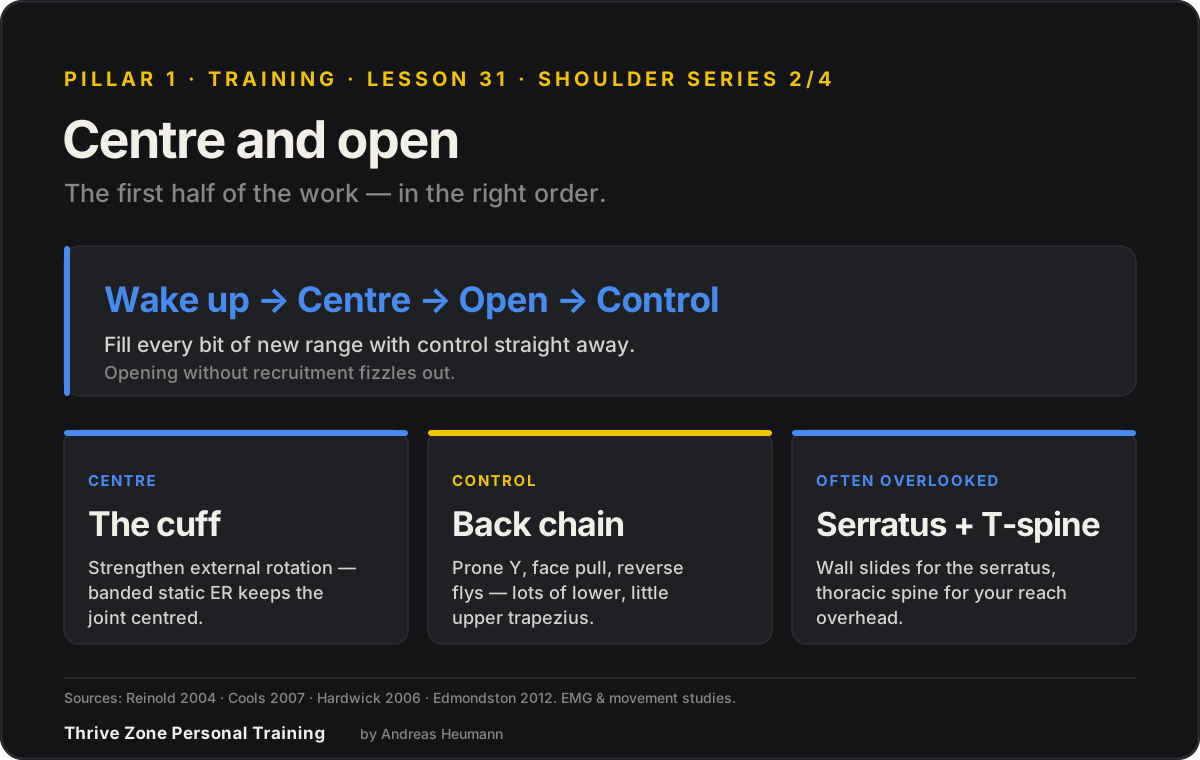
The order is the principle: first wake up, then centre, then open — and fill every new bit of range with control straight away. Opening is never an end in itself. Range you can't control won't stick. That's what balancing mobility and stability looks like in practice.
1. Wake up — short, frequent, low-key
The opener moves the shoulder through its range and switches the nervous system on. Kept deliberately small — this can happen a few times a day, in between, not as a big session.
- Arm circles and corkscrews. Take the arms through the full arc, then deliberately through internal and external rotation. This mobilises and activates at once.
- Halo (kettlebell or plate around the head) and shoulder CARs (controlled articular rotations: slow, maximal circles with a straight arm, under your own tension) — range you control yourself, rather than getting stretched passively.
- Quadruped shoulder circles / shoulder square. On all fours the shoulder blade carries load — serratus and stabilisers learn to guide it cleanly across the rib cage.
- Chin nods. A gentle nod wakes up the deep neck flexors — the direct counter to the forward-head drift that daily life builds in.
- Wall angel. Back and arms against the wall ask for thoracic extension, upward rotation of the shoulder blade and external rotation all at once — a test and an exercise in one.
2. Centre — the rotator cuff
This is the heart of the work against a tight neck. The aim: make the external rotators strong and easy to recruit, so the joint stays centred in every position. For most people this is the single biggest lever.
My key exercise for it is the banded static external rotation with elevation: you hold external rotation against a band while the arm is raised. That works the cuff under constant tension in exactly the position the shoulder is challenged in during daily life. Add dynamic versions on the cable or band, and rotator-cuff band work across several angles.
Among the common external-rotator exercises, side-lying external rotation produces the highest activity in infraspinatus (~62% MVIC) and teres minor (~67% MVIC), with low deltoid involvement. Ideal for hitting the cuff directly rather than working around it. Infraspinatus and teres minor are two of the four rotator cuff muscles, both external rotators. MVIC is the percentage of maximal voluntary contraction, measured by EMG — electromyography, which records a muscle's electrical activity and so how hard it's working.
Reinold MM, et al. (2004). Electromyographic analysis of the rotator cuff and deltoid musculature during common shoulder external rotation exercises. J Orthop Sports Phys Ther 34(7):385–394. DOI: 10.2519/jospt.2004.34.7.385 · EMG study.
That's also why the static external rotation works as a gentle way in when the shoulder is irritated: it builds recruitment and strength without having to move through the full range. As things settle, the dynamic work comes in.
3. Open — free up the front
For the shoulder blade to sit up, the front needs length. The short pectoralis minor is the lead player here.
- Doorway stretch. Forearms on the frame, step gently through. Targets the pec that pulls the shoulder blade forward.
- Shoulder dislocates with a stick or band overhead. Takes the shoulder through the full overhead arc; the width is set by your grip.
A shortened pectoralis minor changes shoulder-blade mechanics: less posterior tilt, more internal rotation. So length at the front is what creates the room that control then fills.
Borstad JD, Ludewig PM (2005). J Orthop Sports Phys Ther 35(4):227–238. DOI: 10.2519/jospt.2005.35.4.227 · Kinematics study.
And this is the ratio principle in its purest form: opening without recruitment afterwards fizzles out. So every stretch flows straight into block 4.
4. Control — the back chain and the shoulder blade
The "down and back" that's weak and poorly recruited in most people. This is where we level the ratio — with exercises that target the lower and middle trapezius, the rhomboids and the rear cuff while barely engaging the upper trapezius.
- Prone Y (lying, arms in a Y, with and without light weight) and bent-over Y — they hit the lower trapezius and upward rotation.
- Face pull — horizontal abduction plus external rotation, the direct counter to pushing. A regular in nearly every programme.
- Standing band shoulder extension at the door — driving the arms back against resistance, once with thumbs in, once holding external rotation (thumbs out). Hits the lower and middle trapezius, the rhomboids and the rear deltoid; the externally rotated version brings the cuff's external rotators in as well. The position is half the exercise: chest lifted, shoulder blades down and back, chin tucked.
- Reverse flys on the cable, bent over, or with a band — once with thumbs up, once with thumbs in: two angles for the back chain.
- Alternating superman — whole posterior chain; arms in line ask for upward rotation and shoulder-blade depression.
Certain scapular exercises — among them the prone extension/Y position and side-lying external rotation — show the most favourable ratio: plenty of lower and middle trapezius activity with little upper trapezius. Exactly the balance the pattern needs.
Cools AM, et al. (2007). Rehabilitation of scapular muscle balance: which exercises to prescribe? Am J Sports Med 35(10):1744–1751. DOI: 10.1177/0363546507303560 · EMG study.
The cue for the whole back chain: weight is secondary, technique is everything. Long arms, movement from the shoulder blade, easy up top. Better half a kilo done well than five with the shoulders hiked up.
The two often-overlooked building blocks
Two things are missing from a lot of shoulder programmes — and they're often exactly why it doesn't come together.
The serratus anterior. It's the main upward rotator and the most commonly overlooked weak spot. Where most people do plenty of pulling together (retraction), the other direction is missing: holding the shoulder blade to the rib cage and rotating it up. The best tools for that are wall slides with protraction and the push-up plus (at the top of a push-up, gently spread the shoulder blades apart).
In the wall slide, serratus anterior activity rises as the arm goes higher — precisely in the range above shoulder height, where the shoulder blade has to rotate up and stay on the rib cage.
Hardwick DH, et al. (2006). A comparison of serratus anterior muscle activation during a wall slide exercise and other traditional exercises. J Orthop Sports Phys Ther 36(12):903–910. DOI: 10.2519/jospt.2006.2306 · EMG study.
The thoracic spine. The arm sits on the rib cage, and the rib cage is shaped by the thoracic spine. If it's stiff and heavily rounded, the shoulder blade can't sit up as well — and the range up top simply isn't there. So a small block of thoracic extension and rotation belongs in the mix (extension over a roller or edge, rotation on all fours).
Full overhead arm elevation needs a certain amount of thoracic extension; a heavily rounded, stiff thoracic spine goes with reduced arm elevation. More thoracic mobility gives the shoulder its range back.
Edmondston S, et al. (2012). Clinical and radiological investigation of thoracic spine extension motion during bilateral arm elevation. J Orthop Sports Phys Ther 42(10):861–869. DOI: 10.2519/jospt.2012.4164 · Movement/imaging study. Review: Barrett E, et al. (2016), Man Ther 26:38–46.
And one detail that's easy to miss: breathing. A rib cage that's held permanently raised (lots of chest breathing, lots of stress) keeps the shoulder blade in a poor starting position and the upper trapezius switched on. A few calm breaths with a longer exhale, letting the ribs settle, work well as a reset before the shoulder-blade work.
How it fits together: wake up, centre, open, control — fill every bit of range with control straight away, and don't forget serratus and the thoracic spine. All of it in the balance of mobility and stability. Part 3 brings the last block: pulling done right — from the shoulder blade to a strong shoulder overhead.
Part 2 — Centre and open (this piece): the cuff, the front, shoulder-blade control.
Part 3 — Learn to pull: the pulling progression from the shoulder blade to a strong shoulder overhead (coming soon).
Part 4 — Defuse your day: what actually helps against a sedentary, tech-driven day (coming soon).
- Why your neck tightens (Lesson 30) — the pattern and the principle behind these exercises.
- Mobility — what it actually is (Lesson 01) — why mobility is a continuum with stability.
Shown right isn't the same as done right
You can build these exercises for yourself here — the practical part is all present. But here's what I see in training again and again: I demonstrate a movement cleanly and explain it well, and in that same moment it still isn't right in the other person's body. With shoulder-blade control especially, the small difference decides whether the right muscles are working. That takes a real person giving you feedback in the moment and reading your situation.
In a world where almost everything runs through a screen, that's my deliberate counterpoint: the workshop and personal training are the safest, fastest and most human way to actually get this into your body.
See the workshopParts 3 and 4 are on the way — the newsletter keeps you posted.
Sources
Reinold MM, et al. (2004). J Orthop Sports Phys Ther 34(7):385–394. DOI: 10.2519/jospt.2004.34.7.385 — side-lying external rotation = highest infraspinatus/teres minor activity (EMG).
Cools AM, et al. (2007). Am J Sports Med 35(10):1744–1751. DOI: 10.1177/0363546507303560 — scapular balance: exercises with a low upper/lower trapezius ratio (EMG).
Hardwick DH, et al. (2006). J Orthop Sports Phys Ther 36(12):903–910. DOI: 10.2519/jospt.2006.2306 — wall slide: serratus activity rises with arm height (EMG).
Borstad JD, Ludewig PM (2005). J Orthop Sports Phys Ther 35(4):227–238. DOI: 10.2519/jospt.2005.35.4.227 — a short pectoralis minor changes shoulder-blade mechanics.
Edmondston S, et al. (2012). J Orthop Sports Phys Ther 42(10):861–869. DOI: 10.2519/jospt.2012.4164 · Barrett E, et al. (2016). Man Ther 26:38–46 — thoracic extension as a prerequisite for overhead reach.
A note on interpretation: EMG studies show which muscles an exercise recruits — that supports the selection but doesn't replace individual coaching. The anatomical mechanisms are textbook. With persistent or severe symptoms, see a doctor.