Dead Hang
Grip the pull-up bar about shoulder-width apart and let yourself hang with straight arms. Your grip is firm, the rest of your body relaxed, and your bodyweight stretches you out through the shoulders. Hold for as long as your grip stays solid, then come down under control.
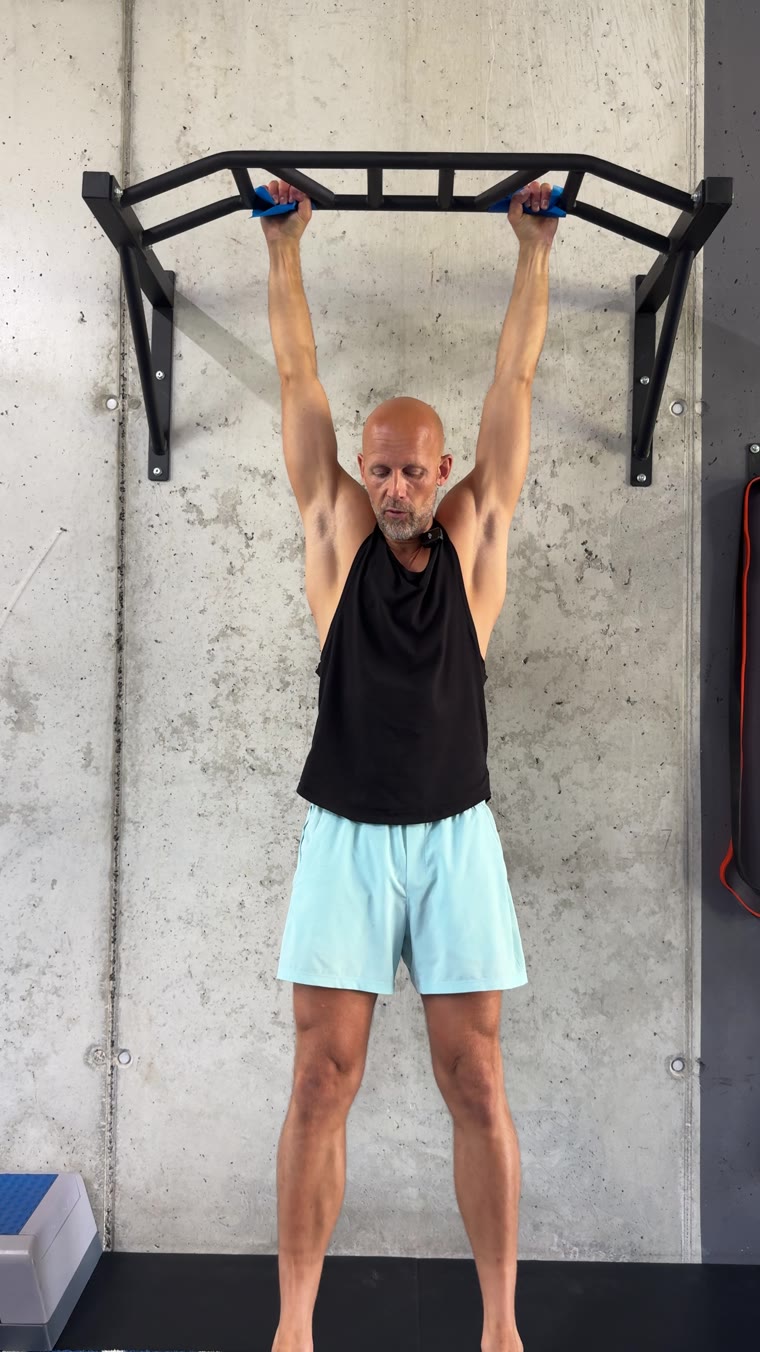
The dead hang is exactly what it sounds like: you hang from the bar. Your arms are fully extended overhead, your bodyweight pulls down, and your hands hold the lot.
That puts the work in two places. Your shoulders go into full overhead elevation, a position everyday life rarely asks for. And the finger flexors in your forearms carry your entire bodyweight, which trains your grip.
To start with, your feet stay on the floor and take part of the load. That way you can build up the hold time week by week.
From practice: For me, hanging is one of the most important exercises for the shoulders, and I like to do it straight after the alternating superman. That is what I see in the studio.
Starting position
Stand under the pull-up bar and take an overhand grip about shoulder-width apart, with your thumbs wrapped around the bar.
Let yourself hang with straight arms. The grip is firm and everything else goes soft: shoulders, back, legs. Your own weight stretches you out, and your shoulders rise all the way up with your arms.
If hanging freely is too much for now, keep your feet on the floor or on a box so they take some of the weight. That lets you get used to the position and build up the load gradually.
To finish, put your feet back on the floor or the box first, and only then let go.
The three cues
- Overhand grip at shoulder width, thumbs around the bar
- Arms straight, grip firm
- The rest of your body stays relaxed
- Let your bodyweight stretch out your shoulders
Common faults
| Fault | How to fix it |
|---|---|
| The whole body tenses up | Only the hands work. Breathe out and let your shoulders, back and legs go soft on purpose. |
| The arms stay slightly bent | Straighten your elbows fully. If that is too hard, keep your feet on the floor to take some of the weight. |
| Letting go abruptly | Feet onto the floor or box first, then release your hands. That way you come down under control. |
| Hanging too long straight away | Start with short holds and stop while your grip is still solid. Then add time week by week. |
Variations
| Variation | When to use it |
|---|---|
| Feet on the floor or a box | Your feet take part of the weight, while your arms stay fully straight. |
| Free hang | Your whole bodyweight hangs from your hands, and your body is relaxed. |
| Longer hold | Add time week by week, working towards a minute in one go. |
Reps and load
Two to three rounds, each for as long as your grip stays solid. Start with ten to twenty seconds and build up in small steps.
It fits at the end of an upper-body session, or straight after the alternating superman. It is also a first step on the way to the scapula pull-up and the pull-up.
Which muscles do the work
| Muscle | Role | What it does here |
|---|---|---|
| Flexor digitorum profundus M. flexor digitorum profundus | Prime mover | Bends the fingertips and keeps your grip on the bar |
| Flexor digitorum superficialis M. flexor digitorum superficialis | Prime mover | Flexes the middle joints of the fingers and closes the grip |
| Flexor carpi radialis M. flexor carpi radialis | Synergist | Steadies the wrist under your bodyweight |
| Brachioradialis M. brachioradialis | Synergist | Supports the hold from the forearm, especially as your grip tires |
| Extensor digitorum M. extensor digitorum | Stabiliser | Balances the flexors and keeps the wrist straight |
| Trapezius M. trapezius | Stabiliser | Holds the shoulder girdle in the overhead position |
| Latissimus dorsi M. latissimus dorsi | Stabiliser | Lengthens in full overhead elevation and helps hold the shoulder in place |
The real work is done by the finger flexors in your forearm, which hold your entire bodyweight. The trapezius and lats hold the shoulder in the overhead position while the rest of your body hangs loose.
Seeing it done right is not the same as doing it right
Video, cues and variations take you a long way. What they cannot give you is an outside eye at the moment the movement isn't quite there yet. That is what training with me is for — in the studio or in a workshop.
See the workshopsNew exercise pages are added all the time — the newsletter keeps you posted.
Sources
Leong DP, Teo KK, Rangarajan S, et al.; PURE Study investigators. (2015). Prognostic value of grip strength: findings from the Prospective Urban Rural Epidemiology (PURE) study. Lancet 386(9990):266–273. DOI: 10.1016/S0140-6736(14)62000-6 — A prospective cohort of 139,691 adults aged 35 to 70 from 17 countries, grip strength measured with a dynamometer, median follow-up four years. Every 5 kg drop in grip strength was associated with a 16 per cent higher risk of all-cause death (hazard ratio 1.16). Background for training grip in the first place. An observational study: grip strength is a risk marker, and the study does not show that hanging lowers risk by raising grip strength. The age range matches the target group. (Evidence type: Kohorte)
Ferrer-Uris B, Arias D, Torrado P, Marina M, Busquets A. (2023). Exploring forearm muscle coordination and training applications of various grip positions during maximal isometric finger dead-hangs in rock climbers. PeerJ 11:e15464. DOI: 10.7717/peerj.15464 — Surface EMG in 25 trained climbers (22 men, 3 women, 29 ± 7 years) during maximal hangs from a fingerboard edge. The deep and superficial finger flexors, flexor carpi radialis and extensor digitorum all worked, to differing degrees depending on grip position. The basis for the forearm rows in the muscle table. Young climbers on an edge rather than a bar, so only the mechanism transfers. (Evidence type: EMG)
Exel J, Deimel D, Koller W, Werle C, Baca A, Maffiodo D, Sesana R, Colombo A, Kainz H. (2023). Neuromechanics of finger hangs with arm lock-offs: analyzing joint moments and muscle activations to improve practice guidelines for climbing. Front Sports Act Living 5:1251089. DOI: 10.3389/fspor.2023.1251089 — 17 advanced to elite climbers (26 ± 4 years) hung with straight and with bent arms; EMG plus joint moments from a musculoskeletal model. With straight arms, shoulder and elbow moments were lower, the finger flexors worked just as hard, and the trapezius and lats were measurably active. The basis for saying that hanging with long arms mainly works the grip while the shoulder muscles help hold the position. Young climbers on a fingerboard edge. (Evidence type: EMG / Biomechanik)
A note on context: EMG studies show which muscles an exercise recruits — that is a good reason to pick it, but it does not replace adjusting things to the person in front of you. See a doctor for persistent or severe pain.