Plank Hold
A forearm hold, elbows under your shoulders, body in one line. Nothing moves — you hold. Your abs link your ribcage to your pelvis and stop your midsection sagging.
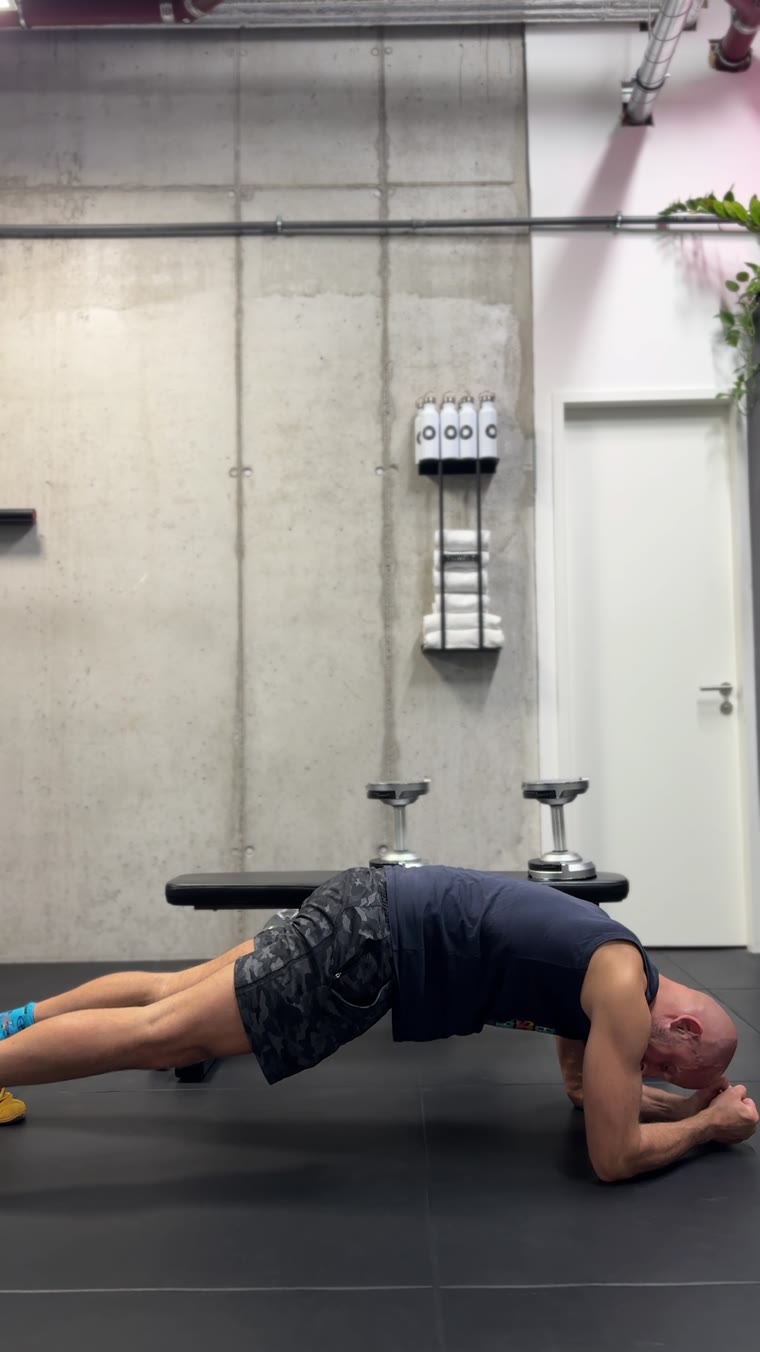
The plank is the base position for everything that follows. It teaches you to link ribcage and pelvis and to keep that link under load — which is exactly what you need later in the mountain climber, the side plank and every position where you hold yourself up on your forearms or hands.
The position itself tells you whether it is right. If your hips sag, the link has gone. If your elbows and feet slide apart, you are pushing them apart instead of pulling them together. And if your shoulders quit before your abs do, that day the plank is training your shoulders — shorten the hold and the work goes back to your middle.
Starting position
Come down onto your forearms, elbows under your shoulders, feet about shoulder-width apart. Andreas builds the position step by step: start on your forearms and knees, brace your abs, then step one leg back, then the other — rather than lying down and fixing it afterwards. Once you are there, draw your ribcage and pelvis towards each other, pull your navel in, and keep your hips from sagging. Your elbows pull back towards your feet and your feet pull forwards towards your elbows, as if you were dragging them together along the floor — instead of pushing them apart.
The three cues
- Elbows under your shoulders, feet about shoulder-width apart
- Draw your ribcage and pelvis towards each other, navel in — hips stay in line
- Pull your elbows back towards your feet and your feet towards your elbows, rather than pushing them apart
Common faults
| Fault | How to fix it |
|---|---|
| Your hips sag | Draw ribcage and pelvis back together. If you cannot hold that, go onto your knees and build the position there. |
| Your backside is up in the air | Then your abs have handed the work over and you are resting on your shoulders and hips. Lower your hips until shoulders, hips and heels sit in one line. |
| Elbows and feet slide apart | Pull them towards each other. Andreas' check: hold it on a wooden floor in socks — if you slide apart, the pull between your elbows and your feet is missing. |
| You lie down into the position and fix it afterwards | Build it the other way round: abs first, then one leg back, then the other. |
| Your head drops | Look at the floor a hand's length beyond your hands and keep your neck long. |
| Shoulders and arms give out first | Hold for less time and repeat more often. If your arms quit before your abs do, shorter holds put the work back where you want it. |
Variations
| Variation | When to use it |
|---|---|
| Forearm hold on your knees | When your hips sag in the full hold — same position, shorter lever |
| Forearm hold on your toes | Once the line from shoulders to heels holds |
| Hold longer, or repeat more often | When the position stays clean and your abs are what gives out first |
| Mountain climber, then side plank | The plank is the base for both — the side plank shifts the work onto the side of your trunk |
Reps and load
Andreas' target: hold for at least 30 seconds; a minute is better. What gives way matters more than the clock — if the line holds and your abs tire, the time is right. If your shoulders or legs go first, shorten the hold and repeat more often.
Which muscles do the work
| Muscle | Role | What it does here |
|---|---|---|
| Abs M. rectus abdominis | Prime mover | Holds your ribcage and pelvis together — the reason your midsection does not sag |
| External obliques M. obliquus externus abdominis | Prime mover | Keeps the abdominal wall firm and guards against twisting |
| Internal obliques M. obliquus internus abdominis | Synergist | Works with the external obliques and tightens the abdominal wall from the side |
| Transverse abdominis M. transversus abdominis | Stabiliser | Wraps around the trunk like a belt when you draw the navel in |
| Back extensors M. erector spinae | Stabiliser | Holds the spine long from behind — your abs work against it so the hold does not become an arch |
| Glutes M. gluteus maximus | Stabiliser | Holds the hips extended so your backside does not ride up — your abs hold the other end of the line |
| Rectus femoris M. rectus femoris | Stabiliser | Keeps your knees straight so your legs stay in the line |
| Serratus anterior M. serratus anterior | Stabiliser | Holds the shoulder blades against the ribcage so your chest does not sink between your shoulders |
The abdominal wall works here as one unit, not as separate muscles. The deep transverse layer is not something you can see working from the outside — it is listed here as anatomy, not as something you can consciously switch on. What counts is one thing: nothing moves in this exercise. You hold it.
Explained in full
Where your elbows go, how your ribcage and pelvis come together, and how long Andreas has you hold it. In the video he also shows what the position should not look like. · 0:26
Seeing it done right is not the same as doing it right
Video, cues and variations take you a long way. What they cannot give you is an outside eye at the moment the movement isn't quite there yet. That is what training with me is for — in the studio or in a workshop.
See the workshopsNew exercise pages are added all the time — the newsletter keeps you posted.
Sources
Escamilla RF, et al. (2016). Sports Health 8(4):372–379. DOI: 10.1177/1941738116653931 — Measured the forearm plank on the toes in 18 men and women aged 23 to 45, MVIC-normalised. The study that transfers best to this audience — the age band actually overlaps. Rectus abdominis and external obliques lead, the lumbar paraspinals sit far behind. The same work shows the knee version as the clearly easier step. (Evidence type: EMG)
Tsartsapakis I, et al. (2023). Sports 11(8):159. DOI: 10.3390/sports11080159 — The only work comparing bracing (firming the abdominal wall) with hollowing (drawing the navel in) inside the plank itself, in the same 24 people. Bracing gave higher activity in rectus abdominis, external obliques and the back muscles; hollowing gave the greater thickness increase in the deep layers on ultrasound. The two techniques pull in different directions. Measured in CrossFit athletes aged 21 to 42. (Evidence type: EMG)
Grenier SG, McGill SM (2007). Arch Phys Med Rehabil 88(1):54–62. DOI: 10.1016/j.apmr.2006.10.014 — Modelling study in 8 healthy men: bracing improved the calculated stability of the lumbar spine, drawing the navel in did not. The transverse abdominis on its own contributed a vanishingly small share in the model. A model in young men, not a training trial. (Evidence type: Modelling)
Vera-Garcia FJ, et al. (2007). J Electromyogr Kinesiol 17(5):556–567. DOI: 10.1016/j.jelekin.2006.07.004 — 11 healthy men, sudden trunk loading: a braced abdominal wall limited the spine's give, drawing the navel in did not. A laboratory condition with a predictable direction of load. (Evidence type: EMG)
Schoenfeld BJ, et al. (2014). Sports Biomechanics 13(3):296–306. DOI: 10.1080/14763141.2014.942355 — 19 resistance-trained young men: a posterior pelvic tilt in the plank raised external oblique activity compared with the neutral version. That is the supported half of "draw ribcage and pelvis together". Some of the study's values exceed 100 per cent of the reference contraction, so they serve only for comparison within the study. Young trained men, 30-second holds. (Evidence type: EMG)
Cortell-Tormo JM, et al. (2017). J Strength Cond Res 31(8):2255–2262. DOI: 10.1519/JSC.0000000000001689 — 15 people, men and women, in the short-lever position — elbows under the shoulders, as shown here. The posterior pelvic tilt produced the highest overall activity and the highest perceived exertion. Confirms the direction of the study above in a mixed group. (Evidence type: EMG)
Strand SL, et al. (2014). J Hum Kinet 40:93–102. DOI: 10.2478/hukin-2014-0011 — Around 471 students held the forearm plank to failure, averaging roughly 100 seconds. The finding that matters for judging hold time: only about one person in five stopped because of their abdominals — in roughly two thirds, arms or legs gave out first. Young adults around 20; there are no normative values for the 40-to-60 age group. (Evidence type: Normwerte)
McGill SM (1998). Physical Therapy 78(7):754–765. DOI: 10.1093/ptj/78.7.754 — A review of low-back exercise. On repetitions and holding times it states explicitly that no data exist to guide the choice and that it rests on the clinician's judgement. For the plank that still holds: no study has tested long single holds against short repeated holds for training effect. (Evidence type: Übersichtsarbeit)
A note on context: EMG studies show which muscles an exercise recruits — that is a good reason to pick it, but it does not replace adjusting things to the person in front of you. See a doctor for persistent or severe pain.