Quadruped Plank
On all fours with your knees hovering a few centimetres off the floor. Your abs are braced, your spine pushes up slightly, and you hold the position steady.
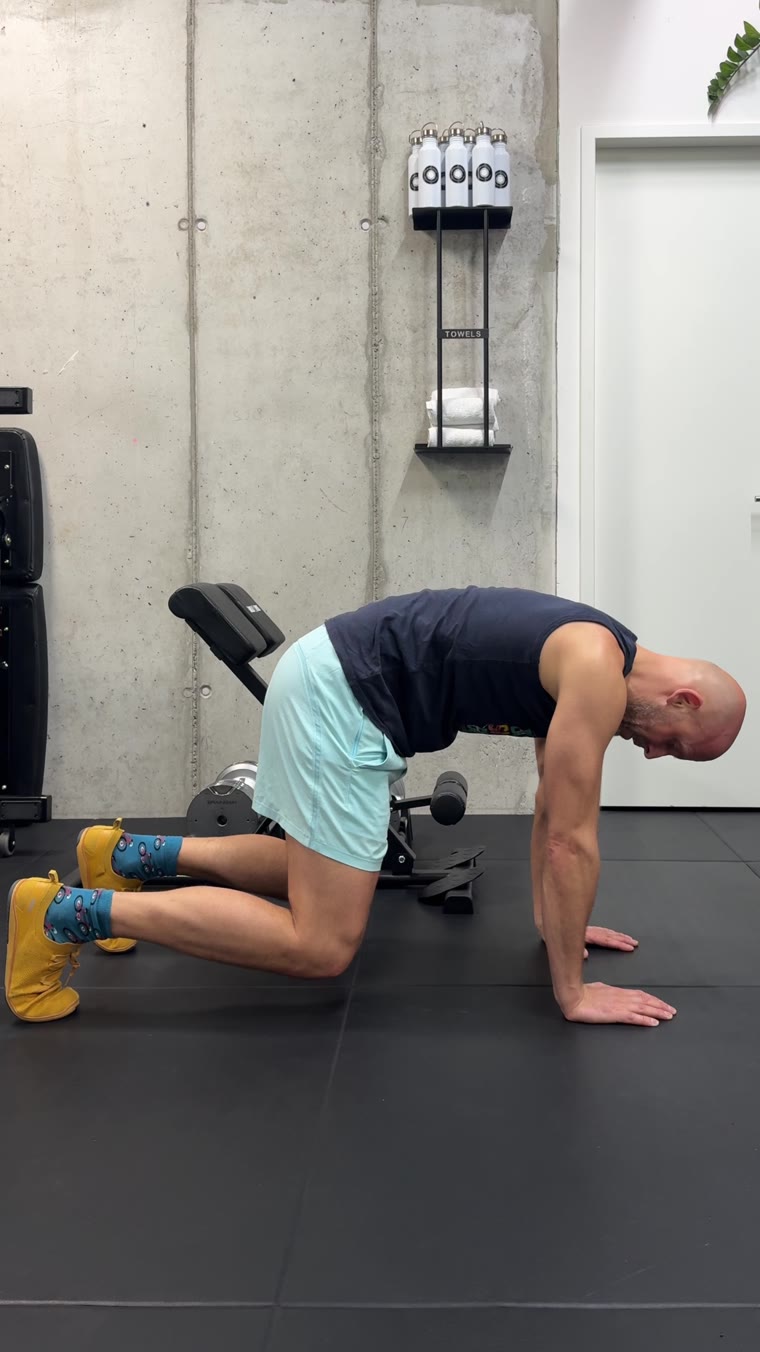
The quadruped plank trains the muscles at the front of your trunk with a static hold. You support yourself on your hands and the balls of your feet, your knees hover just off the floor, and your whole abdominal wall works to hold the position.
The lever is short, and you can deliberately push your spine up a little. That makes it easier for many people to properly control their abs.
In my practice, plenty of clients get back pain in a plank. In this modified position the same clients train pain-free and build up their trunk muscles over time. That is what I see in the studio.
The exercise grows with you. Lift a hand or a foot and the forces run diagonally across your trunk, so every muscle around your middle has to work to hold the position.
Starting position
Knees under your hips, hands under your shoulders. Draw your navel in as far as you can: your spine slowly rises and your pelvis tilts towards your ribs. Once you feel the tension, pull your shoulders down and lift your knees slightly. A few centimetres is plenty. Then hold for as long as the position stays clean.
The three cues
- Knees under your hips, hands under your shoulders
- Navel in — your spine rises and your pelvis tilts towards your ribs
- Shoulders down, then lift your knees slightly
Common faults
| Fault | How to fix it |
|---|---|
| Your back sags | Draw your navel back in until your spine rises and your pelvis tilts towards your ribs. |
| Your knees lift too high | A few centimetres off the floor is enough. Your abs do the work; your knees just hover. |
| Your shoulders creep up towards your ears | Pull your shoulders down before you lift your knees, and keep them there the whole time. |
| Your hips tip to one side when you lift a hand or foot | Go back to the hold on your hands and feet. Move on once the position stays steady with one hand or foot off the floor. |
Variations
| Variation | When to use it |
|---|---|
| Braced on all fours, knees stay on the floor | When your back sags as soon as your knees lift |
| Lift your knees and hold | For as long as the position stays clean |
| Lift one hand or one foot | Once you can comfortably hold it for 30 seconds to a minute |
| Crawl slowly — forwards, backwards, in a circle, changing direction | Once the position stays steady with a hand or foot off the floor |
Reps and load
Start with the hold, for as long as the position stays clean. Once 30 seconds to a minute feels easy, add instability: lift one hand or one foot first, then crawl slowly forwards, backwards and in a circle, changing direction as you go.
Most of what you can do in a plank works in this position too. That makes it a good starting point for beginners and still worthwhile for more experienced exercisers, who can hold it longer or add more instability.
Which muscles do the work
| Muscle | Role | What it does here |
|---|---|---|
| Abs M. rectus abdominis | Prime mover | Holds your ribs and pelvis together so your back does not sag |
| External obliques M. obliquus externus abdominis | Prime mover | Keeps the abdominal wall firm and resists twisting once a hand or foot lifts |
| Internal obliques M. obliquus internus abdominis | Synergist | Works with the external obliques and absorbs the diagonal forces |
| Transverse abdominis M. transversus abdominis | Stabiliser | Wraps around your trunk like a belt when you draw your navel in |
| Serratus anterior M. serratus anterior | Stabiliser | Keeps your shoulder blades against your ribcage while you hold yourself up on your hands |
| Hip flexors M. iliopsoas | Stabiliser | Keeps your hips bent so your knees stay off the floor |
| Quads M. quadriceps femoris | Stabiliser | Holds the bend in your knees so they hover just above the floor |
| Back extensors M. erector spinae | Stabiliser | Holds your spine in place from behind while your abs work from the front |
Your abdominal wall works as one unit here. The moment your knees lift, a relaxed all-fours position turns into a hold your whole trunk has to work for, with your shoulders, hip flexors and thighs helping to keep it in place.
Explained in full
Andreas builds the position step by step: navel in, shoulders down, knees up. Then he shows how lifting a hand or a foot, and then crawling slowly, adds more instability. · 2:28
Seeing it done right is not the same as doing it right
Video, cues and variations take you a long way. What they cannot give you is an outside eye at the moment the movement isn't quite there yet. That is what training with me is for — in the studio or in a workshop.
See the workshopsNew exercise pages are added all the time — the newsletter keeps you posted.
Sources
Chang XQ, et al. (2022). Front Bioeng Biotechnol 10:965295. DOI: 10.3389/fbioe.2022.965295 — 19 healthy students around 22 years old. The study compared all-fours with knees on the floor against a hands-and-feet position with the knees in the air. With the knees lifted, activity in rectus abdominis, external obliques and the back extensors was higher; with the knees down, every muscle measured stayed below 10 per cent of maximal contraction. Hips and knees were bent further in the study than shown here. Young adults without pain — transfer to ages 40 to 60 is open. (Evidence type: EMG)
Stevens VK, et al. (2007). Eur Spine J 16(5):711–718. DOI: 10.1007/s00586-006-0181-1 — 30 healthy young adults on all fours. Once a leg, or an arm and the opposite leg, came off the floor, the obliques did most of the work (above 20 per cent of maximal contraction) while rectus abdominis stayed below 10 per cent. Supports the diagonal demand when a hand or foot lifts. Measured with the knees down, in young healthy people. (Evidence type: EMG)
Yoon TL, et al. (2015). Physiother Res Int 20(2):126–132. DOI: 10.1002/pri.1611 — 10 people with chronic low back pain on all fours. Lifting a leg challenged the internal obliques more than lifting an arm, and the diagonal arm-and-leg lift produced the highest back-muscle activity. The authors recommend starting with leg lifts in back pain and building up to the diagonal version gradually. A very small group, knees on the floor. (Evidence type: EMG)
Heredia-Elvar JR, et al. (2024). J Strength Cond Res 38(2):266–273. DOI: 10.1519/JSC.0000000000004630 — 57 young active men; pelvic movement was tracked with a smartphone accelerometer. Two-point positions were harder to stabilise than three-point ones, and versions with limb movement harder than static ones. Supports the order hold → lift a hand or foot → crawl. Young men, no muscle activity measured. (Evidence type: Beschleunigungsmessung)
A note on context: EMG studies show which muscles an exercise recruits — that is a good reason to pick it, but it does not replace adjusting things to the person in front of you. See a doctor for persistent or severe pain.