Wall Assisted Reverse Plank
Lean back against a wall with your feet a little in front of it. Only your elbows press into the wall, pushing your body away from it. Push your chest out, draw your shoulders back towards the wall, turn your thumbs out and hold for 10 to 20 seconds.
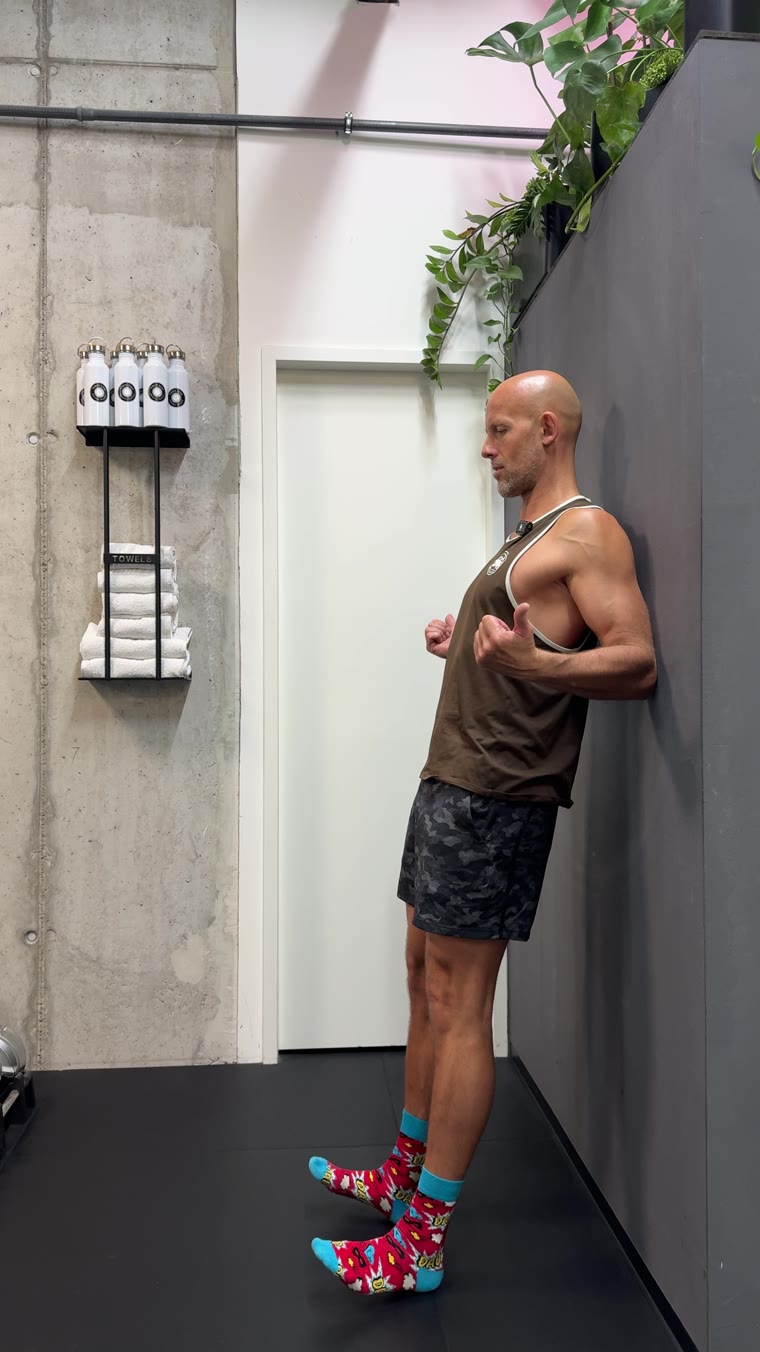
The wall assisted reverse plank is a standing hold, and all you need is a wall. You press yourself away from the wall with your elbows and keep your body straight. This works the muscles that draw your shoulder blades back and down, along with the muscles that turn your upper arm out.
The position takes seconds to set up. The distance between your feet and the wall determines how much of your weight rests on your elbows.
From my practice: this exercise switches on the very muscles that pull my shoulders into a good position. I like to pair it with the wall angel, and you can fit both into your day at any time. That is what I see in the studio.
Starting position
Stand with your back to a wall and your feet a little in front of it. To start, let your hips and shoulders rest against it. Bend your arms so your elbows sit against the wall at your sides.
Now push your hips away from the wall and press off it with your elbows only. Start with your feet close to the wall. Keep your body straight, in one line from your heels to your shoulders.
Push your chest out as far as it will go and try to bring your shoulders back as close to the wall as you can. Turn your thumbs out. Hold this position for 10 to 20 seconds.
The three cues
- Hips away from the wall, press with your elbows only
- Chest out, as far as it will go
- Shoulders back to the wall, thumbs turned out
Common faults
| Fault | How to fix it |
|---|---|
| Your hips stay against the wall and your body folds in the middle | Push your hips away from the wall until your body forms one line from your heels to your shoulders. |
| Your shoulders roll forwards as soon as you press off | Chest out first, then bring your shoulders back towards the wall. Standing closer to the wall makes this easier. |
| Your thumbs point forwards | Turn your thumbs out. The rotation comes from your shoulder joint, and your elbows stay on the wall. |
| Your shoulders creep up towards your ears | Draw your shoulders down and away from your ears before you settle into the hold. |
Variations
| Variation | When to use it |
|---|---|
| Close to the wall | Your feet are close to the wall and your body is almost upright. This lets you find your chest, shoulder and thumb position without rushing. |
| Hold for 10 to 20 seconds | Once you have the position: chest out, shoulders back towards the wall, thumbs out. |
| Feet further from the wall | Once 20 clean seconds feel easy. The more you lean, the more of your weight rests on your elbows. |
Reps and load
Two to three rounds, holding for 10 to 20 seconds each, with a quick shake-out in between.
It fits into your warm-up before push and pull exercises, works as a short break from your desk, and sets you up nicely for the wall angel: hold, shake out briefly, then go straight into your wall angels.
Which muscles do the work
| Muscle | Role | What it does here |
|---|---|---|
| Middle trapezius M. trapezius, pars transversa | Prime mover | Draws your shoulder blades towards your spine and keeps your shoulders back |
| Lower trapezius M. trapezius, pars ascendens | Prime mover | Draws your shoulder blades down so your shoulders stay away from your ears |
| Rhomboids Mm. rhomboidei | Synergist | Work with the middle trapezius to pull your shoulder blades together |
| Infraspinatus and teres minor M. infraspinatus, M. teres minor | Synergist | Turn your upper arm out as your thumbs rotate outwards |
| Rear deltoid M. deltoideus, pars spinalis | Synergist | Presses your elbows back into the wall |
| Back extensors M. erector spinae | Stabiliser | Keeps your chest lifted as you push it out |
| Glutes M. gluteus maximus | Stabiliser | Keeps your hips extended so your body stays in one line |
| Abs M. rectus abdominis | Stabiliser | Keeps your pelvis in line so your lower back stays quiet |
The work happens between your shoulder blades: they are drawn back and down while your upper arm turns out. Your glutes, abs and back extensors keep your body straight throughout.
Explained in full
Andreas sets up against the wall, presses off with his elbows and builds the hold step by step: hips away, chest out, shoulders back to the wall, thumbs turned out. · 0:40
Seeing it done right is not the same as doing it right
Video, cues and variations take you a long way. What they cannot give you is an outside eye at the moment the movement isn't quite there yet. That is what training with me is for — in the studio or in a workshop.
See the workshopsNew exercise pages are added all the time — the newsletter keeps you posted.
Sources
Kara D, Harput G, Duzgun I. (2019). Trapezius muscle activation levels and ratios during scapular retraction exercises: a comparative study between patients with subacromial impingement syndrome and healthy controls. Clin Biomech 67:119–126. DOI: 10.1016/j.clinbiomech.2019.05.020 — Surface EMG in 22 patients with shoulder impingement and 22 healthy controls. Scapular retraction while standing with the arms at the sides gave the most favourable ratio of upper to middle and lower trapezius, in patients and controls alike. This is the closest match to the position used here. The study measured activation, not training effects, and the abstract does not report participants' ages. (Evidence type: EMG)
Cools AM, Dewitte V, Lanszweert F, Notebaert D, Roets A, Soetens B, Cagnie B, Witvrouw EE. (2007). Rehabilitation of scapular muscle balance: which exercises to prescribe? Am J Sports Med 35(10):1744–1751. DOI: 10.1177/0363546507303560 — Surface EMG in 45 healthy people. Exercises with the arm at the side moving into extension, such as prone extension, recruited the middle and lower trapezius strongly while the upper trapezius stayed relatively quiet. Supports the upper-back roles listed here. This exercise itself was not measured; healthy young adults, so transfer to ages 40 to 60 is open. (Evidence type: EMG)
Reinold MM, Wilk KE, Fleisig GS, Zheng N, Barrentine SW, Chmielewski T, Cody RC, Jameson GG, Andrews JR. (2004). Electromyographic analysis of the rotator cuff and deltoid musculature during common shoulder external rotation exercises. J Orthop Sports Phys Ther 34(7):385–394. DOI: 10.2519/jospt.2004.34.7.385 — Fine-wire EMG in 10 healthy people. Infraspinatus and teres minor work during external rotation, and the rear deltoid when the upper arm moves back and out. The basis for the rotator cuff and rear deltoid roles in the table. Measured in different arm positions from this exercise, in a very small group. (Evidence type: EMG)
Ekstrom RA, Donatelli RA, Soderberg GL. (2003). Surface electromyographic analysis of exercises for the trapezius and serratus anterior muscles. J Orthop Sports Phys Ther 33(5):247–258. DOI: 10.2519/jospt.2003.33.5.247 — Surface EMG in 30 healthy people. The middle trapezius was most active when drawing the arm back was combined with external rotation. Supports pairing shoulders back with thumbs out. Measured lying face down at high intensity; this exercise itself was not measured. (Evidence type: EMG)
A note on context: EMG studies show which muscles an exercise recruits — that is a good reason to pick it, but it does not replace adjusting things to the person in front of you. See a doctor for persistent or severe pain.