The switch to your nervous system
You breathe around 20,000 times a day — almost always without thinking about it. That's exactly what makes breathing special: it runs automatically, yet you can take it over at any moment. That makes it the only direct line to a system otherwise outside your control.
Your autonomic nervous system has two gears. One, the sympathetic, handles performance: heart rate up, attention sharp, "ready to act". The other, the parasympathetic, is for recovery: heart rate down, digestion on, "all safe, you may power down". In everyday life many people are stuck too much in the first gear — and can't properly drop into the second in the evening.
The fascinating part: you can change gear. Not by thinking — but through the breath.
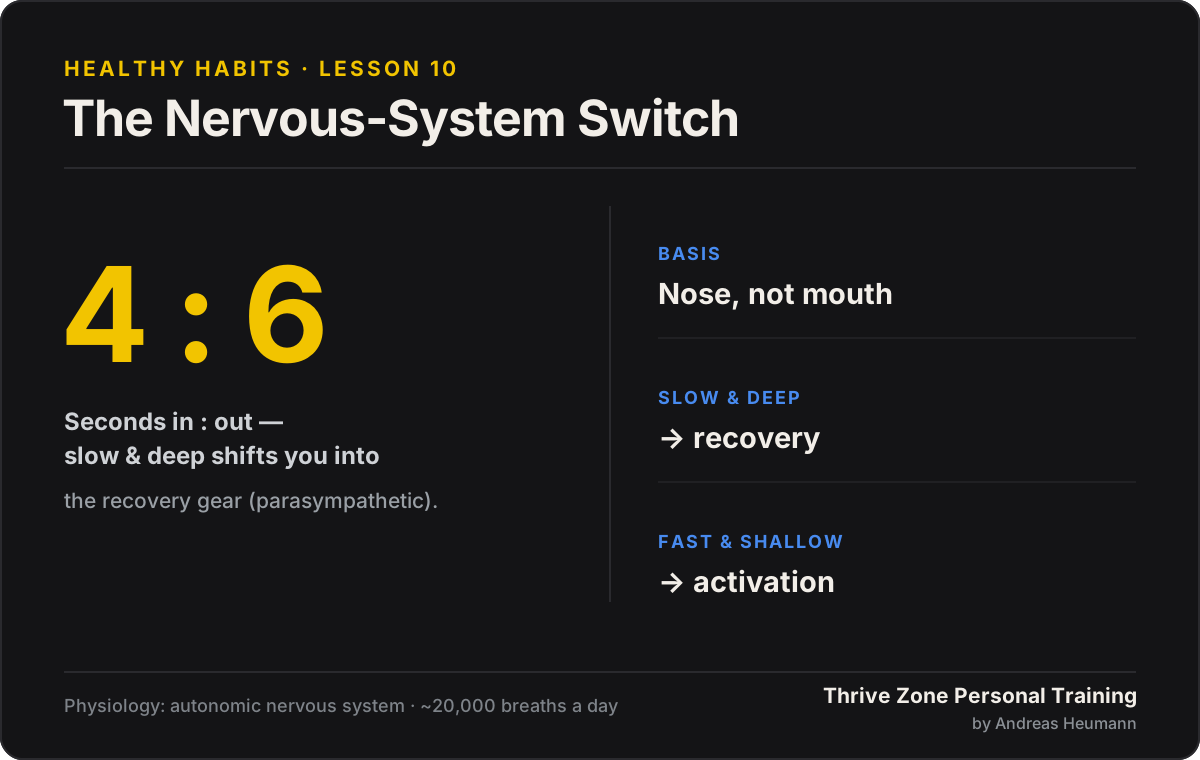
Fast, shallow breathing shifts you toward the sympathetic (activation). Slow, deep breathing shifts you toward the parasympathetic (recovery). Your breath is the remote control for your inner state — and you always have it with you.
First the basics: through the nose
Before techniques comes the foundation — and that's simply what you breathe through. The nose is built for breathing, the mouth for eating. Through the nose, air is filtered, warmed and moistened before it reaches your lungs. It activates the diaphragm — your actual breathing muscle — and nudges you gently toward the recovery gear.
Mouth breathing bypasses all of that: unfiltered air, shallower chest breathing, more toward the stress gear. Breathe through your mouth all day and you keep your system in a low-level state of constant alert without noticing. The simplest correction there is: mouth closed, breathe through the nose — sitting, walking, and ideally during sleep too.
The 4:6 rhythm — recovery on demand
If you learn one single technique, make it this one: through the nose, in for four counts, out for six. The longer exhale is the lever — it specifically activates the parasympathetic system and signals the body "you may power down". A few minutes of it noticeably lower heart rate and tension.
Slow breathing at around six breaths per minute increases heart rate variability (HRV) — a recognised marker of nervous-system balance — and strengthens parasympathetic (recovery) activity. The effect arises through resonance between breath, heartbeat and blood pressure.
Sevoz-Couche C, Laborde S (2022). Heart rate variability and slow-paced breathing: when coherence meets resonance. Neuroscience & Biobehavioral Reviews 135:104576. DOI: 10.1016/j.neubiorev.2022.104576 · Review article
For context: most people breathe 12 to 15 times per minute. With the 4:6 rhythm you land at around 5 to 6 — and that's exactly where your system works most efficiently. Breathing more isn't better here; calmer and slower is.
Box breathing — when it gets acute
For moments when tension spikes — before an important conversation, a presentation, a decision — there's a technique as simple as it is effective, used in the military and elite sport too:
Box breathing: 4 counts in · 4 hold · 4 out · 4 hold. Five to ten rounds through the nose. The even rhythm overrides the stress response and brings you into a clear, calm state within minutes.
And Wim Hof? Powerful, but with respect
The Wim Hof method (intense breathing cycles plus cold) is popular — and there is indeed a remarkable piece of evidence that it lets you consciously influence processes otherwise considered involuntary:
In a small proof-of-principle study, trained participants were able to voluntarily activate their sympathetic nervous system through breathing technique, meditation and cold — and thereby measurably dampen an artificially induced inflammatory response, something previously thought impossible to influence.
Kox M et al. (2014). Voluntary activation of the sympathetic nervous system and attenuation of the innate immune response in humans. PNAS 111(20):7379–7384. DOI: 10.1073/pnas.1322174111 · Small proof-of-principle study (limited generalisability)
Important: these intense breathing cycles are something different from the calm 4:6 breath for everyday use — and they're not for everyone. With high blood pressure, cardiovascular conditions, epilepsy or in pregnancy, this doesn't belong in self-directed practice, and never in or near water. For the everyday benefit — calm, focus, better sleep — you don't need that intensity at all. The calm breath carries it.
How to build it into your day
- Morning: two or three minutes of hand-on-belly breathing through the nose — belly rises, chest stays calm. Sets your breathing default for the day.
- During the workday: every 60 to 90 minutes, one or two minutes of 4:6 — a short reset that keeps your focus fresh.
- In a stressful moment: box breathing, five to ten rounds, before you react.
- Evening: the extended exhale (4:6) is part of winding down — more in the lesson Good sleep starts two hours before bed.
If you take one thing from today: breathe through your nose. And if you take two: sit down once and do two minutes of four in, six out. You'll feel the gear change immediately.
New lessons every two weeks, straight to your inbox
This lesson is part of the Healthy Habits pillar — the daily routines that carry everything else. Sign up and you'll get each new lesson straight to your inbox.
Join the newsletterSources
Sevoz-Couche C, Laborde S (2022). Neuroscience & Biobehavioral Reviews, 135:104576. DOI: 10.1016/j.neubiorev.2022.104576 — review article (slow-paced breathing & HRV)
Kox M et al. (2014). PNAS, 111(20):7379–7384. DOI: 10.1073/pnas.1322174111 — small proof-of-principle study (Wim Hof method)
Nasal breathing (filtering/warming/moistening), the diaphragm as the main breathing muscle, box breathing, sympathetic/parasympathetic basics: established textbook physiology, presented here as principle.