Good Sleep Starts Two Hours Before Bed
Falling asleep isn't a button you press — it's the result of what happens beforehand. How to build your evening so your body takes over the falling-asleep part itself.
Sleep series · Part 4
You're reading Good Sleep Starts Two Hours Before Bed — the practice. The steps before: Why Sleep Decides Everything · How Sleep Works · In Sync with the Sun — how your day builds your sleep · then Food and Sleep.
What actually happens during sleep — muscle repair, memory, the brain's nightly clean-up — you saw in How Sleep Works. For all of that to happen, your body needs one thing above all: the right signal at the right time. And that is exactly what your evening routine delivers.
Melatonin needs darkness, your nervous system needs a wind-down signal. You provide both not in bed — but in the two hours before it.
Lever 1: Dim the lights — properly
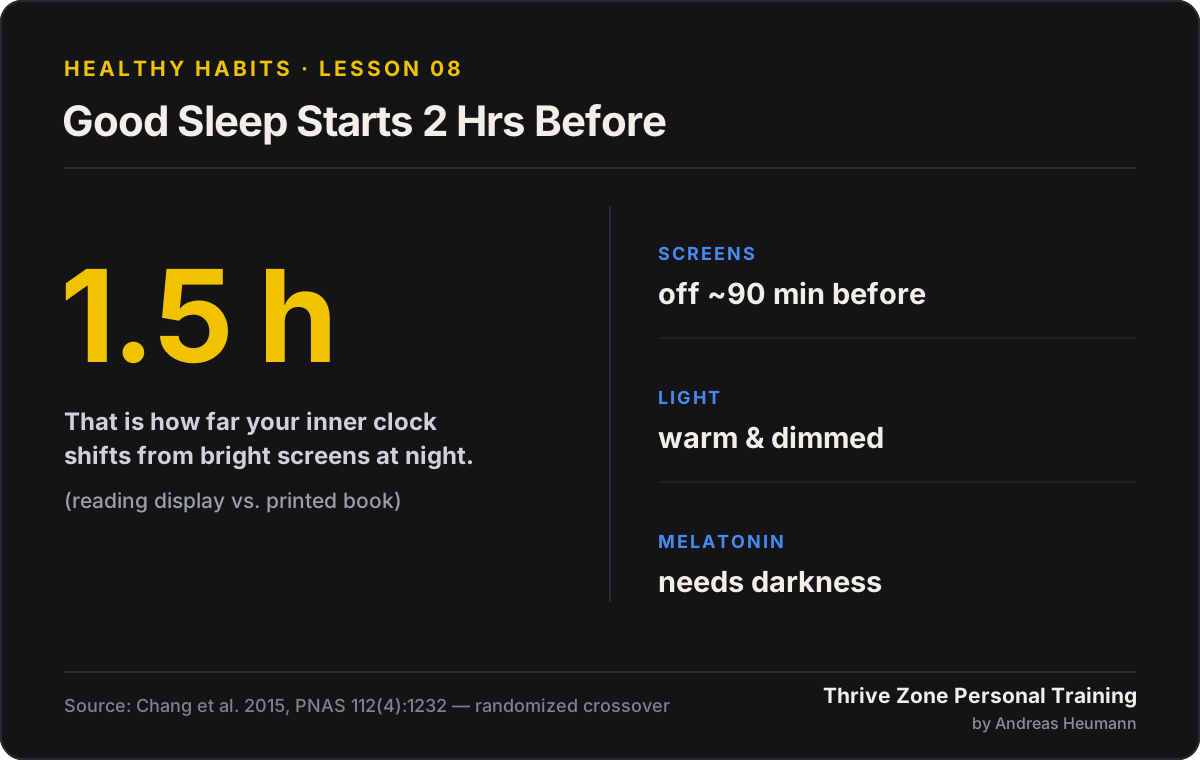
Melatonin is your sleep timekeeper, and it is only released in darkness. Bright light in the evening — especially the blue-heavy light of screens — pushes that moment back. An experiment at Harvard Medical School showed just how much:
People reading on a light-emitting display in the evening (instead of a printed book) released less melatonin, their internal clock shifted back by about 1.5 hours, REM sleep shortened — and next-morning alertness suffered measurably.
Chang AM et al. (2015). Evening use of light-emitting eReaders negatively affects sleep, circadian timing, and next-morning alertness. PNAS 112(4):1232–1237. DOI: 10.1073/pnas.1418490112 · Randomized crossover experiment
The fix is pleasantly simple: send your screens off duty about 90 minutes before sleep and switch to warm, dimmed light — a floor lamp instead of ceiling light; candlelight counts double. Your evening automatically takes on a different quality.
Lever 2: The caffeine window
Caffeine blocks adenosine — the molecule that builds your sleep pressure over the day. That espresso after dinner is more expensive than it tastes:
A common caffeine dose (400 mg) still measurably disrupted sleep when taken six hours before bedtime — and the participants underestimated the effect in their own perception.
Drake C et al. (2013). Caffeine Effects on Sleep Taken 0, 3, or 6 Hours before Going to Bed. Journal of Clinical Sleep Medicine 9(11):1195–1200. DOI: 10.5664/jcsm.3170 · Randomized placebo-controlled experiment
Rule of thumb: plan your last coffee at least six hours before sleep — bed at 11 pm means last coffee at 5 pm, ideally earlier.
Lever 3: The wind-down ritual
Your nervous system has two gears: performance (sympathetic) and recovery (parasympathetic). The evening routine is the deliberate gear change. What works in practice — pick two or three that suit you:
- Read a real book — paper instead of display, the most relaxing form of screen-freedom
- Real conversations — genuine connection breaks down stress hormones
- Breathing exercises or meditation — even five minutes of slowed breathing engage the parasympathetic system
- Journaling — capture seven positive moments and park open thoughts on paper so they don't come to bed with you
- Progressive muscle relaxation or gentle stretching — release physical tension deliberately
- Warm shower or bath — the cool-down that follows supports your body's falling-asleep signal
Your last big meal ideally sits about three hours back, intense training too — both are activation signals you no longer need in the evening.
The sleep environment: cool, dark, quiet
Your body lowers its core temperature to fall asleep — a cool bedroom (16–18 °C / 61–64 °F) works with it rather than against it. Add: as dark as possible (blackout curtains or a sleep mask, since melatonin responds even to small amounts of light) and as quiet as possible (earplugs are entirely legitimate).
A personal lever: nasal breathing — and mouth taping
One lever I've used myself for ten years, and it's too important to leave out — but it needs a clear framing. At some point I switched consistently to nasal breathing. Breathing through the nose filters and humidifies the air, calms the breath and keeps the throat more open; breathing through the mouth dries you out and encourages snoring.
The last step for me was mouth taping — a small strip across the lips that keeps you breathing through the nose overnight. I'll admit, it took me a long time to dare. Today it's so normal that in ten years I've slept only a handful of nights — maybe five in total — without it. I even wake up if I forget it once: it feels wrong, and I start to snore.
As convinced as I am, a clear word on safety belongs here, because what works for me doesn't work for everyone. Your body has a built-in safeguard: when CO₂ rises at night, a reflex normally wakes you. In a healthy person with a clear nose that's a strong safety net — which is why you simply wake up when you have a cold. But that reflex isn't reliable under all conditions: alcohol and sleeping pills blunt it, and undiagnosed sleep apnea dulls it over time. That's exactly when a taped-shut mouth becomes a risk.
A 2025 systematic review (10 studies, 233 people) concludes: for mouth breathing and sleep apnea, mouth taping offers only limited benefit and may carry risks — especially with a blocked nose, where taping can become dangerous. Overall the evidence is still thin.
Systematic review (2025). Safety and efficacy of mouth taping in patients with mouth breathing, sleep disordered breathing, or obstructive sleep apnea. PLOS One. DOI: 10.1371/journal.pone.0323643 · Systematic review — evidence thin
So if you want to try it, tie it to three conditions: your nose is clear, you haven't had alcohol, and you have no sign of sleep apnea (loud snoring with breathing pauses, pronounced daytime sleepiness — when in doubt, get it checked). If any of those doesn't hold, daytime nasal breathing is the better starting point: how to train it is in Breathing: the switch to your nervous system.
The short checklist: plan 7.5–9 hours · consistent sleep and wake times · screens off 90 min before · last coffee 6 hrs before · 16–18 °C, dark, quiet · two or three ritual elements that do you good.
And the strongest evening lever? Sits in the morning.
It sounds paradoxical, but your evening starts after you wake up: morning light sets your internal clock so melatonin arrives at the right time at night. If you spent ten minutes outside in the morning, you'll need far less effort in the evening.
New lessons every two weeks, straight to your inbox
The Healthy Habits pillar keeps growing: movement throughout the day, daily structure, focus windows — the habits that carry your day. Always with something you can apply today.
Join the newsletterSources
Chang AM et al. (2015). PNAS, 112(4):1232–1237. DOI: 10.1073/pnas.1418490112 — Randomized crossover experiment
Drake C et al. (2013). Journal of Clinical Sleep Medicine, 9(11):1195–1200. DOI: 10.5664/jcsm.3170 — Randomized placebo-controlled experiment
Mouth taping — systematic review (2025). PLOS One. DOI: 10.1371/journal.pone.0323643 — limited benefit, possible risks, evidence thin
Arousal reflex to CO₂/low oxygen and its blunting by alcohol, sedatives and sleep apnea: established sleep physiology (incl. J Appl Physiol Review)
The mechanics of sleep (growth hormone, glymphatic clean-up, sleep stages) are sourced in How Sleep Works. Adenosine mechanism and core temperature drop at sleep onset: established physiology, presented without individual-study citations.


