Body Recomposition: Building Muscle and Losing Fat at the Same Time
It's possible, it has a scientific basis and it needs no five training sessions per week. But it only works under clear conditions — and the most common reason it doesn't catch is a strategy chosen wrongly for the starting point.
Anyone who starts training with the goal of building muscle and losing fat has a question in front of them whose answer shapes the next six to twelve months: which approach fits your own starting point?
Whoever begins here without clarifying it — and simply starts with the program that happens to be within reach — frequently lands in a strategy that doesn't fit their own situation. Bulking, even though body recomposition would have been possible. Aggressive cutting, even though the building phase could still have been taken along. High training frequency, even though two structured sessions would have sufficed. The result is months in which the body changes — but more slowly than it could.
Whoever invests training time should choose the approach that fits their own starting point — not the standard program.
The usual answer — and why it's incomplete
Whoever deals with body transformation for the first time quickly comes across a seemingly hard rule: building muscle needs a calorie surplus, losing fat needs a calorie deficit. From that, apparently, it follows inevitably — either or. Bulking or cutting.
This rule is not wrong. It is incomplete.
In nineteen years of personal training, I regularly see clients in whom exactly the opposite takes place: muscle mass builds up, body fat goes down — at the same time. The term for it is Body Recomposition. It's not a training fad, but a well-documented physiological phenomenon with clear prerequisites.
The real question is not whether body recomposition is possible. But for whom — and under what conditions.
What body recomposition exactly is — the mechanism
Body recomposition describes a change in body composition in which muscle mass and fat mass move simultaneously in opposite directions — muscle up, fat down — while body weight remains overall stable.
The key concept behind it is called energy partitioning (P-ratio). The body decides where it directs energy from food and stored reserves. With the right stimulus and nutrient supply, it can use stored body fat as an energy source while simultaneously investing amino acids into muscle protein synthesis.
In a controlled study, trained men in a 40-percent calorie deficit over four weeks — combined with intense strength and interval training and a high protein intake (2.4 g/kg) — simultaneously built muscle mass and lost fat. The systematic review by Barakat et al. shows that this also succeeds in already trained individuals, not just beginners.
Longland et al. (2016), Am J Clin Nutr 103(3):738–746. DOI: 10.3945/ajcn.115.119339 · RCT · Barakat et al. (2020), Strength Cond J 42(5):7–21. DOI: 10.1519/SSC.0000000000000584 · Systematic review
In beginners — people who have never trained in a structured way — the phenomenon is significantly more pronounced and occurs almost regularly.
Where it reliably works — four populations
From the practice in the studio, four groups crystallize out in whom body recomposition occurs with high probability — provided training and nutrition are optimally structured.
Training beginners (first six to twelve months). Whoever has never done systematic strength training has a pronounced adaptation reserve. The stimulus is new, the musculature responds strongly — and the body can simultaneously mobilize fat. Described in sports science as "novice gains."
Returners after a longer break. Here "muscle memory" takes effect — myonuclear persistence: the cell nuclei per muscle fiber remain elevated long-term after a hypertrophy phase. On resumption, the musculature builds up significantly faster, even in a slight deficit.
Clients with a higher body-fat percentage. With large fat reserves, the energy availability for anabolic processes is high even in a deficit — the mobilization of stored energy proceeds without loss of muscle building, provided stimulus and protein intake are right.
Clients with hard time windows. Film productions often give me six to twelve weeks to bring an actor into a particular condition. Bulk-cut periodization is ruled out — the shoot date is set. Here we work consistently in body-recomposition logic.
What connects all four: an adaptation reserve that has not yet been exhausted. It is the biological foundation. What makes it usable is the training and nutrition structure.
The training requirements
Strength training as the main stimulus. Muscle protein synthesis responds primarily to mechanical tension. Multi-joint exercises like squat, deadlift, bench press, pull-up and row are the foundation — maximal stimulus density with a minimal number of exercises.

Progressive overload. What forces the body to adapt is not the repetition of the same load, but the continuous increase — week by week, cleanly documented.
Training volume in the effective window. Here it becomes decisive — and here lies a widespread misconception.
The often-cited "ten to twenty sets per muscle group per week" stem from meta-analyses with trained athletes: more volume there brought more muscle growth (dose-response relationship). For beginners, however, the effective window often lies considerably lower — at four to eight sets per muscle group per week. The untrained muscle responds to a small stimulus with maximal adaptation, while the regeneration capacity is still limited.
Schoenfeld et al. (2017), J Sports Sci 35(11):1073–1082. DOI: 10.1080/02640414.2016.1210197 · Meta-analysis
Whoever as a beginner starts with twenty sets per muscle group exceeds their recovery capacity many times over — the consequences are days of muscle soreness, collapsing performance in the following week, and absent adaptation. That's the explanation for the classic "I trained, I see nothing" trajectory.
The good news for beginners: the training grows with your development. Low entry, observed stimulus response, gradual increase.
The actual volume management is dynamic — dependent on recovery, sleep, life load and performance. Making exactly this steering decision week by week is the point at which most self-made programs fail. In coaching with me as your trainer, I take this over: stimulus response observed session by session, volume dosed within the individual window, program adjusted as soon as your recovery capacity shifts.
Frequency: twice per week per muscle group, split over two integrated full-body sessions — optimal for muscle protein synthesis and a working everyday life at the same time.
The nutrition requirements — three variables
Protein: 1.8 to 2.2 g per kilogram of body weight per day — scientifically validated for muscle building in a deficit (Helms et al. 2014). Spread over three to four meals, so that muscle protein synthesis stays stably activated throughout the day.
Energy balance moderate. Body recomposition succeeds best in a slight deficit (200 to 500 kcal below maintenance) or at maintenance. Aggressive cutting above 700 kcal daily breaks muscle protein synthesis — the adaptation window closes.
Carbohydrates as training fuel, above all on training days. Whoever can't call up their volume in strength training loses the stimulus density that makes body recomposition possible in the first place. (More on fueling around training in Lesson 02 — Hydration.)
Sleep and regeneration
What happens in the studio is the stimulus. What happens between the sessions is the adaptation. Seven to nine hours of sleep are not a luxury but a biological necessity — growth-hormone release, glycogen-store refilling and muscle repair run primarily in deep sleep.
The time factor: why two hours per week suffice
Body recomposition needs no five training sessions per week. It needs two right ones.
Two sessions of sixty minutes each, planned in an integrated way, yield a volume in the effective window of all five capacities. A typical structure of an advanced session:
- Mobility & activation (8 min) — preparation of the main movements
- Main strength (25 min) — two multi-joint exercises, 4 working sets, progressive overload documented
- Assistance (15 min) — stability and single-side exercises, 3 sets
- Interval conditioning (8 min) — power and metabolic stimulus
- Cool-down & mobility (4 min)
For beginners, the same format is run with considerably reduced volume — two to three sets per main exercise, with more time for movement quality. The volume grows over six to twelve weeks in parallel with the recovery capacity. Making this adjustment week by week is the core of my work as a personal trainer. (How mobility and control play together in this is in Lesson 01 — Mobility.)
Case example: Mirko, 47 years old, zero training experience
Mirko begins his training at forty-seven — as a client at my studio. Zero training years, a pronounced rounded back, limited mobility, low strength values. Two sessions of sixty minutes each per week, continuously, planned by me and steered session by session in the integrated ThriveZone format.
Two hours per week. Zero prior experience. Eight kilograms of muscle mass built. Six kilograms of fat lost.
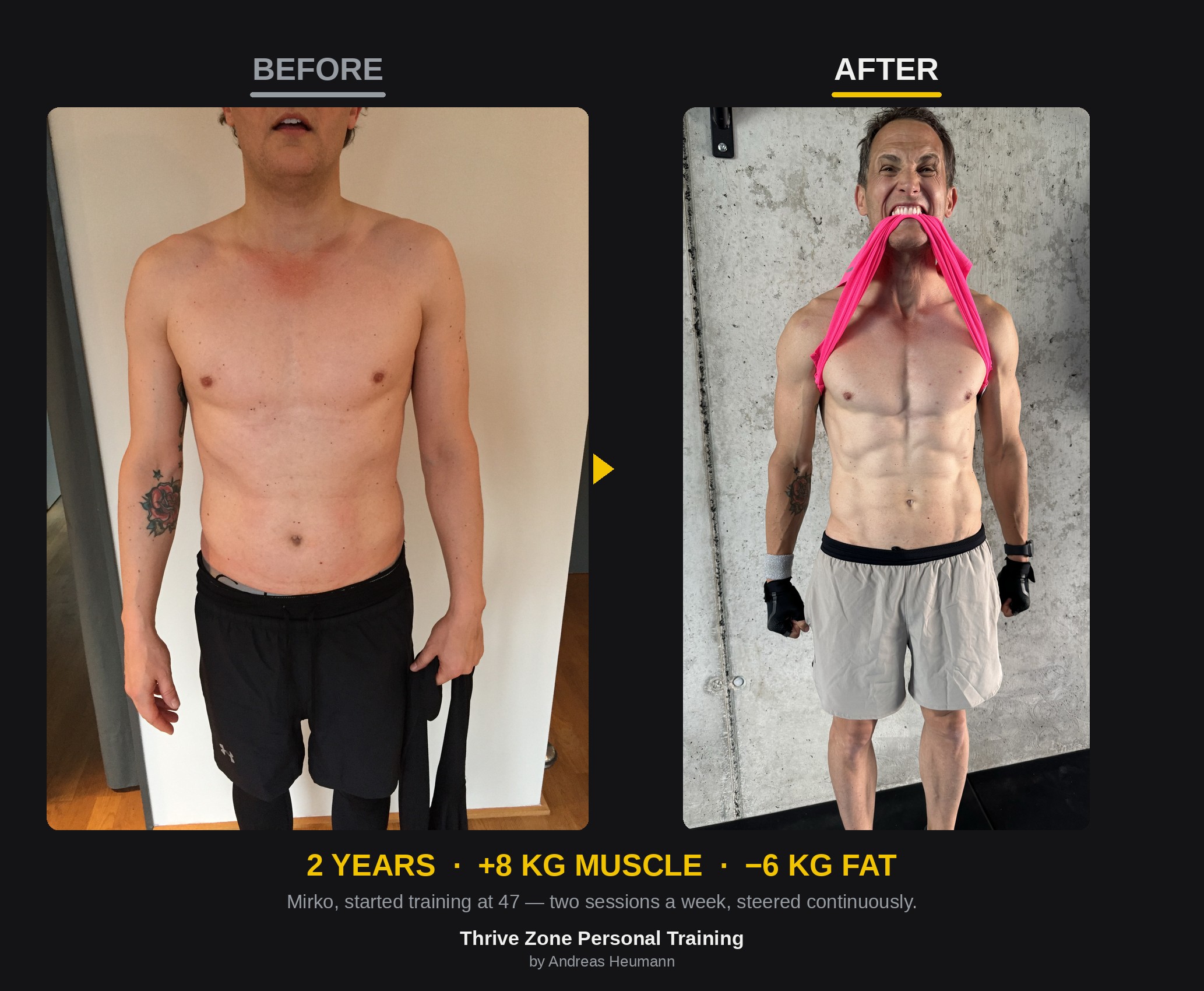
Visible abdominal musculature, posture fundamentally changed. Today, at fifty, he trains intensely — with full mobility and a stable shoulder. Body recomposition over the beginner adaptation reserve, then continued hypertrophy via precise stimulus steering. No bulk-cut switches, no fragmented training week.
When it gets slower
The adaptation reserve is finite. After twelve to twenty-four months of well-structured training, the client approaches a point at which building and fat loss have to be more clearly separated again — the "novice gains" effect fades. Then the program switches into periodized bulking and cutting. What changes is the steering of the energy balance — not the training duration, which usually stays at two to three hours per week.
Why professional steering makes the difference
Body recomposition is not a single trick — it's an interplay of training volume, load management, protein timing, energy balance, recovery observation and progressive adaptation over months. Each variable has its own effective window, and all of them must be tuned to one another. One variable set wrongly — and the whole process becomes suboptimal.
Whoever is responsible for results in their profession knows the principle: expertise gets bought in to reach the goal faster and more safely. With your own body it's exactly the same.
Whether body recomposition works for you, we clarify in the assessment
That depends on training history, body composition, strength and mobility values and your everyday life — not on a standard answer. At the studio in Berlin-Mitte I carry out the assessment personally with you and design the fitting strategy.
Request an assessment at the studioRather just read along first? A new lesson in your inbox every two weeks →
Sources
Longland TM et al. (2016). Higher compared with lower dietary protein during an energy deficit combined with intense exercise promotes greater lean mass gain and fat mass loss. Am J Clin Nutr, 103(3):738–746. DOI: 10.3945/ajcn.115.119339 — RCT
Barakat C et al. (2020). Body Recomposition: Can Trained Individuals Build Muscle and Lose Fat at the Same Time? Strength Cond J, 42(5):7–21. DOI: 10.1519/SSC.0000000000000584 — Systematic review
Schoenfeld BJ et al. (2017). Dose-response relationship between weekly resistance training volume and increases in muscle mass. J Sports Sci, 35(11):1073–1082. DOI: 10.1080/02640414.2016.1210197 — Meta-analysis
Helms ER et al. (2014). Evidence-based recommendations for natural bodybuilding contest preparation: nutrition and supplementation. J Int Soc Sports Nutr, 11:20. DOI: 10.1186/1550-2783-11-20 — Review (protein recommendation)


