VO₂max — the fitness number that predicts longevity
Almost everyone knows their blood pressure. Hardly anyone knows their VO₂max — yet it's one of the strongest predictors we have for long-term health. And here's the useful part: you don't have to chase elite numbers. Moving yourself into a protective range is enough.
VO₂max is one of the strongest predictors we have for a long, healthy life. But the goal isn't maximum VO₂max — it's enough. And you reach "enough" without a lab or an elite protocol — through real, structured training that fits a life you actually enjoy living.
What VO₂max actually measures
VO₂max is the maximum amount of oxygen your body can take up, transport and use in the muscles per minute — given in millilitres per kilogram of body weight per minute (ml/kg/min). It isn't a "fitness feeling" but an objective measure of how heart, lungs, vessels and mitochondria work together. That very system protects you from heart disease, metabolic disease and cognitive decline.
The evidence: nearly a million people, one clear pattern
Few numbers in medicine are this well studied. Three studies carry the foundation:
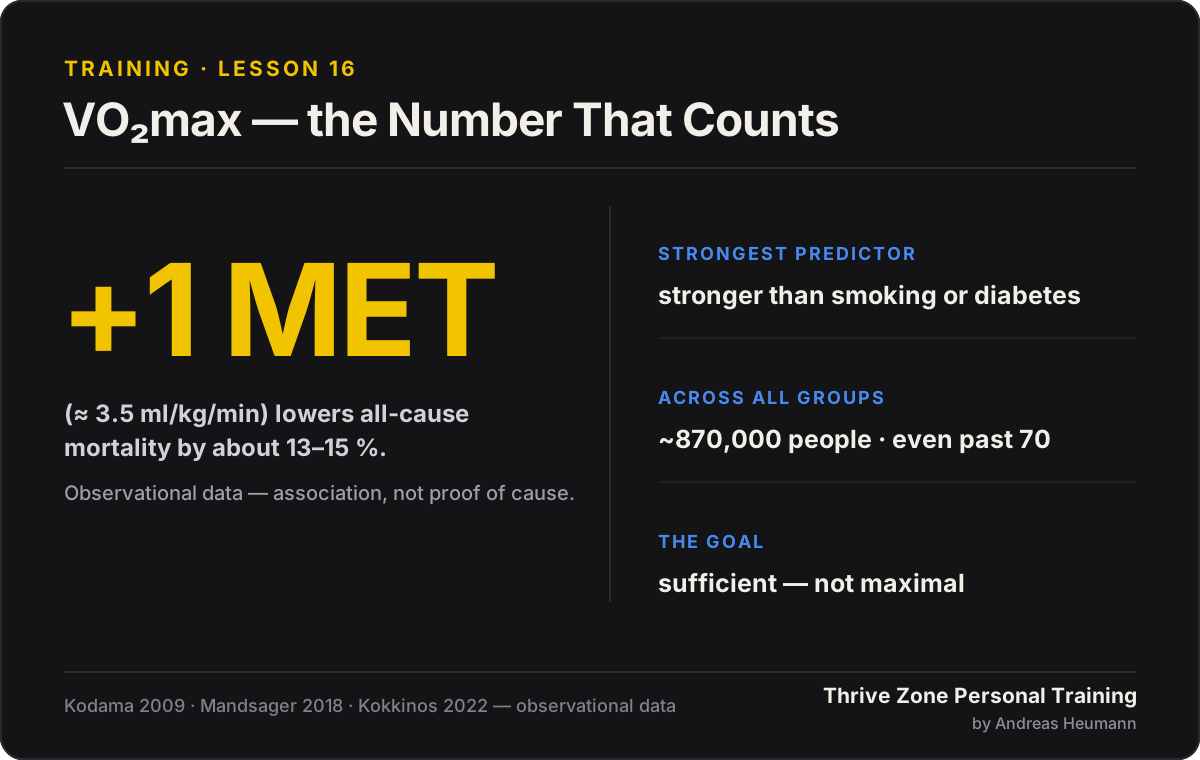
In 122,007 adults, cardiorespiratory fitness was the strongest single mortality predictor in the cohort — stronger than smoking, diabetes or high blood pressure. And there was no upper plateau: even the fittest groups had continuously lower mortality.
Mandsager K et al. (2018). JAMA Network Open 1(6):e183605. DOI · Observational study (association, not causal proof; fitness estimated as METs)
The largest study of its kind — 750,302 US veterans — confirms the pattern across all age, ethnicity and sex groups. Even beyond 70 the association held.
Kokkinos P et al. (2022). JACC 80(6):598–609. DOI · Observational study
The dose-response figure we work with: for every +1 MET (about 3.5 ml/kg/min), all-cause mortality drops by roughly 13–15%.
Kodama S et al. (2009). JAMA 301(19):2024–2035. DOI · Meta-analysis
Placed properly — which makes this more credible, not less: these are observational data. They show an exceptionally strong, dose-dependent, repeatedly replicated association — not proof in the sense of an experiment. The American Heart Association nonetheless draws a clear conclusion: fitness should be recorded as a vital sign, like blood pressure (Ross/Arena/Myers 2016).
How much is enough? The target corridor
Here's where this lesson parts ways with the fitness industry: it's never about having the most — it's about the right amount. For orientation, here are the norm values from the US reference register FRIEND, for age 50 as an example:
| Median (50th percentile) | "Good" (~75th percentile) | |
|---|---|---|
| Men | ~33 ml/kg/min | ~40 ml/kg/min |
| Women | ~23 ml/kg/min | ~28 ml/kg/min |
Norm table (US reference register): Kaminsky LA et al. (2015), Mayo Clin Proc. DOI
These two columns define the target corridor: getting above the median for your age group is the foundation. The 75th percentile is the ambitious, worthwhile goal. Anything beyond that is sport, no longer health prevention.
The kink in the curve
The biggest gain sits right at the bottom: moving out of the lowest fitness fifth brings by far the largest risk reduction (Blair 1989, observation). After that the curve flattens — each further improvement still adds something, but less and less per training hour. Two truths stand side by side:
- There is no upper plateau. More is never harmful to the prognosis.
- But the price per percent rises steeply. From median to 75th percentile: doable with 4–5 hours a week. From the 75th percentile toward elite: athlete-level volumes for small extra gains.
That's why "enough, not maximum": not a biological limit on the benefit, but a lifetime decision. The last 10% of benefit costs more hours than the first 90%.
How you actually build VO₂max
Here's the distinction that blurs in a lot of longevity writing. Your VO₂max only goes up measurably through real endurance training with enough of a stimulus: a solid base of easy work (Zone 2), targeted intervals, or — most effective — a mix of both. None of that needs a lab or a gym appointment, but it does need structure and intensity. Leisurely walking or "being on your feet all day" is activity, not a training stimulus — it won't move your VO₂max.
VILPA: a strong lever — for mortality, not (proven) for VO₂max
Keep this one cleanly separate: VILPA — short, intense everyday moments where you genuinely get out of breath.
In 25,241 people who never formally exercise, as little as 3–4 minutes of brief, intense everyday moments per day — running up stairs, walking briskly uphill — were associated with around 24–30% lower all-cause mortality. With more frequent episodes the association was larger still.
Stamatakis E et al. (2022). Vigorous Intermittent Lifestyle Physical Activity (VILPA). Nature Medicine 28:2521–2529. DOI · Observational study (UK Biobank) — what was measured is mortality, not a rise in VO₂max; an association, not causation.
Put in its place: this study measures mortality, not VO₂max — and as an observational study it shows an association, not proof. That makes VILPA a valuable health lever, especially for people who otherwise don't train at all. It doesn't replace the actual building of your VO₂max — and sprinting up stairs at your limit without warming up isn't a training programme, it's mostly an injury risk. The building happens through the structured endurance training above; VILPA sits on top, as an everyday stimulus.
The signature insight: "pure HIIT" doesn't exist
When a paper says "4×4 minutes of HIIT", it shows only the peak. The complete session looks different — here broken down from the original protocols:
| Study | Complete session | Share of true peak |
|---|---|---|
| Wisløff 2007 (RCT, cardiac patients) | Warm-up + 4×4 min @ 90–95% + active rests + cool-down ≈ 38 min | ~40% |
| Gillen/Gibala 2016 (RCT) | 3×20 s all-out in a 10-min session | ~10% |
| Burgomaster 2005 (pilot) | 4–7×30 s with 4 min rests | ~10% |
Every "HIIT protocol" in the literature is in truth a mixed session — mostly low intensity with peaks woven in. That these mixed forms work is well documented: they improve VO₂max more than steady continuous training (Milanović 2015, meta; ~+5 ml/kg/min difference), in patients about twice as much (Weston 2014, meta), and interval formats were even experienced as more pleasant than monotonous continuous training (Bartlett 2011, RCT, small).
(Thesis — based on experience + physiology, not yet directly studied this way.) If every effective session is a mixture anyway, then build it deliberately as one: Zone 2 → Zone 3 → peak → Zone 2 → peak, fartlek-style. No abrupt start from zero to a hundred, active recovery between the peaks, more base volume — and psychologically much more pleasant. The studies show that mixed forms work; the exact order is my signature as a trainer, and I say so plainly.
The natural consequence: sports with built-in intensity variability — mountain biking, trail running, tennis, ball sports — deliver this mixture by themselves. None of them "train VO₂max" by protocol; the structure of their activity forces the stimulus.
The trap: mono-optimisation
This is where the lesson differs from any longevity podcast. The intellect can only ever see one thing sharply — and the more closely it focuses on that one thing, the more it blanks out everything else. Optimise only for the VO₂max number and you get a nice number — and overlook what actually carries a life. (A way of thinking, not a study finding.)
Social connection raises the probability of survival by around 50% — an effect on the same scale as established risk factors.
Holt-Lunstad J et al. (2010). PLoS Medicine 7(7):e1000316. DOI · Meta-analysis across 148 studies
So longevity has at least two big levers that can reinforce each other: the physiological stimulus and social embedding. A training life that gathers both at once — a running group, ball sports, a family bike ride — optimises two factors in one hour.
And the factor that decides everything is adherence: the best programme is worthless if you quit after eight weeks. So the most important property of a programme isn't "maximally effective" but "actually kept up". Activities that are socially embedded, fun, or built into everyday routes win in the long run over any ambitious protocol that sits in the calendar like a foreign body. (A model from coaching practice.)
Your life: the core and three ways
From all the evidence, a common core distils that every profile reaches (synthesis of the evidence):
- 2 intense stimuli per week — as a mixed session or ball sports with built-in peaks
- 2–3 h of base movement (Zone 2) — brisk walking counts if it's demanding; ≥150 min/week of moderate activity is the established baseline recommendation (Pedersen & Saltin 2015)
- 2× strength per week — basic lifts; see Strength training
- Total budget: 4–5.5 hours per week. Practice note: a compound strength circuit often drives the heart rate into intense zones by itself — two such sessions already deliver two mixed stimuli.
The same science looks like this in three different lives (applying the supported principles — example weeks):
Profile 1 — time-poor, with family. Two strength sessions during the week (~45 min each), bike commuting with hill sprints, and at the weekend a mountain-bike or hiking trip with the family including steep climbs. The trick: the weekend family activity is the long base session — training doesn't displace family time, it is family time.
Profile 2 — high work stress, prefers solitude. Two strength sessions, one Zone-2 run alone as a stress valve, a long hilly bike ride at the weekend. Zone 2 is doubly valuable here: physiological stimulus and mental recovery. The social axis deliberately low, recovery high — that too is a legitimate optimum.
Profile 3 — best ager 60+. Two strength sessions with a compound focus (ideally guided), two to three sessions of brisk uphill walking, cycling or swimming, gentle intervals after medical clearance (e.g. 4–6× one minute briskly uphill), stairs instead of the lift. The benefit is greatest in this group — and the stimulus keeps working, because fitness stays trainable into old age.
Not "which setting is optimal", but "which setting fits this life and is therefore kept up". The intensity has to be right — the backdrop is yours to choose.
The limits
So nothing stands overstated: the mortality data are correlations — exceptionally strong and replicated, but not experiments. The trainability of VO₂max is to a considerable degree familial (HERITAGE, Bouchard 1999) — target corridors are averages. The norm values are robust, but the intervention research is male-heavy; cycle and menopause are topics of their own. And without spiroergometry we work with practical surrogates (submaximal step test, recovery heart rate, talk test) — good for steering, not lab-precise.
The five sentences to take with you
- VO₂max is the strongest single longevity marker — shown across nearly a million people.
- The goal is "enough", not "maximum": above the median for your age group, ideally into the good quarter — the benefit per hour drops steeply beyond that.
- Everyday intensity counts: as little as 3–4 minutes of real intensity a day is associated with 24–30% lower mortality.
- "Pure HIIT" doesn't exist — every effective session is a mixture. Build it deliberately mixed, or choose a sport that mixes by itself.
- Never optimise the number alone: socially embedded, sustainable training beats any protocol — because relationships are themselves a longevity factor, and adherence decides everything.
How this one number fits into the bigger picture — why the years in full function count, not just the years themselves — you'll read in Healthspan: the years that really count.
From the number to action
If the topic has caught you, the most useful first step isn't "train more" — it's clarity: knowing where you stand. Everything else builds on that.
You can measure your VO₂max and find out exactly where you stand relative to your age group — the number we steer everything by. The video workshop on how to structure VO₂max training into everyday life (at home, no gym) is coming soon — the newsletter tells you first.
If you're in Berlin, there's more: a VO₂max test with our cooperating longevity practice, an individual VO₂max protocol with me at the studio, and possibly a regular group. Message me on WhatsApp and I'll point you to the right next step.
New lessons every two weeks, straight to your inbox
This lesson belongs to the Training pillar. Sign up and you'll get each new lesson first — and if you want to place your own starting point, an assessment at the studio is the most direct route.
Join the newsletterSources (all verified)
Mandsager K et al. (2018). JAMA Netw Open 1(6):e183605. DOI — observation (N=122,007)
Kokkinos P et al. (2022). JACC 80(6):598–609. DOI — observation (N=750,302)
Kodama S et al. (2009). JAMA 301(19):2024–2035. DOI — meta-analysis (+1 MET ≈ 13–15%)
Blair SN et al. (1989). JAMA 262(17):2395–2401. DOI — observation
Kaminsky LA et al. (2015). Mayo Clin Proc (FRIEND register). DOI — norm table
Stamatakis E et al. (2022). Nature Medicine 28:2521–2529. DOI — observation (VILPA)
Wisløff U et al. (2007). Circulation 115(24):3086–3094. DOI — RCT (cardiac patients)
Gillen JB et al. (2016). PLOS ONE 11(4):e0154075. DOI — RCT
Burgomaster KA et al. (2005). J Appl Physiol 98(6):1985–1990. DOI — pilot (n=8)
Milanović Z et al. (2015). Sports Med 45(10):1469–1481. DOI — meta-analysis
Weston KS et al. (2014). Br J Sports Med 48(16):1227–1234. DOI — meta-analysis
Bartlett JD et al. (2011). J Sports Sci 29(6):547–553. DOI — RCT (small)
Holt-Lunstad J et al. (2010). PLoS Med 7(7):e1000316. DOI — meta-analysis
Bouchard C et al. (1999). HERITAGE, J Appl Physiol 87(3):1003–1008. DOI — intervention study
Ross R et al. (2016). Circulation (AHA). DOI — evidence synthesis
Pedersen BK, Saltin B (2015). Scand J Med Sci Sports 25(S3):1–72. DOI — review
Christensen DL et al. (2022, Maasai). Am J Hum Biol. DOI — measured ·
Pisor AC et al. (2013, Tsimané). DOI — estimated ·
Raichlen DA / Pontzer H et al. (2017, Hadza). DOI — observation
Marked as thesis / model calculation (deliberately without a study citation): the mixed-session order · the mono-optimisation way of thinking · the adherence argument · the three profiles · the orders of magnitude in the model calculation.
Note: This lesson summarises scientific evidence and does not replace individual medical advice. Before starting intense training — especially from age 40, with pre-existing conditions or after a long period of inactivity — a medical check is sensible. The values given are orientation values; individual variation is large.