Healthspan: The Years That Really Count
How long you live and how long you live in full function are two different numbers. On the global average, just under ten years lie between them. Closing this gap is not a training problem — it's an integration problem. And that's exactly what the five-pillar system is built for.
"At 58 I came to Andreas — with constantly shifting hip and back pain. Not even five meters to the tram without risking days of complaints. After half a year the pain was gone, and I felt strong. Today I'm in the running club and keep up without any problem. I really thought those days were long gone. They're not."
"How old do you want to get?" — that's the question I consider the wrong one after nineteen years on the training floor.
The better question is: how many of your years do you want to spend in full function — mobile, strong, clear in the head, capable? Because between "how long you live" and "how long you stay in shape" lies a measurable difference. And it's at exactly this difference that it's decided whether the years you gain are also years in which you live your life to the full.
It's not about living as long as possible. It's about living in full function as long as possible — and these two numbers are not the same.
Two numbers you should keep apart
The first number is lifespan: how many years you live in total. The second is your healthspan: the years of those that you spend in full health and function — without complaints, stiffness or declining strength determining your everyday life.
The medicine of recent decades has become strong above all in the first number. We get older on average than any generation before us. What has not grown at the same pace is the second number — the years in full function.
This gap is not a felt impression but measured. An analysis by the World Health Organization across 183 countries quantified it systematically for the first time in 2024.
Across 183 WHO member states, the distance between lifespan and time lived in health averages 9.6 years — and since the year 2000 it has grown by around 13%. In women the gap is on average 2.4 years wider than in men. The largest distance of all countries is shown by the USA at 12.4 years.
Garmany A, Terzic A (2024). Global Healthspan-Lifespan Gaps Among 183 WHO Member States. JAMA Network Open 7(12):e2450241. DOI: 10.1001/jamanetworkopen.2024.50241 · Cross-sectional analysis (observational)
For Germany, a detail stands out in the same analysis: the difference between the sexes in the healthspan-lifespan gap is here as large as in no other country examined — 3.6 years. We live longer than the global average, yet the gap between lifespan and functional time is widening here too.
The question, then, is not whether you get older. But in what condition you spend the years you've gained.
Why this gap arises in the first place
One of the most convincing explanations comes from evolutionary biology. The Harvard researcher Daniel Lieberman describes a mismatch: our body was shaped over hundreds of thousands of years for a life that hardly exists today — lots of movement spread over the day, natural food, daylight, real recovery. The modern environment has reversed these stimuli in a short time.
Lieberman's short formula for the triggers: complaints arise where a stimulus is too much, too little or too new for a body that was built for something else. Too much sitting, too little movement, too new stimuli like chronic stress or heavily processed food. It's not the genes that have changed — it's the environment.
The mismatch hypothesis is a theoretical framework of evolutionary medicine, not a single measured value. It explains why many chronic complaints are connected with our way of life — as a concept, not as causal proof in the individual case.
Lieberman DE (2013). The Story of the Human Body: Evolution, Health, and Disease. Pantheon. · Theoretical framework / hypothesis
The market's answer — right, but incomplete
The suggestions you hear everywhere today are not wrong. More strength training. Better nutrition. Longer sleep. Less stress. Every one of these statements is scientifically well supported. Each one nonetheless falls short — because it acts as if one adjustment screw could be turned independently of the others.
What I regularly see after almost two decades on the floor looks different:
- Strength training works differently with seven hours of sleep than with five.
- Nutrition works differently at 8,000 steps a day than at 3,000.
- Stress regulation only takes hold once the body regularly gets demanding movement.
- A strong mindset carries you — as long as the body goes along over weeks.
Healthspan is not a training problem. Healthspan is an integration problem.
The five-pillar system — why it works as a system
This is exactly what we built the framework for at Thrive Zone, the one we've been working with in the studio for years. Five pillars that don't stand side by side but build on each other: Training, Nutrition, Mindset, Healthy Habits — and, as the state that emerges from them, Flow.
The decisive thought: no pillar compensates for another. Each pulls the others up. Your strength training only unfolds its effect when nutrition delivers the building material and sleep takes over the repair. Your mindset carries you through full weeks — and your daily habits decide how well the body processes the training.
Flow is therefore the fifth pillar and at the same time the result: the state in which execution becomes easier and the focus clearer — in which you're "in it" instead of having to force yourself. It can't be trained directly. It sets in when the other four pillars carry.
What integration over years makes possible: Mirko
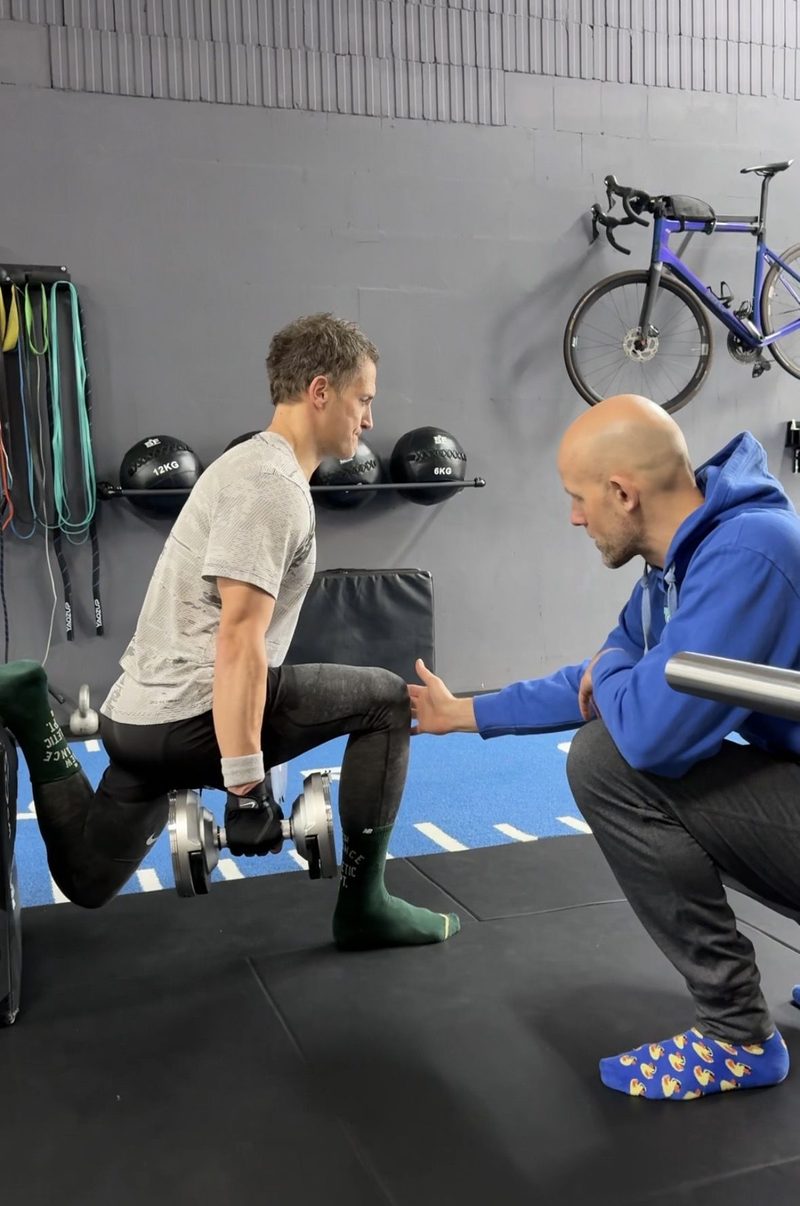
Mirko begins his training at forty-seven — zero training experience, a pronounced rounded back, limited mobility, low strength values. Not a single pull-up.
Today, in his early fifties, he's in the best shape of his life: eight kilograms of muscle mass built, six kilograms of fat lost, forty kilometers of running per week, weighted pull-ups.
The decisive thing about this trajectory: it's not the result of a training program. It's the result of all five pillars growing along over the years — and none being left behind. Strength training set the stimulus, nutrition delivered the building material, sleep carried the adaptation, the mindset held the constancy. Only in the interplay does this add up to a person who, in his early fifties, runs, lifts and moves as he rarely did at thirty.
Healthspan doesn't lengthen through one perfect pillar. It lengthens when the weakest pillar grows along.
Where you start
The good news: you don't have to perfect all five pillars at the same time. The system works precisely because progress in one pillar pulls the others along. The most sensible starting point is usually the pillar that currently carries the least — because that's where the lever is biggest.
Concrete entry points you'll find in the lessons so far: how mobility and control play together is in Lesson 01 — Mobility. How two hours of training a week suffice to build muscle and lose fat is in Lesson 03 — Body Recomposition. And how your fluid balance co-steers your daily form is in Lesson 02 — Hydration.
Each of these lessons is one pillar. Taken together, they form the foundation on which healthspan grows.

Where do you stand across your five pillars?
In the assessment we go through all five pillars together and find the one where the most can move for you right now. I do this personally with you at the studio in Berlin-Mitte — and from it design your concrete starting point.
Request an assessment at the studioRather just read along first? A new lesson in your inbox every two weeks →
Sources
Garmany A, Terzic A (2024). Global Healthspan-Lifespan Gaps Among 183 World Health Organization Member States. JAMA Network Open, 7(12):e2450241. DOI: 10.1001/jamanetworkopen.2024.50241 — Cross-sectional analysis (WHO data)
Lieberman DE (2013). The Story of the Human Body: Evolution, Health, and Disease. New York: Pantheon Books. — Mismatch concept / theoretical framework
Fries JF (1980). Aging, natural death, and the compression of morbidity. N Engl J Med, 303(3):130–135. DOI: 10.1056/NEJM198007173030304 — Hypothesis / concept (basis of the lead graphic)