Why Your Hips Feel Stuck
A stiff hip, a nagging lower back, that packed-in feeling after a long day of sitting: almost everyone who comes to me with it — into training or a workshop — shows a similar pattern. Too much work in front, too little coming through behind, and the lower back stepping in. Before we get to exercises, it's worth a step back: what's actually going on — and why is straightening out your pelvis usually not the fix?
The big trigger isn't mysterious. It's everyday life. We sit — in the car, at the desk, on the sofa. The hip stays bent for hours. The front works at a short length, the back barely gets a real stimulus. One day becomes a week, a week becomes years. And at some point, standing up doesn't feel free anymore — it feels sluggish.
Then the front pulls. The hip extension is missing. And movement that should come from the hip lands one floor up: in the lower back. A lot of people call that a back problem. Often the story starts at the hip.
The surprising part: this hits people who train a lot, too. It's rarely "not enough movement." It's an imbalance — and that can be understood and undone. That's what this is about.
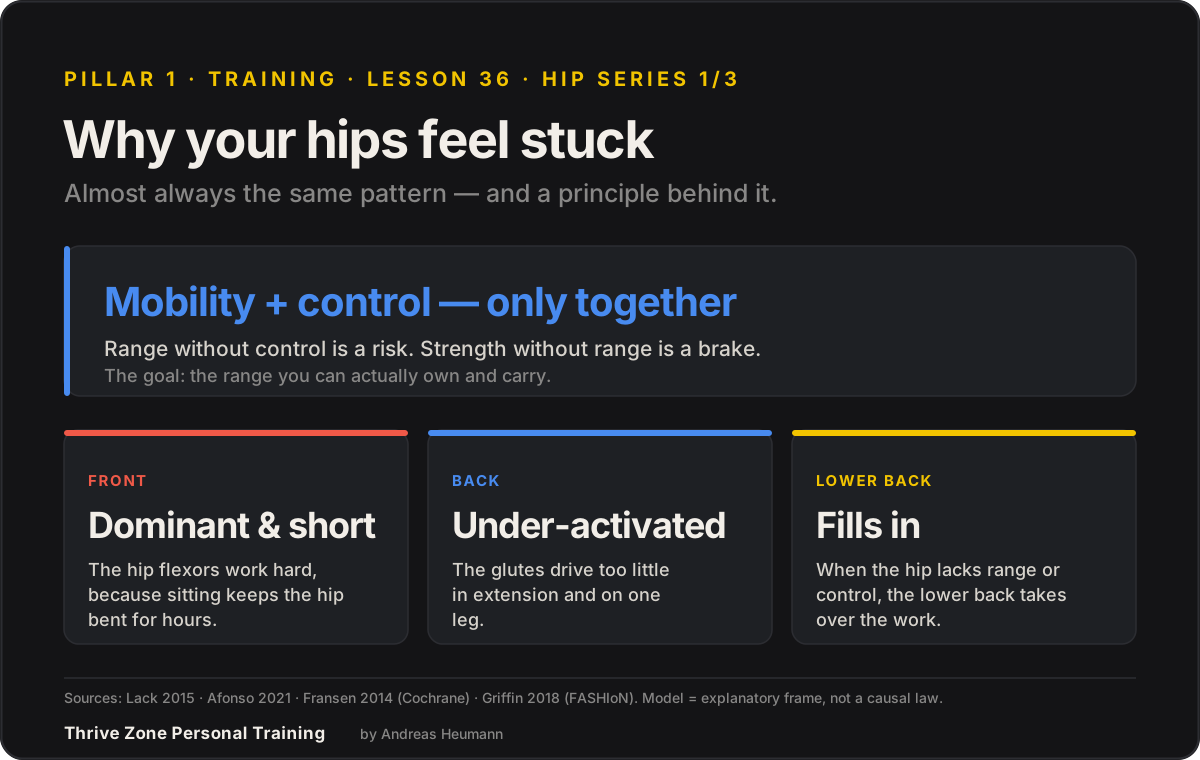
Your hip is the most powerful mover in your body — every step, every time you stand up, every lift runs through it. Unlike the shoulder, it's deeply and bonily secured; stability from the structure usually isn't the problem here. What it needs is something else: enough range, enough rotation, and enough glute activation. And that only works together. Range without control is a risk. Strength without range is a brake. So the goal isn't maximal mobility — it's a range you can actually control and load.
How the hip actually works
Like the shoulder, the hip is a ball-and-socket joint — but built the opposite way. The head of the thigh bone sits deep in a bony socket, wrapped by a rim of cartilage. Stability comes from its structure: the hip largely holds itself. The trade-off is that range has to be earned here — it isn't a given. Three things hold it all together:
- Front and back are opponents. In front, the hip flexor lifts the leg. Behind, the glutes extend and stabilize: the large glute as the strongest extensor, the smaller glute beneath it as a side-to-side stabilizer. Standing tall, walking, lifting — all of it needs the two in balance.
- The smaller glute keeps the pelvis level. Stand on one leg and it stops the pelvis from dropping to the other side. And every step is really a brief moment on one leg — so that side-to-side stability helps decide whether the knee tracks cleanly or caves inward.
- The hip hinge is the central pattern. The hinge: bending and extending at the hip while the spine stays long and stable. Bending down, lifting, standing up, deadlifting — move from the hip and you spare the lower back. Skip the pattern and the work shifts there instead.
That's where the key sits. If one part of this teamwork weakens or stops firing well, the work shifts onto the parts already doing too much — usually the front and the lower back. The result is a recurring pattern.
The pattern that keeps coming back
Dominant hip flexors. Sitting keeps the hip bent for hours; the front works a lot and rarely gets worked at full length. When you stand up it pulls, and extension feels sluggish. What people often conclude from this — that short hip flexors tip the pelvis forward and that causes back pain — needs a careful caveat: a forward-tipped pelvis is very common in the population and barely tracks with pain. The chain "shortening → tilt → pain" isn't established. In practice that means we don't chase a "wrong" pelvis position; we build activation, length and load capacity.
Weakly activated glutes. The glutes contribute too little to hip extension; the hamstrings and hip flexors take over. Side to side, the smaller glute is often under-active — the pelvis drops on one leg, the knee caves in. That's the trainable core of the pattern.
Limited rotation, and a lower back stepping in. Internal and external rotation of the hip are often asymmetric and limited. When the hip lacks range or activation, the lower back takes over the movement and the load — the most common compensation, and the reason "back issues" are so often decided at the hip.
That the hip has a say all the way down at the knee shows up in treatment: for pain at the front of the knee, strengthening the hip muscles improves pain and function on top of knee work alone. That supports the hip-first logic.
Lack S, et al. (2015). Proximal muscle rehabilitation is effective for patellofemoral pain: a systematic review with meta-analysis. Br J Sports Med 49(21):1365–1376. DOI: 10.1136/bjsports-2015-094723 · Systematic review with meta-analysis.
To sum up: busy and short in front, weakly recruited at the back, rotation limited, the lower back filling in. That lines up with the classic clinical picture (the "lower crossed pattern"). And to place it precisely: that's a useful explanatory model, not a proven causal law — and the case for the fix rests on something else anyway, as becomes clear next.
I'm speaking from my own experience here. I cycle a lot and I'm active in plenty of sports — and still, my glutes were poorly recruited for years, because for most of my life I compensated with my back and my quads: quad-dominant squats, heavy lifts driven more by the back than the glutes. The pattern that came with it: on long walks, my back would eventually start to hurt. People used to put that down to my height — I'm just under 1.91 m and grew fast — but for me the real reason was elsewhere: glutes that never properly developed and were poorly recruited. The turning point came about ten years ago, when I made glute bridges and hip thrusts the foundation of my training — since then the lower back no longer has to cover for weak recruitment, and my overall condition improved dramatically. It really isn't about more movement; it's about the right ratio — and about building blocks that normal strength and everyday training often miss.
Why straightening out your pelvis isn't the goal
Working on mobility has its place — but trying to force a "wrong" pelvis position into a "right" one leads you astray. What actually holds up is a hip that has activation and strength across its full range — one that can handle everyday life. And on that, the evidence is refreshingly clear.
Strength training through a full range of motion improves flexibility on par with stretching — while building strength at the same time (the programmes reviewed trained mostly with external load). Range and strength aren't opposites; trained right, they come together.
Afonso J, et al. (2021). Strength Training versus Stretching for Improving Range of Motion: A Systematic Review and Meta-Analysis. Healthcare 9(4):427. DOI: 10.3390/healthcare9040427 · Systematic review with meta-analysis.
The same holds for the common hip issues people come to me with. Training goes a long way here — it's the solid first path, and it makes the hip robust.
For hip osteoarthritis, regular exercise lowers pain and improves function (a small but well-supported effect). And for hip impingement syndrome, both a structured exercise program and surgery clearly improve hip-related quality of life — in the large head-to-head trial, surgery came out clearly ahead (past the threshold for a clinically meaningful difference), but exercise therapy still helped substantially. So here's how it settles: training is the solid first path; for a subset of cases, surgery remains an additional option.
Fransen M, et al. (2014). Exercise for osteoarthritis of the hip. Cochrane Database Syst Rev (4):CD007912. DOI: 10.1002/14651858.CD007912.pub2 · Systematic review. · Griffin DR, et al. (2018). Hip arthroscopy versus best conservative care for FAI (UK FASHIoN). The Lancet 391:2225–2235. DOI: 10.1016/S0140-6736(18)31202-9 · Randomised controlled trial.
One more word on a term that comes up a lot: "gluteal amnesia," the sleepy backside. As an image it's not bad. As a diagnosis it's too crude — a muscle doesn't just forget how to work. But if you sit a lot for years and rarely get into real hip extension, the glutes get recruited less clearly, and other structures take over. That's exactly what you can train — which is what the build is about.
First find out what's holding you back
This is where the ratio principle comes in. Before you start drilling exercises, a quick self-check pays off: is your hip more range-limited (it won't get into the range and rotation) or more control-limited (it gets into the range, but out of control — the pelvis drops, the back helps out)? The answer shifts the emphasis of your programme.
| Test | What you see | What it means |
|---|---|---|
| Stand on one leg, watch the pelvis in a mirror | the pelvis drops to the free-leg side, the knee caves in | more of an activation/stability gap |
| Hip hinge: push the hips back, spine long | the movement comes from the back, not the hip | learn to control the pattern cleanly first |
| On one leg, drive the other knee up, then fully extend the standing hip | extension feels sluggish, the front pulls | more of a range/length gap in front |
| Compare internal and external rotation of both hips (seated) | one side is clearly tighter | address the side difference directly |
A starting point that shows you where to focus. Needing both at once is completely normal — then you lean toward whatever is clearly tighter.
The through-line: don't straighten the pelvis, build function — activate the glutes, control the hip hinge, open up range and rotation and back them with strength. All in the balance of mobility and activation. The concrete exercises for that come in Parts 2 and 3.
Part 2 — Activate and lengthen: drive the glutes, actively lengthen the front, build the side-stabilizing glute (coming).
Part 3 — Hinge and single leg: the hip hinge under load, single leg and lateral work, rotation, and the load-ready hip (coming).
- Why Your Neck Tightens (Lesson 30) — the same ratio principle, one floor up at the shoulder.
- Mobility — what it actually is, and what you can do yourself (Lesson 01) — why mobility is a continuum with stability.
- Strength Training — the base that carries everything (Lesson 13) — why progressive load is the core of every adaptation.
Shown right isn't the same as done right
You can work through this whole series — the practical part is all here. But what I see in training again and again: I demonstrate a movement cleanly, explain it well — and it still doesn't land in the other person's body yet. With the hip especially, it's often the small things: do you actually feel the glute, or the lower back again? Does the pelvis stay still, or does it tip away? Does the movement come from the hip, or from the lumbar spine?
Sometimes that takes a person who can see directly what's happening and correct it in real time. In a world where almost everything runs through a screen, that's my deliberate counterpoint: workshop and personal training are often the most direct and human way to actually get this into your body.
To the workshopParts 2 and 3 land one after the other — the newsletter brings them to you.
Sources
Hip, knee & the pattern
Lack S, et al. (2015). Br J Sports Med 49(21):1365–1376. DOI: 10.1136/bjsports-2015-094723 — strengthening the hip muscles improves pain at the front of the knee (meta-analysis).
Training, mobility & treatment
Afonso J, et al. (2021). Healthcare 9(4):427. DOI: 10.3390/healthcare9040427 — strength training through a full range improves flexibility on par with stretching.
Fransen M, et al. (2014). Cochrane Database Syst Rev (4):CD007912. DOI: 10.1002/14651858.CD007912.pub2 — exercise lowers pain and improves function in hip osteoarthritis.
Griffin DR, et al. (2018). The Lancet 391:2225–2235 (UK FASHIoN). DOI: 10.1016/S0140-6736(18)31202-9 — for FAI syndrome both surgery and exercise therapy help; surgery a bit more, exercise clearly and substantially (RCT).
A note on placing this: the "lower crossed pattern," "gluteal amnesia," and anterior pelvic tilt as a cause of pain are explanatory models or observed associations, not proven causal laws. For persistent or severe pain, numbness, or loss of strength, see a doctor.