Flow — the state you can't force
There's a moment almost everyone knows but few can name: time disappears, effort stops feeling like effort, everything meshes. Flow can't be planned — but it can be provoked. And it has an entry ticket you have to earn.
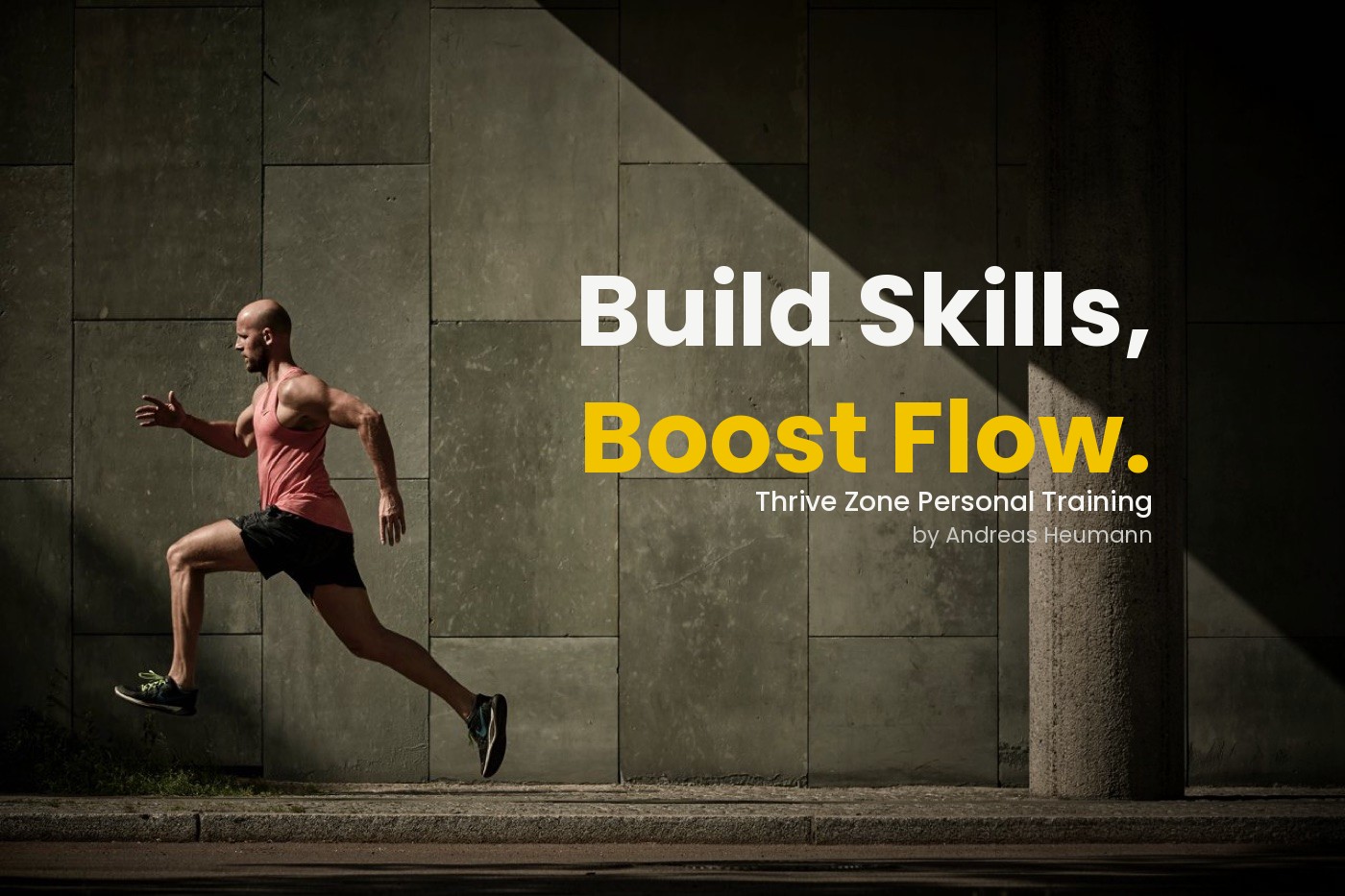
You climb, play an instrument, run, write, ride — and suddenly time disappears. Effort stops feeling like effort. You no longer think about the next move, you just make it. Everything meshes, and you're in it instead of in front of it.
This state has a name. The psychologist Mihály Csíkszentmihályi gave it one in 1975: flow.
Flow was one of my focus topics in my oral final exam — in sport psychology, where I chose positive psychology. Not because it was an academically tidy subject. But because I had experienced this state again and again myself and wanted to understand what actually happens.
Flow is the only one of the five pillars you don't directly do. It's the result. And it has an entry ticket you have to earn.
What flow is — and what it isn't
Csíkszentmihályi called flow the optimal experience: a state of complete absorption in an activity, in which action and awareness merge. You're so deep in what you're doing that nothing else has room — no self-observation, no clock, no worry about the result.
What matters is what flow is not. It isn't relaxation — there's too much concentration involved. It isn't motivation — motivation is what brings you to the activity, flow is what arises within it. And it isn't euphoria — the high often comes only afterwards. During flow itself it's calm, clear, effortless.
It's easiest to grasp through an image: flow arises wherever the demand forces your focus — and the whole thing still feels good.
Csíkszentmihályi coined the term "flow" in 1975 in Beyond Boredom and Anxiety and developed the concept in 1990 in Flow: The Psychology of Optimal Experience.
Csikszentmihalyi, M. (1975). Beyond Boredom and Anxiety: Experiencing Flow in Work and Play. San Francisco: Jossey-Bass. · Csikszentmihalyi, M. (1990). Flow: The Psychology of Optimal Experience. New York: Harper & Row. — foundational psychological work
The narrow channel — why flow doesn't come on command
Csíkszentmihályi also described when flow arises — and that's the most practical part of the whole theory.
Picture two axes: the height of the challenge and the height of your skill. If the task is far too hard for your level, the state tips into anxiety. If it's too easy, it tips into boredom and your attention wanders. Flow lies in the narrow channel exactly between them: where the challenge is just above your current skill — a stretch, not a leap.
That explains something that frustrates a lot of people: flow can't be planned. But it can be provoked — by setting up the conditions under which it becomes likely. The right difficulty. Clear goals. Fast feedback. Undivided attention.
You can't command flow. You can only build the space in which it shows up — and then step in.
The nine characteristics of the flow experience
Csíkszentmihályi's description was later made measurable for sport. Susan Jackson and Herbert Marsh developed the Flow State Scale in 1996 — a questionnaire that captures flow across nine dimensions. Three of them are preconditions, six describe the experience itself.
The three preconditions: challenge-skill balance (challenge and skill meet), clear goals (you know exactly what "done" means) and unambiguous feedback (you see right away whether it's working).
The six characteristics: action-awareness merging (you're not doing the thing, you are the thing), concentration on the task, loss of self-consciousness (the inner voice goes quiet), transformation of time, sense of control (control without having to control) and the autotelic experience (you do it for its own sake — the doing is the reward).
The nine dimensions come from Csíkszentmihályi; they were made measurable by Jackson & Marsh in the Flow State Scale (36 items, nine subscales).
Jackson, S. A. & Marsh, H. W. (1996). Development and Validation of a Scale to Measure Optimal Experience: The Flow State Scale. Journal of Sport and Exercise Psychology, 18(1):17–35. Original article · psychometric validation. Expanded: Jackson & Csikszentmihalyi (1999). Flow in Sports. Human Kinetics.
Three times I experienced exactly this
Theory is one half. The other is what it feels like when it happens. Three experiences have stayed with me.
The water that becomes a different substance
At university I was never one of the best swimmers. At the start I felt like a piano in the water — heavy, stiff, no feel for the element. I still passed the swimming exams with top marks, because I trained a lot and intensely.
One day, after about an hour of a hard session, a short break, then easy cool-down swimming — the whole perception tipped. Time ran differently. The water suddenly had a grip to it, as if I could really seize it and push it away. That lightness, as if I were simply pushing myself through the water. As if the water had taken on a different substance. The high afterwards lasted several days.
Action-awareness merging, transformation of time, an altered body perception in which effort and control coincide — three of the nine dimensions, in a single moment.
The opponent in slow motion
Escrima, a Filipino martial system, open sparring with boxing gloves. Music was playing. My sparring partner was exactly at my level — neither over- nor under-challenging. Challenge-skill balance in its purest form.
After about thirty minutes everything suddenly shifted. My opponent moved as if in slow motion. I could react to every action, completely relaxed while doing it — as if my speed had multiplied tenfold, or his had slowed tenfold. My field of vision widened, my whole perception shifted. It lasted around ten minutes.
The remarkable part: the state was visible from the outside. My opponent asked me afterwards what had been going on with me — I had suddenly become untouchable to him. This widening of the field of vision shows up in every flow experience I have — a kind of personal signature of the state.
Flow can be provoked — an example from the lawn
The third experience is my favourite, because here I didn't simply have flow — I actively brought it about.
My father — now around seventy — wins at table tennis. Always. Except once. And that one time I changed nothing about my technique, but everything about the conditions: we played barefoot on the lawn. I deliberately shifted my focus to my footwork and tried not to concentrate on the ball — to tune the whole thing out a little. As I did, I remembered the Escrima sparring, that shift in visual perception.
And it came back. I slipped into a relaxed flow state — and suddenly won the games regularly, which I otherwise never managed. I grew beyond my normal performance level. While it felt completely relaxed.
That's the practical core: change the environment (barefoot, lawn — new sensory input), shift attention away from the result onto the process (legs instead of ball), turn the inner observer down. Don't force flow — open the door for it.
By the way, the same happens to me snowboarding in deep powder: completely focused, and yet I ride things, with a relaxedness, that I'd otherwise never ride. Flow isn't tied to one discipline. It shows up wherever skill meets the right challenge.
Pick a task just above your skill. Set yourself a clear goal for this session. Switch off distractions and give yourself an uninterrupted block. And steer your attention onto the process, not the result. It's no guarantee — but it's the space in which flow arises.
More than a good workout: flow as peak experience
What distinguishes a moment like that from a simply good session? The quality of the experience itself.
The psychologist Abraham Maslow already described so-called peak experiences in 1964 — rare, intense moments that are self-sufficient and carry their value within themselves. Csíkszentmihály's flow has much of this, but proceeds more systematically and empirically: it describes not only the peak feeling but the conditions under which it arises. And flow is cumulative. Whoever has experienced it once wants more of it — because it opens an access to a deeper power of experience that you don't forget.
Maslow's "peak experience" is regarded as a precursor concept of flow. The connection is conceptual, not a measured finding.
Maslow, A. H. (1964). Religions, Values, and Peak-Experiences. Columbus: Ohio State University Press. — theoretical framework
Flow as resonance — and why that matters today
There's a bridge from these experiences to something larger. The sociologist Hartmut Rosa describes resonance as a successful relationship to the world — a responsive relationship in which something touches you and you answer back. Resonance with your own body, with the sports equipment, with the surroundings, with other people, for instance while dancing.
My thesis: flow states are resonance states. They give access to a depth of experience that goes beyond merely "being there" — a coming-into-connection with what you're doing right now. Almost everyone has felt this, and it's something deeply fundamental.
That's exactly why a look at the present is worthwhile. Resonance and flow both need something that's increasingly under pressure: built-up skill and undivided attention. The more technology takes off our hands, the fewer abilities we have to acquire ourselves — and without that foundation the door to flow stays shut. Add to that an attention that gets used to something new happening every ten seconds. Whoever constantly jumps between stimuli gives up the depth from which flow arises in the first place.
The good news: you can actively protect both. Build skills. Train focus — more on that in Lesson 14 — Where your attention goes and in the Resistance Principle, Lesson 09.
"Resonance" is a sociological concept by Hartmut Rosa — the counter-model to alienation. Rosa explicitly applies it to sport and art as well. Equating "flow = resonance" is my own linking of the two fields (psychology + sociology), not a statement by Rosa.
Rosa, H. (2016). Resonanz: Eine Soziologie der Weltbeziehung. Berlin: Suhrkamp. (EN: Resonance: A Sociology of Our Relationship to the World, Polity 2019). — theoretical framework / thesis
How the five pillars prepare the ground for flow
Flow is the fifth pillar of the ThriveZone Personal Training Framework — and at the same time not a pillar like the others. You don't train it directly. It arises when the other four stand.
Training builds the physical capacity that lets movements become automatic — the basis of any skill foundation. Nutrition delivers the energy and clear head without which concentration doesn't hold. Mindset steers attention and turns self-observation down. Healthy Habits give, through sleep, light and structure, the circadian base on which depth becomes possible in the first place.
And above it all stands a foundation without which none of it holds: health and a body you can trust. How many of those years you spend in full function is a topic of its own — read it in Lesson 05 — Healthspan.
Build Skills, Boost Flow
When I lay all these experiences side by side — swimming, Escrima, table tennis, snowboarding — they share a single condition. Each time it took a certain level of skill. Without command of my own body, without the technique, without the endurance to last even ten minutes in sparring, this state would never have been available to me. The same goes for musicians and artists who speak of flow: they have a skill level that opens the door in the first place.
That's the most important insight of this lesson — and the reason it's on my hoodie and on some of our team shirts: Build Skills, Boost Flow.
Flow is the reward for built-up skill, protected attention and a body you can trust. The way there leads through your abilities — step by step, no shortcut. And that's exactly what makes it special. You build your skills, and at some point the door opens.
And this is exactly where my work begins. With the ThriveZone Personal Training Framework I've made it my task to accompany you in building exactly this physical level — the key that opens the door to flow. For me that's the deeper purpose of training: not the visible results alone, but the ability to perceive the world differently, to gather more experience of the world and to change the depth of what you experience.
PS: Last year I started getting more serious about surfing. And I can tell you: I'm still a good way off the level where you experience flow in the wave. Right now I mostly get reliably washed through, and I'm already happy when I stand a few waves without scraping my skin on the reef. So I'm still building the skill from which those really good flow states in the waves will one day arise. It's like that everywhere: everything is a challenge — and the reward simply doesn't come right at the start. ;)
Where do you stand across your five pillars?
In the assessment we go through all five pillars together and find the one where the most can move for you right now — the lever that brings you closer to your flow states. I do this personally with you at the studio in Berlin-Mitte.
Request an assessment at the studioRather just read along first? A new lesson in your inbox every two weeks →
Sources
Csikszentmihalyi M (1975). Beyond Boredom and Anxiety: Experiencing Flow in Work and Play. San Francisco: Jossey-Bass. — first coining of the flow concept
Csikszentmihalyi M (1990). Flow: The Psychology of Optimal Experience. New York: Harper & Row. — foundational work, nine dimensions
Jackson SA, Marsh HW (1996). Development and Validation of a Scale to Measure Optimal Experience: The Flow State Scale. Journal of Sport and Exercise Psychology, 18(1):17–35. Original article — psychometric validation
Jackson SA, Csikszentmihalyi M (1999). Flow in Sports: The Keys to Optimal Experiences and Performances. Champaign, IL: Human Kinetics. — flow in the sport context
Maslow AH (1964). Religions, Values, and Peak-Experiences. Columbus: Ohio State University Press. — peak experience as precursor concept
Rosa H (2016). Resonanz: Eine Soziologie der Weltbeziehung. Berlin: Suhrkamp. (EN: Resonance, Polity 2019). — resonance as counter-concept to alienation