Cold Showers — my personal game changer
How, of all things, underfloor heating made me soft — and why a deliberate cold stimulus has brought me to 200% every morning for years. My story, the evidence, and how to start yourself.
When my son Leopold was born in 2016, we moved fairly quickly out of noisy Prenzlauer Berg to Niederschönhausen — to the kind of place where at night you hear a hedgehog rustling instead of traffic, and the fox greets you politely on your walk.
The new flat came not only with more nature and space, but with underfloor heating on both storeys. An unfamiliar comfort we duly indulged to the full. And as people so often do, we responded to the new technology with total overkill. It went so far that guests who weren't used to these sauna-like conditions regularly sat there in their underwear — and still found it too warm. Visiting kids: all completely sweaty. We ourselves wore shorts even in winter.
Not only would Greta Thunberg have burned the place down in fury had she known — it also had health consequences. Especially for me.
Stage 1 of going soft
It started small. On walks I needed winter gear as early as autumn, and the outside world felt cold as a rule. Visiting someone, I needed slippers, because my feet no longer warmed up on their own.
By the first winter after the move I regularly felt like I'd caught a chill — just from being out in the "normal" world. I started searching online for thermal trousers and was close to becoming a proper casualty.
Since that didn't match my self-image — and it was frankly embarrassing to walk around in two jackets next to people in a jumper — I switched my brain on for a few seconds. And something became clear to me:
You don't fight feeling cold with more coats.
As my karate coach would have bellowed across the hall back then, after two hours of non-stop kata: "The tough head for the garden, the soft head for the grave!" A call of reason that, thankfully, still echoes in me today.
Because what's the antagonist of feeling cold? Exactly: a deliberate cold stimulus that gives the body the direction to adapt in. Just as resistance in strength training carries the body from a weak state into a strong, lively one. It's the same pattern as in the lesson The Resistance Principle — only this time through the skin.
Cold isn't an end in itself and it isn't a contest. It's a deliberate way to give the body back a resistance that constant comfort has taken from it — in a dose you set yourself. Briefly unpleasant, lastingly stronger.
Cold showers as a hormetic stimulus — briefly explained
Here a principle comes into play: hormesis. It means a short, controlled stress stimulus makes the body stronger in the long run. Cold is exactly such a stimulus. The body gets the message "the environment is challenging — become more robust", and that's what happens. The dose matters: if the cold water gives a slight sting on the skin, you're in the right zone. Lukewarm water just feels unpleasant but doesn't trigger the adaptation we're after.
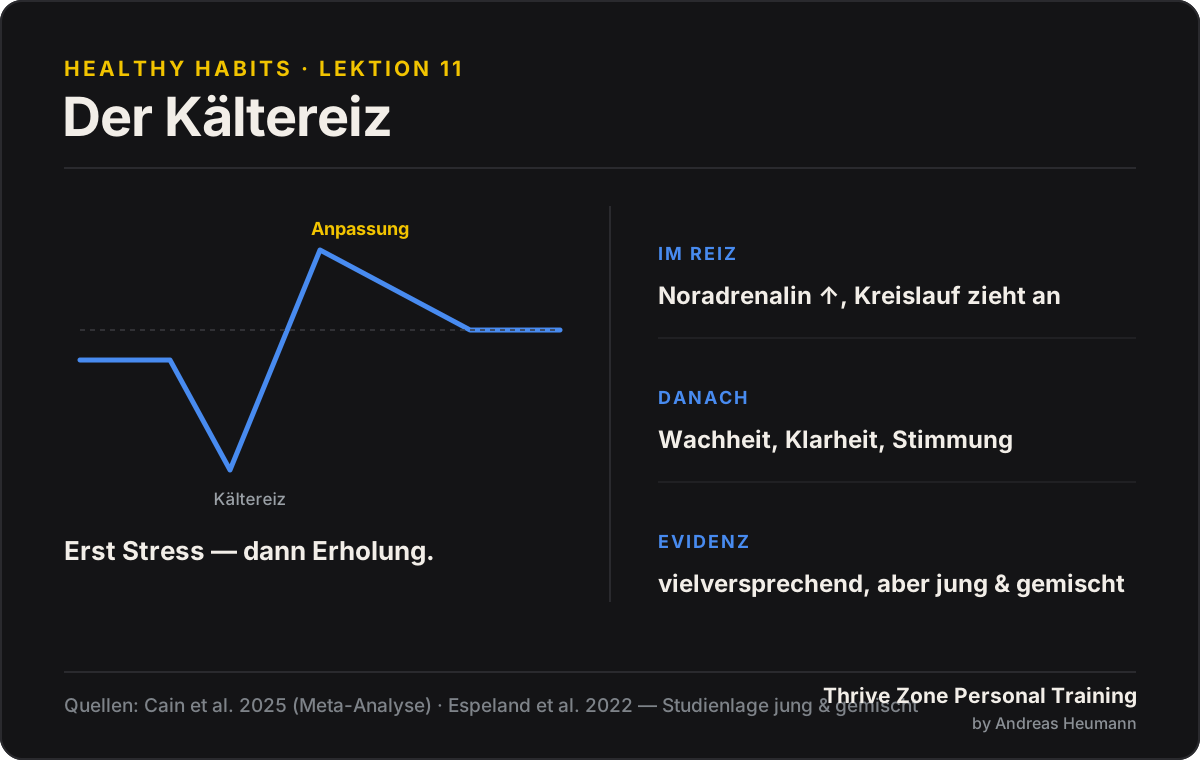
Physiologically, the moment cold water hits your skin a lot happens at once: blood vessels contract sharply, stress hormones shoot up, circulation fires. Stay calm and keep breathing, and once you step out the powerful counter-reaction follows — vessels widen, circulation rises, the body actively produces heat. And with it comes a wave of alertness and clarity.
That noticeable wake-up effect has a measurable driver: cold water makes the stress hormone noradrenaline rise sharply — in one study by around 500% during immersion in 14 °C water. Noradrenaline is the messenger behind alertness and focus. That's the physical reason for the "switch" you feel instantly.
Šrámek P et al. (2000). Human physiological responses to immersion into water of different temperatures. European Journal of Applied Physiology 81(5):436–442. DOI: 10.1007/s004210050065 · Small physiological study
My morning — a clean cut
That moment is, for me, not just a physical stimulus but a powerful starting shot into the day. Not because I'm tired — on the contrary, I'm usually well rested — but because the cold shower signals unmistakably to my nervous system: here we go. Focus. Presence. Active mode. It marks the transition from sleep into the day. A clean cut.
One thing I want to place properly, because it often gets muddled: your inner clock — the circadian rhythm that gives you the natural cortisol peak in the morning and tiredness in the evening — is set not by cold but by morning light. Cold delivers the acute wake-up call, light delivers the timing. Especially in winter, with little daylight, the two together are unbeatable — why, you'll read in In Sync with the Sun. For me the cold shower is the daily anchor that sets body and mind in sync to "awake and ready".
After a few weeks of experimenting, wrestling with myself and the usual excuse attempts ("today really isn't a good day for it …"), I landed on a routine I haven't changed to this day:
I get up with a purposeful look, go straight to the bathroom, and let the water run until it reaches street temperature. Then I start with the right arm, then the right leg, then the left arm, then the left leg. From there I work up to the hips and finally pour it — accompanied by an inner, sometimes audible, scream — over my torso and face. However awake or tired I was before: afterwards it's 200%.
And that scream isn't a cry for help. It isn't a whimper either. It's a powerful, life-affirming warning shout — to that seductive inner voice that wants to whisper to me almost every day that I don't really have to do this, that I could just skip it today …
Afterwards I quickly apply body lotion, with deliberate, sweeping strokes that mobilise the lymph and protect the skin from drying out. Then I sprint up the stairs, step onto the terrace and move intensely for two to three minutes, until the body feels properly warm within the next five to ten minutes.
That's what I do. Others get into an ice-covered lake or an ice barrel; others again shower warm and finish cold. All proven ways of telling the body's life-force systems the same thing: you are being challenged.
What the science supports
As convinced as I personally am: cold is often sold online as a miracle cure, and it isn't one. I'd rather give you the real state of it than a pretty promise. The serious evidence is promising but young and mixed.
A systematic review of voluntary cold-water exposure finds hints of favourable effects on circulation, immune function, inflammation, mood and recovery — but stresses in its very title that much is still a subject of debate: small samples, varying protocols, often cold-adapted participants.
Espeland D, de Weerd L, Mercer JB (2022). Health effects of voluntary exposure to cold water — a continuing subject of debate. Int. Journal of Circumpolar Health 81(1):2111789. DOI: 10.1080/22423982.2022.2111789 · Review (evidence mixed)
A meta-analysis across 11 studies (around 3,200 people) concludes that cold-water exposure can lower stress and improve sleep quality and quality of life — with some effects appearing only after a delay, and a database that keeps growing.
Cain T et al. (2025). Effects of cold-water immersion on health and wellbeing: a systematic review and meta-analysis. PLOS ONE 20(1):e0317615. DOI: 10.1371/journal.pone.0317615 · Systematic review + meta-analysis
The missing building block for my winters
I was rarely ill before either — nutrition, training and sleep, the foundations were long in place. My issue was a different one: the cold-sensitivity in winter I constantly struggled with. And this is exactly where the deliberate cold stimulus became the missing building block for me — one that, alongside the other pillars, made my protective shield, the sum of the habits that keep me healthy and robust, a notch stronger. Interestingly, the research points in a similar direction — and the most interesting piece is, of all things, a randomised trial, the more serious study type:
In a randomised controlled trial with 3,018 adults, participants finished their shower cold (30–90 seconds) for 30 days. Result: 29% fewer self-reported sickness absences from work compared with the control group. Worth saying: the number of illness days themselves did not drop significantly — people apparently felt more resilient and called in sick less often, but weren't measurably ill less often.
Buijze GA et al. (2016). The Effect of Cold Showering on Health and Work: A Randomized Controlled Trial. PLOS ONE 11(9):e0161749. DOI: 10.1371/journal.pone.0161749 · Randomised controlled trial
At the mechanism level, a small lab study (7 men) shows that acute cold briefly stimulates the immune system: more white blood cells, an increase in natural killer cells and a rise in interleukin-6. A hint at the direction — but a very small, acute study, not proof of lasting infection protection.
Brenner IKM et al. (1999). Immune changes in humans during cold exposure: effects of prior heating and exercise. Journal of Applied Physiology 87(2):699–710. DOI: 10.1152/jappl.1999.87.2.699 · Small mechanistic study (N=7)
Sleep and recovery
After the stimulus, as the body settles again, the nervous system switches from stress mode into recovery mode — the parasympathetic system takes over. That's what makes cold interesting for sleep and regeneration.
In trained swimmers, daily cold-water immersion was associated with greater parasympathetic activity (measured via heart rate variability) and better-rated sleep quality. This fits the meta-analysis above — the effects are real but moderate, and mostly studied after physical exertion.
Al Haddad H et al. (2012). Effect of daily cold water immersion on heart rate variability and subjective ratings of well-being in highly trained swimmers. Int. Journal of Sports Physiology and Performance 7(1):33–38. DOI: 10.1123/ijspp.7.1.33 · Small controlled study
My verdict as a sports scientist: the best-supported effect is on mood, alertness and stress — plus the mental training of voluntarily choosing discomfort. Immune benefits and better sleep are plausible and partly supported, but not set in stone. That's plenty for me: the effort is tiny, the risk small when dosed properly, the daily effect immediate.
One important exception: after strength training
On one point the research is even clearly nuanced: directly after strength training, an ice bath can actually slow muscle growth, because it dampens exactly the inflammatory signals that trigger the adaptation. So if your goal is muscle, don't put the cold right after your strength session — put it at another time, such as the morning.
Why the daily shower in particular changes so much
There's a reason it isn't the one epic ice bath but the daily cold shower that makes the difference — and it's as psychological as it is physical. Every time you voluntarily step into the cold, you give yourself a small piece of proof: "I'm someone who does hard things." In the sense of Atomic Habits (James Clear), each repetition is a vote for a new self-image — resilient, capable, not dependent on comfort.
Discomfort as growth: you don't grow despite the resistance, but because of it. The cold shower is the smallest, most reliable chance to practise that every morning — and each time you carry the feeling "I can get through discomfort" into the rest of your day.
That's the answer to the comfort trap from the start. My view as a sports scientist — and this is a stance, not a study finding: the modern world has optimised away almost all natural resistance, and a body without challenge sheds the unused ability. The deliberate cold stimulus brings that resistance back on purpose. It keeps you adaptable and free rather than sensitive and dependent.
How to start — gradually, by the resistance principle
The most common mistake is starting with too much. Better small and regular than once and heroic. That's exactly how I began:
- Stage 1 — ease in carefully. First the face for 30 seconds, then the arms, then the lower legs with cold water. The entry point anyone can manage.
- Stage 2 — the cold end of the shower. Shower as usual, then make the last 20–30 seconds as cold as your tap allows, and build up to 1–2 minutes over weeks. The cold doesn't get more extreme — your tolerance grows.
- Stage 3 — ice bath / cold plunge. If you want more: short immersions in cold water. Here quality beats duration — a few minutes is enough.
The most important thing at every stage: keep breathing calmly. The reflex screams "gasp for air" — you practise the opposite. Slowly through the nose, a long exhale. This is where the breathing lesson interlocks with cold: the breath is your anchor that turns the stress gear back towards calm.
How it fits a busy day
The beauty: cold needs no extra time in the calendar. It hangs onto something that happens daily anyway — your shower. Even if you only fit in two to four hours of training a week, here's a lever that costs thirty seconds a day.
- Morning anchor. The cold end of the shower as a fixed close to your morning routine — tied to something that happens every day anyway.
- Think seasonally. In winter even normal tap water is a decent stimulus; in summer you can make it deliberately colder. The season does half the dosing for you.
- Better than nothing. Full routine impossible today? Ten seconds count. The identity holds, the thread doesn't break.
A few clear rules
Cold is a genuine cardiovascular stimulus and not suitable for everyone without thought. With cardiovascular disease, high blood pressure, heart-rhythm disorders, during pregnancy or with other pre-existing conditions, clear it with your doctor first. Those with experience can judge for themselves — those without, feel free to ask me. And crucial for safety: the intense breathing cycles of the Wim Hof method (see the breathing lesson) belong never in or by the water — the combination of breath-holding and immersion can cause sudden loss of consciousness underwater. Always keep cold and such breathing techniques separate.
Beyond being a deeply life-affirming act for me, cold showering is one of the most powerful tools I know for reminding body and mind every day what they're actually capable of. A small, voluntary resistance — that leaves you a little more awake, calmer and freer each time.
New lessons every two weeks, straight to your inbox
This lesson belongs to the Healthy Habits pillar and builds on The Resistance Principle. Sign up and get every new lesson straight to your inbox.
Join the newsletterSources
Šrámek P et al. (2000). European Journal of Applied Physiology, 81(5):436–442. DOI: 10.1007/s004210050065 — small physiological study (noradrenaline rise)
Espeland D, de Weerd L, Mercer JB (2022). Int. Journal of Circumpolar Health, 81(1):2111789. DOI: 10.1080/22423982.2022.2111789 — review (evidence mixed)
Cain T et al. (2025). PLOS ONE, 20(1):e0317615. DOI: 10.1371/journal.pone.0317615 — systematic review + meta-analysis
Buijze GA et al. (2016). PLOS ONE, 11(9):e0161749. DOI: 10.1371/journal.pone.0161749 — randomised controlled trial (sickness absence −29%, illness days themselves not significant)
Brenner IKM et al. (1999). Journal of Applied Physiology, 87(2):699–710. DOI: 10.1152/jappl.1999.87.2.699 — small mechanistic study (N=7, acute immune response)
Al Haddad H et al. (2012). Int. Journal of Sports Physiology and Performance, 7(1):33–38. DOI: 10.1123/ijspp.7.1.33 — small controlled study (HRV/sleep)
Hormesis as the underlying principle: see The Resistance Principle (Mattson 2008). Acute cold response (vasoconstriction, heat production afterwards), thermal acclimatisation and the blunting of training adaptation by cold directly after strength training: established research, summarised here. The "comfort trap" and the growth paradox are marked as Andreas' interpretation, not a study finding. The inner clock (circadian rhythm) is set by light, not by cold — cold provides the acute wake-up stimulus. Identity/habit framing after Atomic Habits (James Clear, 2018).