The Day Decides, Not the Workout
One hour of training a day is powerful. But what happens in the other 23? That's where the biggest movement lever of your life sits — and you never have to set foot in a gym for it.
Picture two people, same height, same weight, same training plan. Both train three times a week for an hour. And yet one burns noticeably more energy across the day than the other — feels more awake, stays leaner, sleeps better. The difference isn't in the training. It's in everything that happens in between.
Training is the spark. Your day is the foundation. And the foundation is far bigger than most people think.
What NEAT is — and why it matters so much
NEAT stands for Non-Exercise Activity Thermogenesis — the energy you spend on everything that isn't sleeping, eating or exercise. So: walking, standing, climbing stairs, cooking, shopping, playing with the kids, even fidgeting. It sounds like small change. But that small change adds up across sixteen waking hours into a huge number.
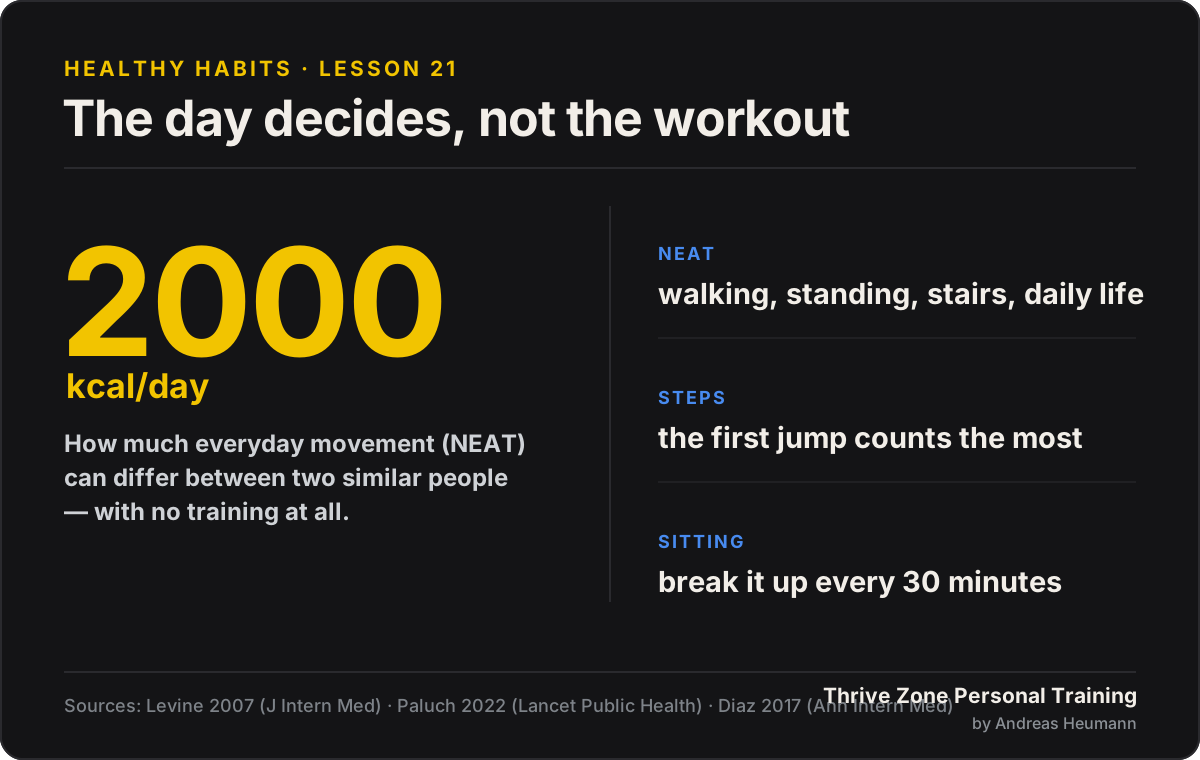
James Levine, the researcher who coined the term NEAT, puts it this way: between two similarly built people, energy expenditure from everyday movement can differ by up to around 2000 kilocalories per day — depending on occupation and lifestyle. For most people it isn't the training volume but this everyday share that explains most of the variation in activity energy expenditure.
Levine JA (2007). Nonexercise activity thermogenesis — liberating the life-force. Journal of Internal Medicine 262(3):273–287. DOI: 10.1111/j.1365-2796.2007.01842.x · Review (physiology)
2000 calories — that's more than a whole day's needs for many people, purely from the difference between an active and a sedentary day. No single workout closes that gap. But your day can.
The biggest lever isn't more discipline in the gym. It's more movement in the day you already live. NEAT can't be "powered through" — it gets built into the routes, breaks and small motions that happen anyway.
Steps: the simplest currency
You don't need to calculate NEAT. There's one number almost every phone already counts and that captures nearly all of it: your steps. They're the most accurate measure of how active your day really was — not how active you intended to be.
For a long time, 10,000 steps was treated as the gold standard. The number isn't a law of nature; it originally came from a 1960s Japanese marketing campaign. The research now paints a clearer — and more reassuring — picture.
A meta-analysis across 15 studies with nearly 50,000 people shows: more steps go hand in hand with a lower mortality risk — but the gain levels off above a certain threshold. For people aged 60 and over it sat at about 6,000–8,000 steps, for younger adults at around 8,000–10,000. The jump from very little to a moderate amount brought the biggest difference of all.
Paluch AE et al. (2022). Daily steps and all-cause mortality: a meta-analysis of 15 international cohorts. Lancet Public Health 7(3):e219–e228. DOI: 10.1016/S2468-2667(21)00302-9 · Meta-analysis of observational studies (association, not proof of cause)
The rule of thumb: the first jump counts the most. Going from 3,000 to 7,000 steps wins you far more than going from 9,000 to 12,000. You don't need to hit the perfect number — you just need to get moving.
An important caveat: these studies show an association, not proof of cause and effect. People who walk more are often healthier in other ways too. But the effect is so consistent across many countries and age groups that the direction is hard to doubt — and the measure itself costs nothing and does no harm.
Sitting is the quiet opponent
NEAT has a natural enemy, and it's a sneaky one precisely because it feels so harmless: long, uninterrupted sitting. Here a distinction is worth drawing, one I see constantly in practice.
Tiredness is a real state of exhaustion — body or mind need a break. Lethargy, by contrast, often arises the opposite way: from too little movement. Sit for hours on end and your system drops into an energy-saving mode. You don't get tired because you achieved something — you get tired because you moved too little. The remedy isn't coffee. It's movement.
A study of nearly 8,000 adults who had their sitting time measured by a motion sensor found: it's not only total sitting time that matters, but also how it's distributed. Those who kept their sitting bouts short — typically under 30 minutes at a stretch — had the lowest mortality risk. Long, uninterrupted sitting was less favourable than the same time taken in small portions.
Diaz KM et al. (2017). Patterns of Sedentary Behavior and Mortality in U.S. Middle-Aged and Older Adults. Annals of Internal Medicine 167(7):465–475. DOI: 10.7326/M17-0212 · Observational study (association, not proof of cause)
The practical translation could hardly be simpler: stand up briefly roughly every half hour. Fetch a glass of water, step to the window, take a lap of the room — two minutes is enough. You break the energy-saving mode before it sets in.
The commute: your biggest unused lever
If there's one place where most people give away movement every single day, it's the trip to work. For our ancestors, movement wasn't an item on a to-do list — it was built into every day, because without it there was nothing to eat. The active commute brings back a piece of that ancient pattern: on foot, by bike, or as a mix of public transport and a short walk.
In a large British cohort of over 260,000 commuters, cycling to work over five years was linked to a roughly 41% lower all-cause mortality (hazard ratio 0.59), as well as less cardiovascular disease and cancer. Walking to work also showed a benefit for cardiovascular disease.
Celis-Morales CA et al. (2017). Association between active commuting and incident cardiovascular disease, cancer, and mortality: prospective cohort study. BMJ 357:j1456. DOI: 10.1136/bmj.j1456 · Observational study (association, not proof of cause)
Here too: cycle commuters tend to be more health-conscious, which skews the picture somewhat. Still, the lever is real — and it has a double effect no single workout delivers like this: being outdoors in the morning also gives you the morning light that sets your body clock. Movement and a light dose in one go. Why that is so powerful, you'll read in the lesson In Sync with the Sun.
And if your route is too long: you don't have to cover the whole thing. Get off one stop early, park ten minutes away, take the bike two days a week. Every active kilometre counts — and quietly lands in your step tally.
Movement snacks — movement in small bites
Between waking and bedtime lie plenty of small opportunities that don't have to feel like training. I call them movement snacks: two to five minutes of movement, dropped in every one to two hours. They bring back circulation, posture and alertness — and they're "better than nothing" in its purest form.
- Muscle shake — briefly shake out all your muscles; releases tension and gets the circulation going
- Shoulder reset — standing arm circles, loosening shoulders and neck (perfect at the desk)
- Stairs instead of the lift — the most classic NEAT lever there is, available several times a day
- Freestyle dancing — a favourite song, door shut, go. Endorphins in three minutes
- Walk the talk — take phone calls on your feet, indoors or out
- Walk the meeting — short discussions as a walking meeting
- Standing as default — work at a standing desk, read on your feet, don't sit down while waiting
That short movement breaks work across the day fits the sitting research above: regularly interrupting long sitting bouts keeps energy and metabolism turning over better than sitting straight through. That moderate movement acutely boosts blood flow to the brain and alertness is established textbook physiology — so the noticeable "fresh" effect after a short lap is no placebo.
Reference: Diaz KM et al. (2017), Annals of Internal Medicine 167(7):465–475. DOI: 10.7326/M17-0212 · Observational study. Mechanism (acute blood flow/alertness): textbook physiology, presented without individual-study citations.
How to build it into your day
The beauty of NEAT: it needs no plan, no equipment, no changing of clothes. It needs just a few decisions you make once and then let run. Three are enough to start:
- Set an anchor. Pick one fixed movement that happens every day — the walk after breakfast, the round after dinner, the stairs to the office. A reliable anchor beats ten good intentions.
- Cap your sitting. Set a gentle reminder every 30–60 minutes. Stand up, move for two minutes, carry on.
- Make your routes active. One trip a day on foot or by bike instead of seated. If only part of it works — take that part.
And on busy days the same principle applies as to all healthy habits: consistency beats perfection. Three minutes of movement is infinitely more than zero — it keeps the habit alive until there's room for more again. How all these levers come together into a day is shown by the Daily Structure — the frame that carries the whole thing. And the fastest single lever waits right after your next meal: the 10-minute walk after eating.
New lessons every two weeks, straight to your inbox
The Healthy Habits pillar is growing: everyday movement, morning light, sleep, focus windows — the habits that carry everything else. One lesson after another, always with something you can put into practice today.
Join the newsletterSources
Levine JA (2007). Journal of Internal Medicine, 262(3):273–287. DOI: 10.1111/j.1365-2796.2007.01842.x — review (physiology)
Paluch AE et al. (2022). Lancet Public Health, 7(3):e219–e228. DOI: 10.1016/S2468-2667(21)00302-9 — meta-analysis of observational studies
Celis-Morales CA et al. (2017). BMJ, 357:j1456. DOI: 10.1136/bmj.j1456 — prospective observational study (UK Biobank)
Diaz KM et al. (2017). Annals of Internal Medicine, 167(7):465–475. DOI: 10.7326/M17-0212 — prospective observational study
Mechanisms (acute blood flow/alertness, energy-saving mode under prolonged sitting): established textbook physiology, presented without individual-study citations. Observational studies show associations, not proof of cause and effect.