Why Sleep Decides Everything
You train, you eat well, you work on your mindset. And then you spend a third of your life asleep — and that's where it all comes together. Why sleep is the invisible multiplier behind every other pillar.
Sleep series · Part 1
You're reading Why Sleep Decides Everything. Next: How Sleep Works, In Sync with the Sun — how your day builds your sleep, Good Sleep Starts Two Hours Before Bed and Food and Sleep.
People talk about sleep as if it were the time when nothing happens. It's the opposite. While you sleep, your body does the real work: it repairs itself, your brain sorts through the day, your hormones reset. Everything you work on during the day — training, nutrition, focus — gets built in while you sleep. Or it doesn't.
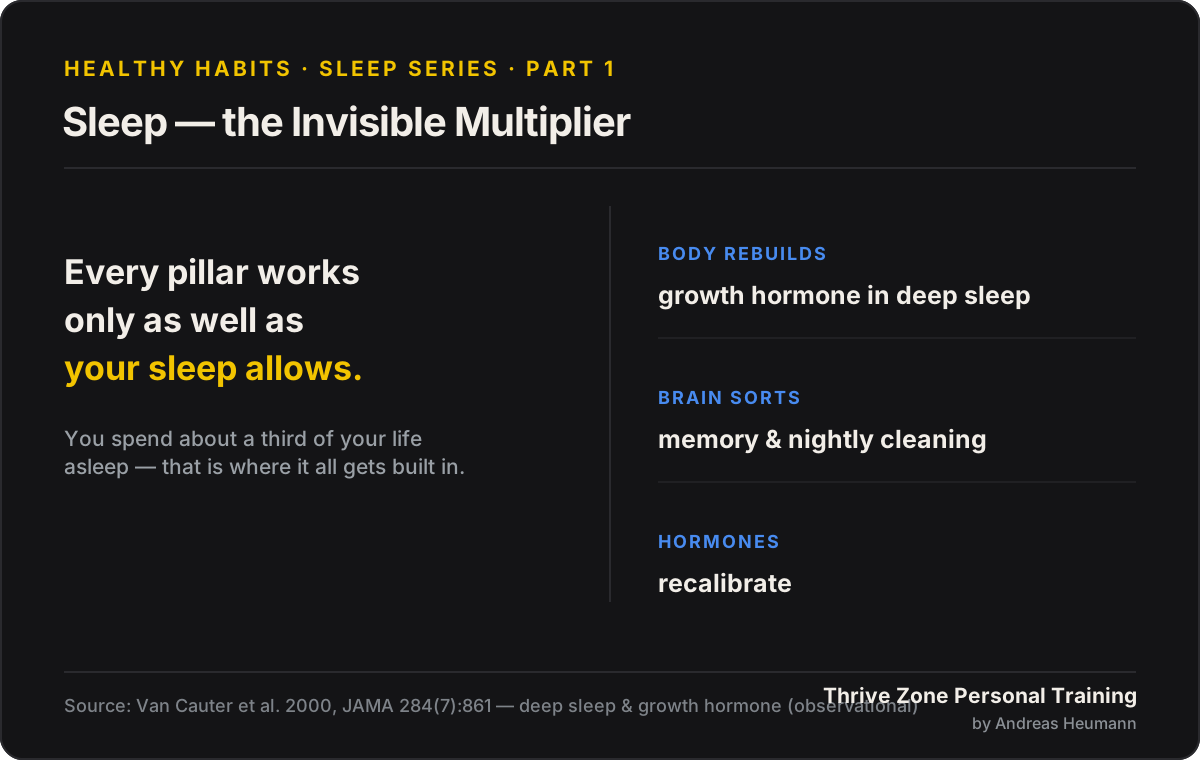
Sleep is the invisible multiplier. Every other pillar — training, nutrition, mindset — only works as well as your sleep carries it.
Let's look at what happens in those hours — and what the research says.
1. Your body rebuilds at night
You set the stimulus in training. The building happens afterwards — and it runs on hormones your body releases mostly at night. Two of them matter most for you, and both hang directly on your sleep.
Growth hormone — somatotropin, or HGH for short — is released in its biggest surge during the deep sleep of the first half of the night. It drives the repair of muscle and tissue — the rebuild your training set in motion. Sleep too little or too broken up, and you miss part of that window: the stimulus was there, but the build comes out smaller.
Growth hormone release is closely tied to deep sleep (slow-wave sleep) — as deep sleep declines over the years, nightly growth hormone production drops significantly too.
Van Cauter E et al. (2000). Age-Related Changes in Slow Wave Sleep and REM Sleep and Relationship With Growth Hormone and Cortisol Levels. JAMA 284(7):861–868. DOI: 10.1001/jama.284.7.861 · Observational study (healthy men) — shows an association
Testosterone — the body's main androgen, a steroid hormone — is the second big building block of the night. It reaches its high in the early morning, but it's built through the night: the overnight rise depends on sleep itself and only comes together over the first hours of sleep. Testosterone stands behind muscle building, recovery, drive and libido. Sleep too little for too long, and production drops. In men this link is especially well studied — but the basic mechanic holds for everyone: your body builds its hormones and its tissue at night.
How much this matters shows up in an experiment:
In ten healthy young men, one week of just five hours of sleep a night lowered daytime testosterone by 10 to 15 percent — an effect the researchers likened to aging 10 to 15 years.
Leproult R, Van Cauter E (2011). Effect of 1 Week of Sleep Restriction on Testosterone Levels in Young Healthy Men. JAMA 305(21):2173–2174. DOI: 10.1001/jama.2011.710 · Intervention study (small sample, n=10)
Or, as I tell my clients: "Sleep less, and you get worse across the board." Less testosterone means less strength, less drive, less desire. Put simply: less sleep = worse sex.
How much this affects the body shows up in sport, too: among adolescent athletes, chronically short sleep went hand in hand with a higher injury risk.
Adolescent athletes who slept on average less than eight hours were about 1.7 times more likely to be injured than those who slept eight hours or more.
Milewski MD et al. (2014). Chronic Lack of Sleep is Associated with Increased Sports Injuries in Adolescent Athletes. J Pediatr Orthop 34(2):129–133. DOI: 10.1097/BPO.0000000000000151 · Observational survey — shows an association, not a cause
2. Your brain sorts and stores
And sleep doesn't just build tissue — it also locks in memories. What you learn during the day is, at first, only loosely filed. Sleep turns it into solid knowledge: your brain replays what you experienced, links it up, and moves it into long-term memory. The technical term for this is memory consolidation. A night of solid sleep is therefore part of your training, your technique, your learning — not an afterthought.
Sleep both before and after learning is critical for memory formation — and different sleep stages consolidate different types of memory.
Stickgold R (2005). Sleep-dependent memory consolidation. Nature 437(7063):1272–1278. DOI: 10.1038/nature04286 · Review article
And the other way around, it hits first the functions you rely on most: attention, clear judgment, creative connection. Those are the first to slip when sleep runs short.
Sleep deprivation impairs a whole range of cognitive functions — alertness and attention, perception, learning and memory, and executive function (planning, deciding, impulse control).
Killgore WDS (2010). Effects of sleep deprivation on cognition. Progress in Brain Research 185:105–129. DOI: 10.1016/B978-0-444-53702-7.00007-5 · Review article
3. Your emotions — yours and other people's
At night, sleep also processes your emotions. With enough of it, you go into the day calmer, read social cues more clearly, get thrown off less easily. Without it, mood swings more, and small things weigh heavier.
In medical residents on duty, sleep loss amplified the negative impact of disruptive events — and at the same time dampened the positive effect of good moments. Sleep acts like a buffer for emotional reactivity.
Zohar D et al. (2005). The Effects of Sleep Loss on Medical Residents' Emotional Reactions to Work Events. Sleep 28(1):47–54. DOI: 10.1093/sleep/28.1.47 · Field study (observation via actigraphy)
But sleep doesn't just regulate your own feelings — it also keeps your read on other people's sharp. A big part of this emotional processing happens during REM sleep — the stage with the most vivid dreams. Short on sleep, you read faces less accurately: friendly and angry signals come across less clearly, and you're quicker to read something into a situation that isn't there.
After a sleepless night, participants recognized emotions in faces less accurately — especially friendly and angry expressions. After a night of sleep, the effect was gone again.
van der Helm E, Gujar N, Walker MP (2010). Sleep Deprivation Impairs the Accurate Recognition of Human Emotions. Sleep 33(3):335–342. DOI: 10.1093/sleep/33.3.335 · Experiment (sleep deprivation, n=37)
Or, put bluntly: "Lose the sleep, and first other people get weird. Then you get weird to them. And eventually everything is just weird."
4. Less sleep, more hunger
Hunger is, to a large degree, hormone control — and that hangs on sleep. Two messengers set the pace: leptin signals "full," ghrelin signals "hungry." Cut your sleep, and the balance shifts toward hunger — you want to eat more, even though your body doesn't need more energy.
Just two nights of short sleep, in a small controlled study, lowered the fullness hormone leptin by 18%, raised the hunger hormone ghrelin by 28%, and noticeably increased hunger and appetite — especially for calorie-dense, high-carb foods.
Spiegel K et al. (2004). Sleep Curtailment in Healthy Young Men Is Associated with Decreased Leptin Levels, Elevated Ghrelin Levels, and Increased Hunger and Appetite. Annals of Internal Medicine 141(11):846–850. DOI: 10.7326/0003-4819-141-11-200412070-00008 · Randomized crossover study (n=12) — intervention
Over the years, this shows up on the scale, too:
In a large population sample, short sleep was associated with lower leptin (fullness) and higher ghrelin (hunger) — and with higher body weight.
Taheri S et al. (2004). Short Sleep Duration Is Associated with Reduced Leptin, Elevated Ghrelin, and Increased Body Mass Index. PLoS Medicine 1(3):e62. DOI: 10.1371/journal.pmed.0010062 · Cross-sectional analysis (Wisconsin Sleep Cohort) — shows an association, not a cause
On top of that comes a second layer: when you're tired, impulse control works less well too. The craving grows — and a tired mind finds it harder to push back. Cravings after a short night aren't a question of character — they're biochemistry.
In short: more hunger, less brake. If you want to lose weight, the first place to look isn't the plate — it's your sleep.
5. Your heart keeps score
Over the years, sleep becomes a foundation of health. Large pooled analyses of long-term studies find an association between sleep duration and the risk of cardiovascular disease — with both too little and unusually long sleep faring worse than a middle amount. So it's not about maximizing sleep, but about reliably getting enough.
A pooled analysis of 15 long-term studies with nearly 475,000 people found a higher risk of coronary heart disease and stroke among short sleepers.
Cappuccio FP et al. (2011). Sleep duration predicts cardiovascular outcomes: a systematic review and meta-analysis. European Heart Journal 32(12):1484–1492. DOI: 10.1093/eurheartj/ehr007 · Meta-analysis of observational studies — shows an association, not a cause
This pays straight into your healthspan — the years you stay fit and mobile. Sleep is one of the pillars that help decide it. For how the five pillars work together, read the deep dive Healthspan: The Years That Truly Count.
And there's one more night shift that does its work entirely while you sleep: your brain's cleaning system. How that works — and what deep sleep, REM sleep and your internal clock have to do with it — is the subject of Part 2 of the series.
What nineteen years in the studio have taught me: sleep is the lever most people reach for last — and yet it decides the most about everything else. Two people, same training, same nutrition: the one who sleeps better usually gets there faster. So with me, sleep isn't a side note — it's part of the training. We look at it as closely as the squat or the protein on your plate.
Sleep isn't the time when nothing happens. It's the time when everything comes together. Before you fine-tune training or nutrition, it pays to start here — this lever works on everything else too.
New lessons in your inbox every two weeks
This lesson is Part 1 of the sleep series. In the next parts we look at how sleep works from the inside, how your day sets it — and how to build your evening so falling asleep comes more easily.
Get the newsletterSources
Van Cauter E et al. (2000). JAMA, 284(7):861–868. DOI: 10.1001/jama.284.7.861 — Observational study (healthy men)
Wittert G (2014). Asian Journal of Andrology, 16(2):262–265. DOI: 10.4103/1008-682X.122586 — Review article (testosterone & sleep)
Leproult R, Van Cauter E (2011). JAMA, 305(21):2173–2174. DOI: 10.1001/jama.2011.710 — Intervention study (sleep restriction & testosterone, n=10)
Milewski MD et al. (2014). J Pediatr Orthop, 34(2):129–133. DOI: 10.1097/BPO.0000000000000151 — Observational survey
Stickgold R (2005). Nature, 437(7063):1272–1278. DOI: 10.1038/nature04286 — Review article
Killgore WDS (2010). Progress in Brain Research, 185:105–129. DOI: 10.1016/B978-0-444-53702-7.00007-5 — Review article
Zohar D et al. (2005). Sleep, 28(1):47–54. DOI: 10.1093/sleep/28.1.47 — Field study (actigraphy)
van der Helm E, Gujar N, Walker MP (2010). Sleep, 33(3):335–342. DOI: 10.1093/sleep/33.3.335 — Experiment (sleep deprivation & recognition of facial emotion)
Spiegel K et al. (2004). Annals of Internal Medicine, 141(11):846–850. DOI: 10.7326/0003-4819-141-11-200412070-00008 — Randomized crossover study (sleep & appetite hormones, n=12)
Taheri S et al. (2004). PLoS Medicine, 1(3):e62. DOI: 10.1371/journal.pmed.0010062 — Cross-sectional analysis (Wisconsin Sleep Cohort)
Cappuccio FP et al. (2011). European Heart Journal, 32(12):1484–1492. DOI: 10.1093/eurheartj/ehr007 — Meta-analysis of observational studies
A note on interpretation: most of these are observational studies. They show an association between sleep and the outcome in question — not proof of cause and effect. The direction of the findings is, however, consistent across many studies.