Food and Sleep — what's on your plate decides your night
You've got your light, your day and your evening handled. One lever is left, often overlooked: your plate. Your body builds sleep partly from what you eat and drink — and the best part is how simple the rules are.
Sleep series · Part 5
You're reading Food and Sleep. The series before: Why Sleep Decides Everything · How Sleep Works · In Sync with the Sun · Good sleep starts two hours before bed.
Few things are promised online as loudly as "sleep foods": a glass of this juice, a handful of that nut, and you'll sleep like a stone. The truth is less spectacular — and more useful to you. There's no miracle food, but there are clear patterns by which your eating either carries your sleep or sabotages it. Those are what we'll look at.
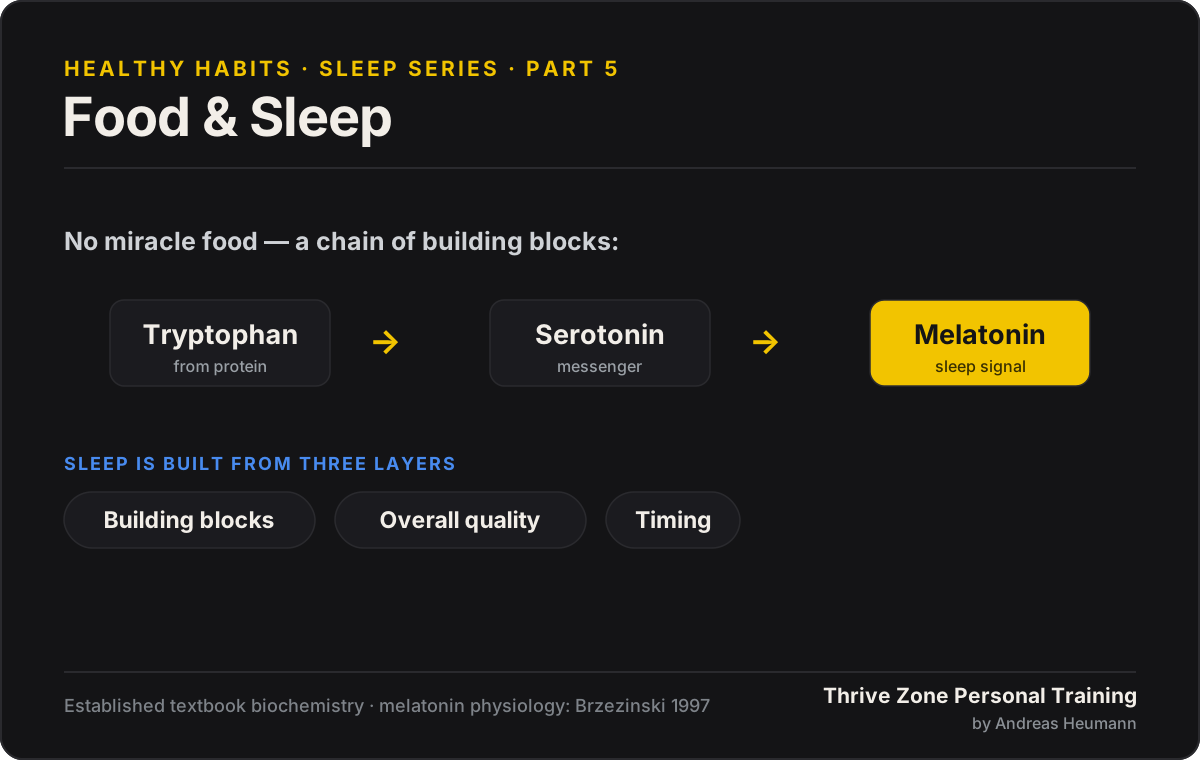
Sleep doesn't come from a single food but from three levels: the building blocks your body uses to make sleep hormones, the overall quality of your diet — and timing.
1. Your body builds sleep from building blocks
Remember melatonin from Part 2 — the hormone that signals "night is coming"? Your body doesn't make it from nothing. At the start of the chain stands an amino acid from your food: tryptophan. From it the body first builds serotonin (the "good-mood messenger") and from that, in the evening, melatonin. Tryptophan sits in entirely everyday protein sources — poultry, eggs, dairy, fish, nuts, legumes, oats.
The pathway tryptophan → serotonin → melatonin is established textbook biochemistry. Importantly: a single food won't measurably raise your melatonin — it's about a reliable supply of the building blocks across the day, not a "dose" in the evening.
Melatonin physiology: Brzezinski A (1997). Melatonin in Humans. New England Journal of Medicine 336(3):186–195. DOI: 10.1056/NEJM199701163360306 · Review article; tryptophan pathway marked as established textbook knowledge
That's exactly why thinking in single "sleep foods" works so badly: your body needs the building blocks reliably — not one hero on the plate, but a good team.
2. Overall quality beats any single food
By far the strongest dietary lever for your sleep isn't a food but the pattern of your diet. And here the research gets pleasingly concrete.
In a controlled feeding study, more fibre went with more deep sleep, while more saturated fat went with less deep sleep. A higher share of sugar and fast carbohydrates was linked to more nighttime awakenings.
St-Onge MP et al. (2016). Fiber and Saturated Fat Are Associated with Sleep Arousals and Slow Wave Sleep. J Clin Sleep Med 12(1):19–24. DOI: 10.5664/jcsm.5384 · Small controlled study (n=26) — shows an association
The same picture emerges when you look at whole dietary patterns. The Mediterranean way of eating — plenty of vegetables, fruit, legumes, olive oil, fish, little heavily processed food — consistently does well for sleep.
Among nearly 2,000 Italian adults, closer adherence to the Mediterranean diet went with better sleep quality. A large systematic review from 2025 confirms this association across many studies.
Godos J et al. (2019). Adherence to the Mediterranean Diet Is Associated with Better Sleep Quality in Italian Adults. Nutrients 11(5):976. DOI: 10.3390/nu11050976 · Cross-sectional study (observational) — shows an association, not cause · 2025 review: Sleep Medicine Reviews (PubMed 40081182)
An important note: these are mostly observational data — they show an association, not proof that diet causes the sleep. But the direction is consistent across many studies, and it fits the mechanism from section 1. The practical message is pleasingly uncomplicated: eat in a way that's good for your body overall — plenty of vegetables, fibre and good protein sources, little sugar and heavily processed food — and your sleep benefits too.
3. Tart cherry and kiwi — what's really there
That leaves the stars of the sleep guides. Do they deserve their reputation? Partly — if you set your expectations right.
Tart cherry: in small studies, tart cherry juice (Montmorency) slightly raised melatonin levels and improved sleep duration and efficiency; in a pilot study with older people with insomnia, sleep time rose by an average of about 84 minutes. The studies are small, however, and larger ones are mixed.
Howatson G et al. (2012). European Journal of Nutrition 51(8):909–916. DOI: 10.1007/s00394-011-0263-7 (RCT, n=20) · Losso JN et al. (2018). American Journal of Therapeutics 25(2):e194–e201. DOI: 10.1097/MJT.0000000000000584 (pilot, n=8) — small studies, evidence preliminary
Kiwi: in a small, uncontrolled study, adults with sleep problems fell asleep faster and slept through better after four weeks of eating two kiwis before bed. Without a control group, though, a placebo effect can't be ruled out.
Lin HH et al. (2011). Effect of kiwifruit consumption on sleep quality in adults with sleep problems. Asia Pac J Clin Nutr 20(2):169–174. · Small study without control group (n=24) — a hint, not proof
The clear verdict: tart cherry and kiwi are harmless and worth a try — as a nice extra, not a sleeping pill. Expect miracles and you'll be disappointed. Fold them into an already good diet and you lose nothing. The big lever stays section 2.
4. Timing and the sleep thieves
It's not only what you eat that counts, but when — and what you'd better leave alone in the evening.
The last big meal doesn't belong at bedtime. When your digestive system is running at full tilt while your body wants to power down, two programmes work against each other. A rule of thumb that holds up: the last heavy meal about two to three hours before sleep. But no one has to endure real hunger — a small, light snack is fine.
The two big sleep thieves you already know from the day part: caffeine still acts hours later (which is why the last coffee belongs in the first half of the day), and alcohol does let you fall asleep faster but wrecks the second half of the night and the REM phases. Both in detail in In Sync with the Sun. Plus a quieter third: too much fluid right before bed pulls you back out of sleep at night — drink enough across the day and ease off late in the evening.
5. And supplements?
"Which pill helps me sleep?" is usually the wrong first question — the right one is: is the foundation in place, of light, daily structure, evening routine and a good diet? If so, individual supplements can be a sensible extra. Which ones really are, from a Thrive Zone view — and which you can skip — is laid out clearly and in one place in the Supplement Compass under the "Sleep" theme (including magnesium bisglycinate, glycine, L-theanine). The same order applies as everywhere: food first, then supplement.
If you take one thing away: there's no sleep food, but there is a sleep diet. Eat well across the day — plenty of vegetables and fibre, good protein, little sugar — keep the last heavy meal away from bed, and the rest comes more easily.
And with that the sleep series closes: you now know why sleep carries everything, how it works, how your day and your evening set it — and how your plate plays its part. No single lever decides it — it's the interplay, brought into your everyday life piece by piece.
New lessons every two weeks, straight to your inbox
That was Part 5 of the Sleep series. Sign up and you'll get each new lesson straight to your inbox — always with something you can put into practice today.
Join the newsletterSources
St-Onge MP et al. (2016). J Clin Sleep Med, 12(1):19–24. DOI: 10.5664/jcsm.5384 — small controlled study (diet quality & sleep architecture)
Godos J et al. (2019). Nutrients, 11(5):976. DOI: 10.3390/nu11050976 — cross-sectional study (Mediterranean diet & sleep)
Sleep and the Mediterranean diet — systematic review & meta-analysis (2025). PubMed 40081182 — review (observational studies)
Howatson G et al. (2012). European Journal of Nutrition, 51(8):909–916. DOI: 10.1007/s00394-011-0263-7 — RCT (tart cherry & melatonin, n=20)
Losso JN et al. (2018). American Journal of Therapeutics, 25(2):e194–e201. DOI: 10.1097/MJT.0000000000000584 — pilot study (tart cherry & insomnia, n=8)
Lin HH et al. (2011). Asia Pac J Clin Nutr, 20(2):169–174. — small study without control group (kiwi & sleep, n=24)
Brzezinski A (1997). New England Journal of Medicine, 336(3):186–195. DOI: 10.1056/NEJM199701163360306 — review article (melatonin)
The tryptophan→serotonin→melatonin pathway and the meal-timing rule of thumb (2–3 h before sleep): established textbook knowledge and rules of thumb — labelled as such, no individual-study citations.
A note on interpretation: nutrition-and-sleep research rests heavily on observational studies (association, not proof) and partly on small studies. The statements on tart cherry and kiwi are explicitly preliminary. What's consistent across studies is above all the pattern: a good overall diet → better sleep.


