Learn to pull
Part 2 was about centring and opening. Now comes the last piece of the physical work: pulling done right. The shoulder blade leads first — and at the end you have a shoulder that's strong overhead too.
Pulling — pull movements, in training terms — is the direct counter to a push-heavy day and a push-heavy training habit. But pulling isn't automatic: pull without leading from the shoulder blade, and you train the old pattern with more load. So there's a clear order — and a goal that goes beyond "corrective."
The terms — so we're talking about the same thing
In training, movements are sorted by direction. That's not hair-splitting: the ratio between those directions is what builds the pattern from part 1 — or dissolves it.
- Pull movement: you draw a resistance towards you. Its counterpart is the push movement: you drive it away from you.
- Vertical pull: from above down to you — lat pulldown, chin-up. Vertical push: from you upwards — overhead press.
- Horizontal pull: from in front towards you — rowing in all its variations. Horizontal push: from you forwards — bench press, push-up.
- Why it matters: daily life and most training programmes are push-heavy — typing, reaching, steering wheel, bench press. The pull directions barely show up. A pull-to-push ratio of at least 1:1 is the baseline; with neck tightness and shoulders pulled forward, pull can outweigh push.
- Scapula is the shoulder blade. Its movements that come up here: depression — the shoulder blade pulls down, away from the ears. Upward rotation — the shoulder blade turns with the arm as it goes up, its lower tip swinging outwards. Retraction — the shoulder blades draw together towards the spine.
- Lat pulldown: a seated cable pull from above — the chin-up with adjustable weight.
- Landmine: a barbell with one end anchored on the floor. You press the free end up at an angle — the guided way into overhead pressing.
- Corrective: an exercise that fixes a movement pattern rather than building strength first. Submaximal means well below your maximum, so every rep stays clean.
The shoulder blade leads, then the arm pulls. First the clean scapular action — depression and upward rotation — then load is added. And the goal isn't endless corrective drilling but a shoulder that's strong overhead. Corrective is the ramp. Strength is the destination.
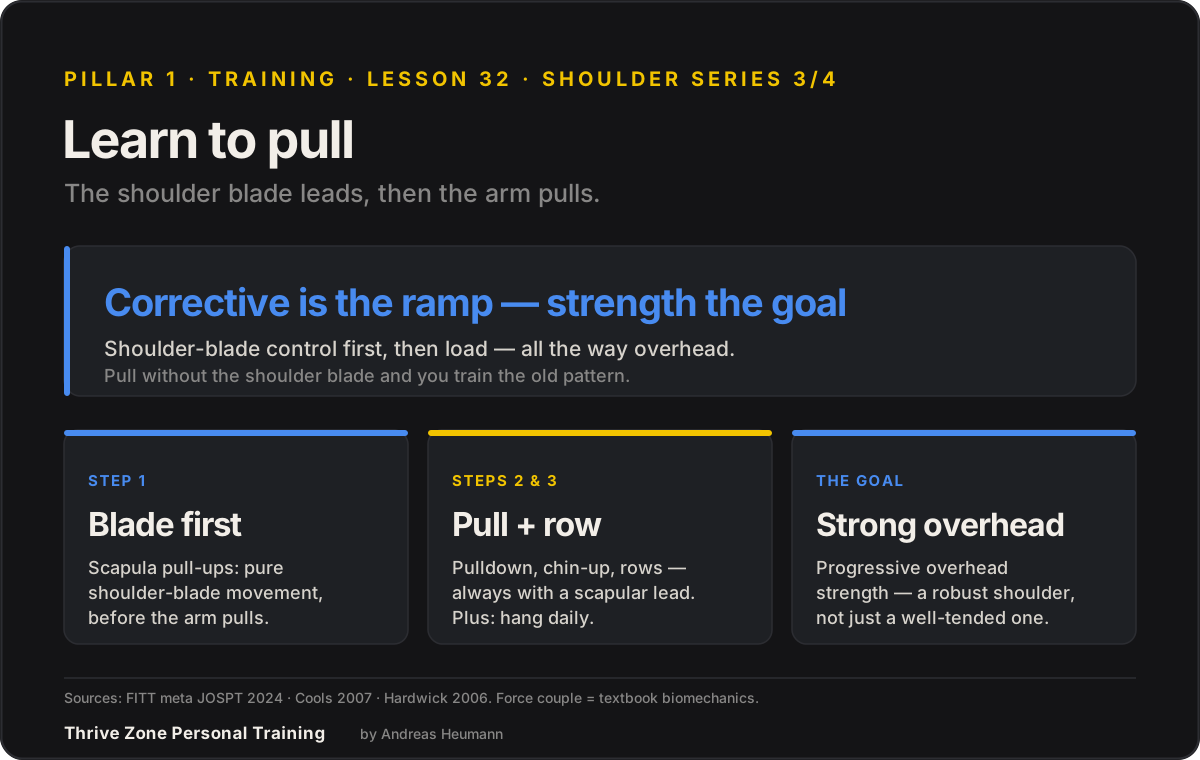
The pulling progression — shoulder blade first
This order is biomechanically sound: it builds shoulder-blade control before load comes into play.
- Scapula pull-ups / scapular lat pulldowns (assisted or on the machine). Pure shoulder-blade movement with no arm bend: the body hangs, and only the shoulder blades pull down. Serratus and trapezius learn depression and upward rotation in isolation. If that isn't there, nothing above it is either.
- Lat pulldown and chin-up with correct scapular action. Only once step 1 is solid: the shoulder blade leads into the movement, then the arm pulls. That turns the vertical pull into an exercise for the shoulder, not against it.
- Horizontal rowing (horizontal pull) — seated with both arms, single-arm with a dumbbell — with a deliberate shoulder-blade movement. Back thickness, retraction, control — the direct counter to horizontal pushing.
- The daily hang. Hanging from a bar decompresses the shoulder, builds grip and stability — and it's the gateway to the chin-up progression.
For pulling to pay off, it has to carry resistance and be progressed: progressive resistance training measurably improves shoulder function and pain, whereas unloaded, non-progressed exercise barely does. So the staircase isn't a permanent state — it leads to real load.
The Efficacy of Exercise Therapy for Rotator Cuff–Related Shoulder Pain According to the FITT Principle: A Systematic Review With Meta-analyses (2024). J Orthop Sports Phys Ther. DOI: 10.2519/jospt.2024.12453 · Systematic review with meta-analyses.
The shoulder-blade-first logic is the practical use of the force couple from Part 1: upper trapezius, lower trapezius and serratus rotate the shoulder blade up together. Train that in isolation before load arrives, and later, under the pull, the whole chain works together — instead of the upper trapezius taking over again.
From corrective to strength
This is where the ThriveZone approach parts ways with pure rehab thinking. For anyone who has range and control, the real goal is a shoulder that carries strength overhead too — not endless little band drills.
So a progressive overhead pressing progression belongs in the mix — starting with a clean landmine or dumbbell variation where the shoulder works in a guided path, up to a true overhead press for those ready for it. That's the principle carried through: what you've centred and controlled, you now make load-bearing. A shoulder that presses cleanly and strongly overhead is a robust shoulder — not just a well-maintained one.
The path in one line: isolate shoulder-blade control, then build it into pulling, then load it progressively — all the way to a strong shoulder overhead. The balance of mobility and stability stays the guardrail: as long as range or control is missing, the early steps come before heavy load.
Frequency — and the bridge to daily life
The cuff and shoulder-blade control tolerate and need frequent, submaximal repetition. The daily hang and a few activations cost minutes and are the best safeguard against slipping back into the old pattern.
And here's the real limit of training: it can offset a lot — but if you then spend twelve hours sitting in the same position, you're working against yourself. What you can change about your day so the training actually pays off is the subject of Part 4.
Part 2 — Centre and open: the cuff, the front, shoulder-blade control.
Part 3 — Learn to pull (this piece): the pulling progression to a strong shoulder overhead.
Part 4 — Defuse your day: what actually helps against a sedentary, tech-driven day (coming soon).
- Centre and open (Lesson 31) — the building blocks pulling builds on.
- Strength Training — the base that carries everything (Lesson 13) — why progressive loading is the core of every adaptation.
Shown right isn't the same as done right
You can build the pulling staircase for yourself here. But here's what I see in training again and again: I demonstrate a movement cleanly and explain it well, and in that same moment it still isn't right in the other person's body. In the shift from scapular action to real load especially, direct feedback decides whether you pull cleanly or slide back into the old pattern. That takes a real person correcting you in the moment and reading your situation.
In a world where almost everything runs through a screen, that's my deliberate counterpoint: the workshop and personal training are the safest, fastest and most human way to actually get this into your body.
See the workshopPart 4 is coming shortly — the newsletter keeps you posted.
Sources
The Efficacy of Exercise Therapy for Rotator Cuff–Related Shoulder Pain According to the FITT Principle (2024). J Orthop Sports Phys Ther. DOI: 10.2519/jospt.2024.12453 — progressive resistance training works; non-progressive barely does.
Cools AM, et al. (2007). Am J Sports Med 35(10):1744–1751. DOI: 10.1177/0363546507303560 — scapular balance: exercises with a favourable trapezius ratio (EMG).
Hardwick DH, et al. (2006). J Orthop Sports Phys Ther 36(12):903–910. DOI: 10.2519/jospt.2006.2306 — serratus activation, the basis of upward rotation (EMG).
A note on interpretation: the force couple of scapular upward rotation is textbook biomechanics. The "shoulder blade first" order is common, well-grounded training practice. With persistent or severe symptoms, see a doctor.