Your minimal stack
Half the internet is selling you supplement hype. This is the opposite: pick your topic, and the compass shows you what actually matters for you — minimal, evidence-based, and with the clear "you don't need this" right alongside.
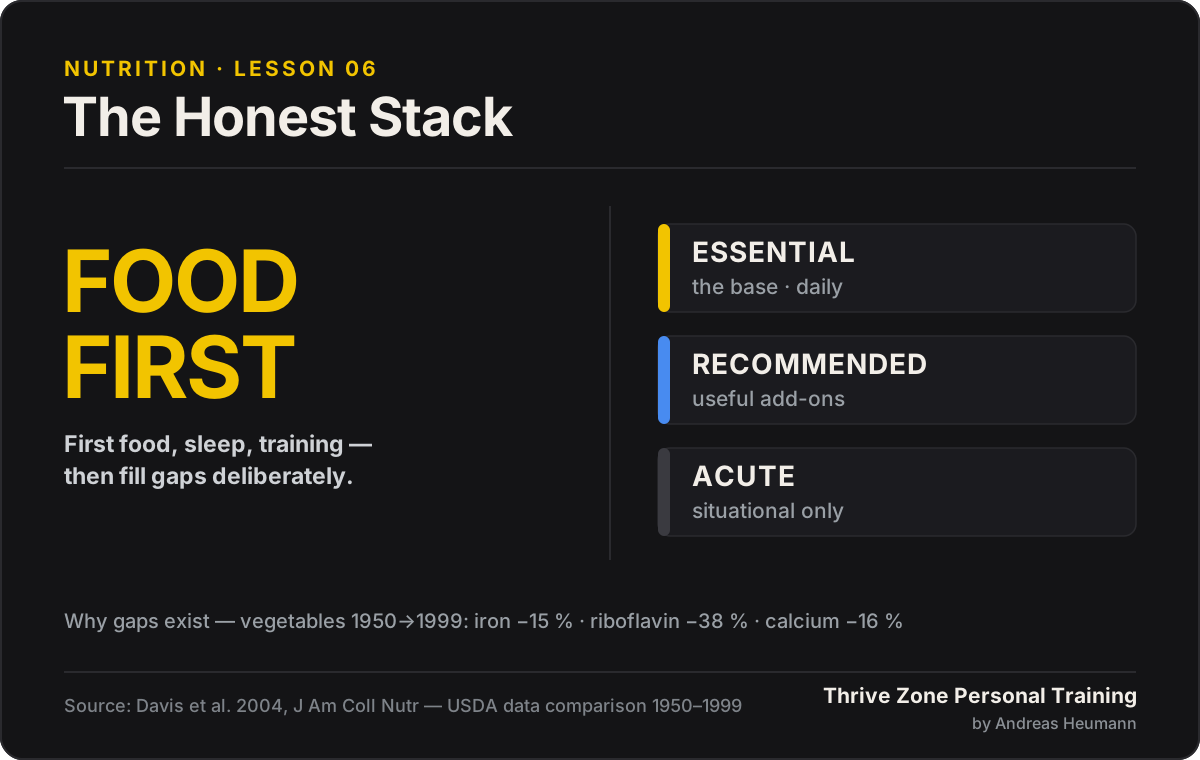
Food first — always. Before you swallow anything, the rule is: optimize your normal diet first. Supplements don't replace good food, sleep, or training. They have one clear job — to fill, in a targeted way, the gaps that genuinely open up in modern everyday life. On that foundation, we add only what gives you a real lever.
Why these gaps exist in the first place. Heavily processed and refined foods lose a large share of their micronutrients on the way into the package. And even fresh vegetables are often less nutrient-rich today than they used to be: modern high-yield varieties grow faster than they can store nutrients — the so-called dilution effect. A farmer put it perfectly to me at a wedding recently: "Our grains are high-performance plants that grow out of fertilizer — there's barely anything left in the soil." That's the blunt farmer's version — the science says the same thing, just a little more soberly.
Davis et al. (2004) compared USDA nutrient data for 43 vegetables in 1950 vs. 1999 and found measurable declines — among them calcium −16%, iron −15%, riboflavin −38%, protein −6% (median). Best explained by yield-optimized varieties (dilution effect), not by "empty soil". DOI: 10.1080/07315724.2004.10719409 · Observation (data comparison)
Every supplement takes one slice of reality and amplifies it. That's its strength — and its risk: if you pull a single nutrient up in isolation, you can create a new imbalance. Too much zinc, for example, pushes copper down, and vice versa. Real food delivers nutrients in a balanced ratio and with all their accompanying compounds. So: food first, fill gaps in a targeted way, think about interactions, and test when in doubt.
How the compass works: Pick one or two topics that apply to you right now. You'll get your stack — sorted into ESSENTIAL (the base, daily), RECOMMENDED (sensible add-ons) and ACUTE (only situational). For each supplement I'll also show you which foods naturally contain the most of it — and which ThriveZone dish covers it.
Multiple selection possible — combine e.g. "Sleep better" + "Immune system", and your stack assembles automatically.
Your stack
The badge shows how strongly I generally recommend a supplement: Tier 1 for almost everyone · Tier 2 sensible after a test · Tier 3 niche · Acute only situational · Special optional experiment.
The ThriveZone product standards
Not every product on the shelf is equal. What Andreas recommends runs against a fixed standard — so you don't pay for healthwashing, but for what actually works:
Organic
Where available and sensible: no pesticide residue risk, often better micronutrient profiles.
No magnesium stearate
A cheap separating agent. Good brands consistently leave it out.
No artificial sweeteners
Sucralose, acesulfame & co. have no business being in your supplement.
No artificial flavors
Natural extracts are fine — synthetic flavors are not.
Made in EU
Stricter quality controls, clear origin, short supply routes.
Clean label
A short, readable ingredient list. What you can't pronounce, you rarely want in there.
What you do NOT need
Just as important as the recommendation is the clear no. These things are heavily marketed — with solid nutrition and training you generally don't need them:
Fat burners
They don't work. Fat loss comes from nutrition, training and sleep — not from a capsule.
Testo boosters
Largely unsupported. The real lever is sleep, strength training, nutrition, stress.
Multivitamin
Targeted supplementation beats the broad watering can almost every time.
BCAAs
Complete protein from food is superior. Save your money.
New lessons in your inbox every two weeks
The compass keeps growing — each supplement will get a short video and its own lesson with the full depth over time. Sign up, and you'll get them first.
To the newsletterSources
de Baaij JHF, Hoenderop JGJ, Bindels RJM (2015). Magnesium in Man: Implications for Health and Disease. Physiol Rev, 95(1):1–46. DOI: 10.1152/physrev.00012.2014 — Review
Yamadera W et al. (2007). Glycine ingestion improves subjective sleep quality, correlating with polysomnographic changes. Sleep Biol Rhythms, 5(2):126–131. DOI: 10.1111/j.1479-8425.2007.00262.x — Human study (small)
Bannai M et al. (2012). The Effects of Glycine on Subjective Daytime Performance in Partially Sleep-Restricted Healthy Volunteers. Front Neurol, 3:61. DOI: 10.3389/fneur.2012.00061 — Human study (small)
Simopoulos AP (2006). Evolutionary aspects of diet, the omega-6/omega-3 ratio and genetic variation. Biomed Pharmacother, 60(9):502–507. DOI: 10.1016/j.biopha.2006.08.005 — Review
Rabenberg M et al. (2015). Vitamin D status among adults in Germany (DEGS1). BMC Public Health, 15:641. DOI: 10.1186/s12889-015-2016-7 — Population survey (RKI)
Hemilä H, Fitzgerald JT, Petrus EJ, Prasad A (2017). Zinc Acetate Lozenges May Improve the Recovery Rate of Common Cold Patients: An Individual Patient Data Meta-Analysis. Open Forum Infect Dis, 4(2):ofx059. DOI: 10.1093/ofid/ofx059 — Meta-analysis (individual patient data)
Magtein® (magnesium L-threonate): the targeted brain effect comes mostly from animal models — for humans it should be classified as a hypothesis/mechanism, not an established clinical effect. Zinc and B-complex base functions are established textbook knowledge.


