Visceral Fat — what it is and why it matters
Two people can weigh exactly the same and still have completely different metabolic profiles. The difference often sits where you can't see it: deep in the abdomen, around the organs. This visceral fat is metabolically active, easy to gauge and — the good news up front — highly responsive to change.
When people think of "belly fat," they picture the part you can pinch. But the part that moves the metabolic needle most sits deeper and is invisible from the outside. Understanding it changes how you think about your body, your scale and your training — especially if your job keeps you sitting.
Your body stores fat in two very different places. Subcutaneous fat lies just under the skin — the kind you can pinch. Visceral fat sits deep in the abdomen around the internal organs, is metabolically active and is closely linked to the liver. It can be raised even under a lean exterior. That's exactly why the scale alone falls short — and why this topic is the perfect proof that all five ThriveZone pillars work together.
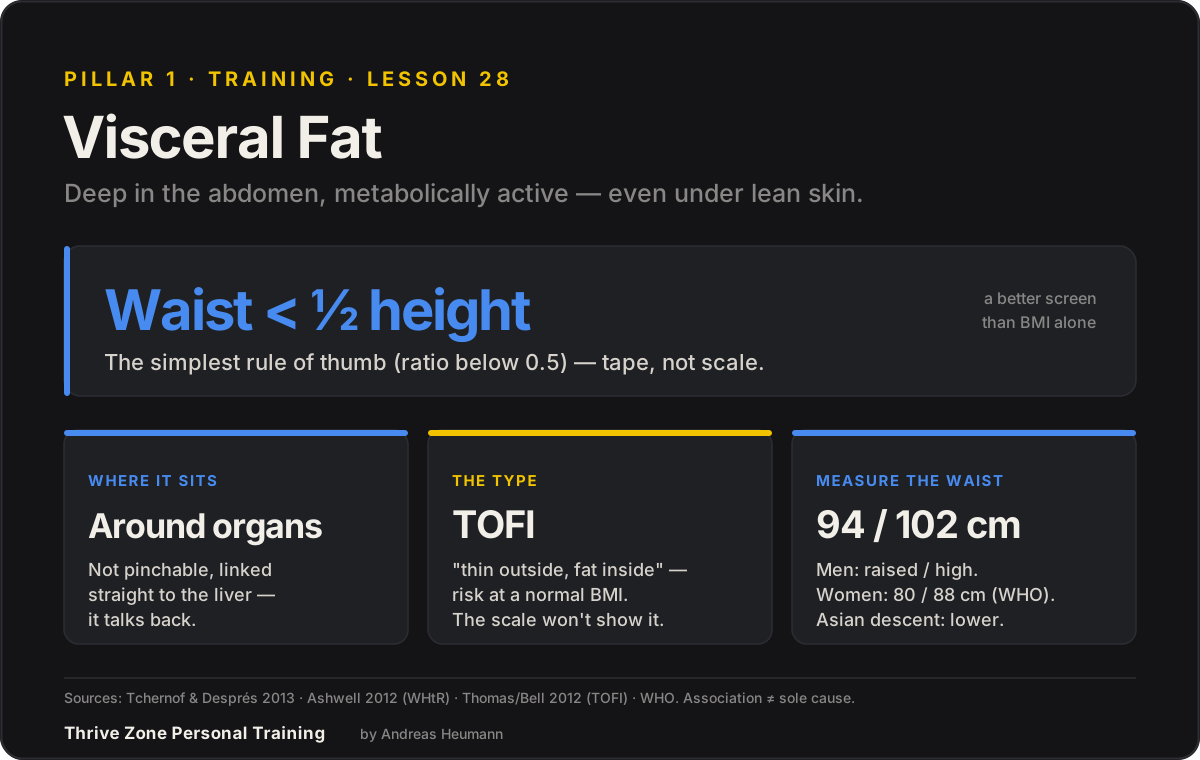
What visceral fat is
Fat isn't just fat — location is everything. Broadly, your body stores it in two places:
- Subcutaneous fat — directly under the skin. This is the fat you can feel on your belly, hips and legs.
- Visceral fat — deep in the abdomen, packed around the gut and liver. Not something you can touch from outside.
Here's the decisive difference: visceral fat is not a quiet store. It's metabolically active — it releases signalling molecules and free fatty acids, and it's tied especially closely to liver metabolism, because its blood drains straight to the liver through the portal vein. This depot talks back, rather than just sitting there.
Why it matters for your health
Compared with subcutaneous fat, visceral fat is metabolically less friendly. Research links it consistently to a whole cluster of things:
- Low-grade, chronic inflammation — it releases pro-inflammatory signalling molecules (including IL-6 and TNF-α).
- Insulin resistance and a higher risk of type-2 diabetes — via free fatty acids and inflammation.
- Fatty liver — encouraged by the direct portal-vein link to the liver.
- Cardiovascular strain — associated with unfavourable blood lipids, blood pressure and vascular health.
- An unfavourable metabolic profile overall (metabolic syndrome).
The comprehensive review by Tchernof and Després sums up the field: visceral fat is metabolically active, connects directly to the liver through the portal vein, and is associated with insulin resistance, unfavourable blood lipids and a raised cardiometabolic risk.
Tchernof A, Després JP (2013). Pathophysiology of human visceral obesity: an update. Physiol Rev 93(1):359–404. DOI: 10.1152/physrev.00033.2011 · Review (research consensus).
One important nuance: most of this is an association plus a plausible mechanism. Visceral fat is a marker and a co-driver of an unfavourable metabolic state — not the sole cause of every consequence. The link is clear and well documented; but it shouldn't be overstated as a single switch. The upside of that nuance: because it's part of a system, it also responds to many levers at once.
The TOFI phenomenon — thin outside, fat inside
Here it gets concrete for a lot of working people. There's a type researchers call TOFI — "thin outside, fat inside," lean on the outside but carrying plenty of fat around the organs. Despite a normal weight and a normal BMI, these people run a raised metabolic risk.
Imaging studies (MRI) show that even normal-weight people can carry a substantial internal fat depot. Bell's group coined the vivid label "TOFI" for it — normal weight, but with raised visceral fat and the metabolic risk that goes with it.
Thomas EL, Frost G, Taylor-Robinson SD, Bell JD (2012). Excess body fat in obese and normal-weight subjects. Nutr Res Rev 25(1):150–161. DOI: 10.1017/S0954422412000054 · Review / MRI research. "TOFI" is a vivid concept, not a formal diagnosis.
For a lot of people between 40 and 60 with a desk job, that's the real hook: you look "normal," but you sit a lot and rarely train in a structured way — and that's exactly when an internal depot can build that the scale never reveals. Which is why training and good nutrition matter for lean people too, not only for those who want to lose weight.
How to gauge it — no equipment needed
The good news: you don't need a lab to track your trend. Two simple markers are plenty for everyday use.
| Marker | Guide value | Why it's useful |
|---|---|---|
| Waist circumference (men) | from ~94 cm raised from ~102 cm high | Rough WHO guide values for the general population. |
| Waist circumference (women) | from ~80 cm raised from ~88 cm high | Mind ethnic differences (see below). |
| Waist-to-height ratio (WHtR) | waist < half your height | Captures fat distribution — a better screen than BMI alone. |
WHtR rule of thumb: keep your waist under half your height (a ratio below 0.5). Ethnic differences exist — for people of South- or East-Asian descent the thresholds are lower (men from around 90 cm).
A systematic review with meta-analysis concludes that the waist-to-height ratio is a better screening tool for cardiometabolic risk factors than waist circumference or BMI alone. The practical cut-off sits at 0.5.
Ashwell M, Gunn P, Gibson S (2012). Waist-to-height ratio is a better screening tool than waist circumference and BMI… Obes Rev 13(3):275–286. DOI: 10.1111/j.1467-789X.2011.00952.x · Systematic review + meta-analysis. The waist thresholds follow the WHO Expert Consultation (2008/2011).

For an exact measurement there are devices — CT and MRI as the research gold standard, DEXA as a good estimate, and body-fat scales with a visceral-fat readout (handy, but less accurate). For everyday use: a tape measure and the WHtR rule of thumb are enough to track your trend and progress — low-effort and free.
What drives visceral fat
Visceral fat doesn't build up at random. The drivers are well known — and most of them are dials you can turn:
- More calories than you burn, over time — a positive energy balance is the main driver.
- Long sitting and lack of movement — an independent risk factor, right at the heart of desk-job life.
- Eating patterns — lots of refined sugar and large amounts of fructose (soft drinks) feed liver and belly fat; add heavily processed food and low fibre and protein.
- Alcohol — encourages visceral storage.
- Too little sleep — controlled studies show visceral fat rising under sleep loss (more on that in the follow-up).
- Chronic stress — persistently raised cortisol is linked with abdominal fat storage.
- Age & hormones — with the years, fat shifts toward the belly; more so around menopause in women, and with falling testosterone in men.
- Genetics — shapes your individual distribution and explains why some store visceral fat faster than others.
You'll spot the pattern: almost all of these drivers are lifestyle — and therefore changeable. That's exactly where the next article picks up.
The good news
Here's the point that really matters, and it's encouraging: visceral fat responds unusually well to movement and dietary change. In percentage terms it's more responsive than subcutaneous fat — even moderate, consistent changes show up here comparatively early.
Precisely put: "more responsive in percentage terms" doesn't mean you can target visceral fat directly. In absolute grams, weight loss often removes more subcutaneous fat — simply because there's more of it. And single exercises strengthen the core, while fat loss always works across the whole body. What counts: the whole-lifestyle route works, and the visceral depot is among the first to respond.
A meta-analysis across 89 studies shows: under diet and exercise, visceral fat shrinks more in percentage terms than subcutaneous fat — but in absolute amounts, more subcutaneous fat is usually lost. No method can target the visceral depot selectively.
Merlotti C, Ceriani V, Morabito A, Pontiroli AE (2017). Subcutaneous fat loss is greater than visceral fat loss with diet and exercise… Int J Obes 41(5):672–682. DOI: 10.1038/ijo.2017.31 · Systematic review + meta-analysis (89 studies).
That's exactly why the whole-lifestyle approach pays off — and exactly what the next article is about.
Why this is the best proof of the ThriveZone idea
Visceral fat responds to strength training, endurance, nutrition, sleep and stress — to every one of the five pillars. No single lever hits all those points at once; an integrated lifestyle does. For people with a sedentary job, that makes it the most relevant, most motivating and best-supported topic to show why the interplay of the pillars beats any single lever — calmly and plainly.
- What Helps Against Visceral Fat (Lesson 29) — the evidence-based levers: endurance, strength, nutrition, sleep, stress — and how they work together.
- Resistant Starch (Lesson 27) — the nutrition lever for insulin sensitivity and gut that keeps coming up in the belly-fat conversation.
- Body Recomposition (Lesson 3) — building muscle and losing fat at once: the bigger picture of body composition.
New lessons every two weeks in your inbox
Next up is the practical part: what actually helps against visceral fat. Sign up and you'll get every new lesson first — and if you have a concrete training need, a trial session at the studio is the most direct route.
To the newsletterSources
Physiology & risk
Tchernof A, Després JP (2013). Physiol Rev 93(1):359–404. DOI: 10.1152/physrev.00033.2011 — review of the pathophysiology of visceral fat (metabolically active, portal vein, cardiometabolic risk).
Thomas EL, Frost G, Taylor-Robinson SD, Bell JD (2012). Nutr Res Rev 25(1):150–161. DOI: 10.1017/S0954422412000054 — TOFI: raised internal fat at normal weight (MRI).
Measurement
Ashwell M, Gunn P, Gibson S (2012). Obes Rev 13(3):275–286. DOI: 10.1111/j.1467-789X.2011.00952.x — waist-to-height (WHtR < 0.5) a better screen than BMI.
WHO (2011). Waist Circumference and Waist–Hip Ratio: Report of a WHO Expert Consultation (2008). Geneva: WHO — waist thresholds (men ~94/102 cm, women ~80/88 cm).
Response to lifestyle
Merlotti C, Ceriani V, Morabito A, Pontiroli AE (2017). Int J Obes 41(5):672–682. DOI: 10.1038/ijo.2017.31 — visceral fat shrinks more in percentage terms, more subcutaneous fat is lost in absolute terms; no selective reduction.
A note on interpretation: that visceral fat is metabolically active and associated with an unfavourable metabolic state is well established. Most of the risk claims rest on observational data plus a plausible mechanism — a clear association, not proof of a sole cause. Thresholds apply to the general population; ethnic differences exist. If a metabolic condition is suspected, check with your doctor.