Resistant Starch — the fibre that ordinary starch turns into
The same potato can behave differently inside your body: cook it, then chill it. What forms in the process is resistant starch — and it acts less like starch and more like a prebiotic fibre. Here's what's genuinely proven, and where to look closely if someone promises you it melts belly fat.
Most of the carbohydrate you eat is broken down to glucose in the small intestine and absorbed — that's the fuel the carbohydrate lesson is about. But a small share of starch slips past that route entirely. It stays undigested and travels on to the large intestine, where it feeds not you but your gut bacteria. That share is what we call resistant starch — resistant to digestion.
Resistant starch is starch that never reaches you as sugar but feeds your gut bacteria instead — so it behaves like a prebiotic fibre. Best proven are the metabolic and gut effects (better insulin sensitivity, steadier blood sugar, a healthier gut flora). The dramatic belly-fat numbers, by contrast, come from studies in people with obesity using high doses — exciting, but for lean, active people what holds up is the effect on blood sugar, insulin and gut. That distinction runs through the whole lesson.
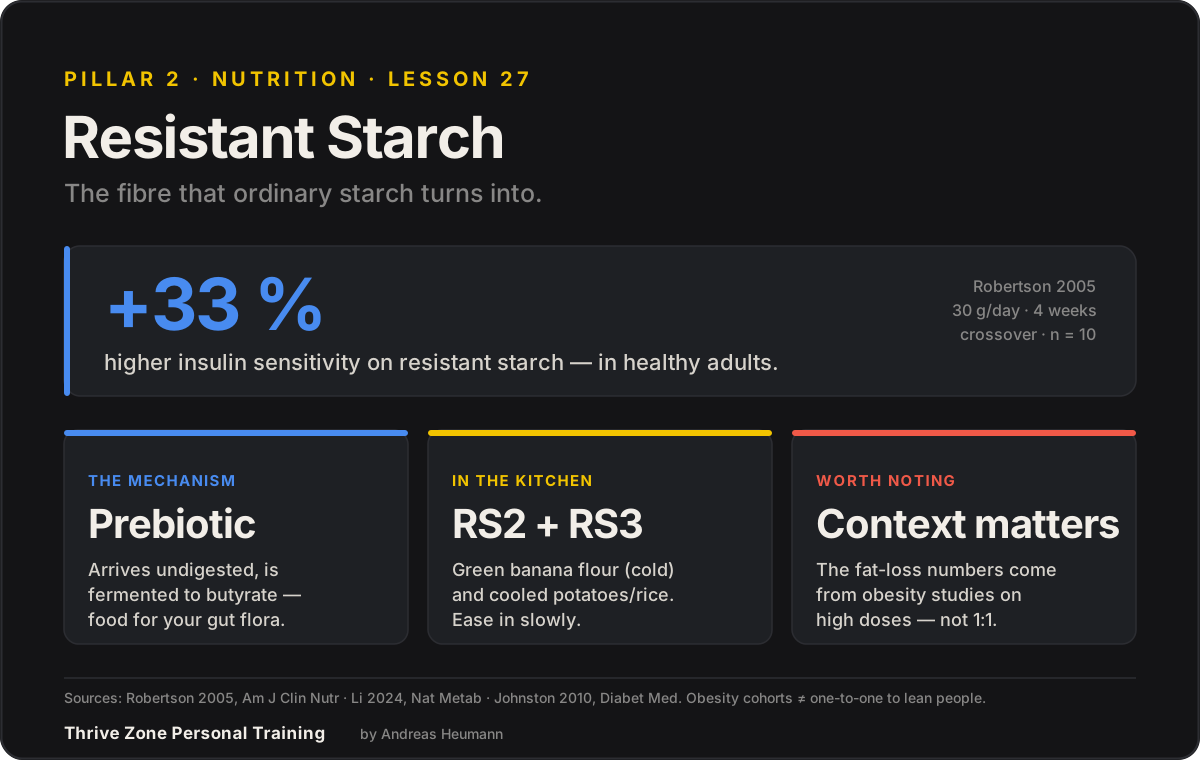
What resistant starch does in the body
The name sounds technical; the principle is simple. Ordinary starch is cut into glucose by your digestive enzymes and taken up into the blood. Resistant starch withstands those enzymes and arrives in the large intestine largely untouched. There the interesting part begins: your gut bacteria ferment it. As a by-product they make short-chain fatty acids, above all butyrate — the preferred fuel of your colon cells and a signalling molecule that supports the gut barrier and calms inflammation.
So resistant starch belongs, in effect, to the fibres: it gives you almost no energy itself, but it feeds your gut flora. And as with fibre in general, there's a lever here that most people underrate.
The four types — and which ones matter in the kitchen
"Resistant starch" is an umbrella term for four forms that come from quite different sources:
| Type | What it is | Everyday sources |
|---|---|---|
| RS1 | physically trapped — shielded by a solid structure | whole or coarsely milled grains, seeds, legumes |
| RS2 | dense, native starch granules that resist digestion when raw | green (unripe) banana, green banana flour, high-amylose maize starch |
| RS3 | retrograded — the starch re-forms as it cools | cooked and then cooled potatoes, rice, pasta |
| RS4 | chemically modified (industrially made) | processed foods, additives |
For the kitchen, RS2 (green banana flour) and RS3 (cooled potatoes and rice) are what count. A nice bonus: reheating keeps much of the RS3 structure intact — leftovers from the fridge hold on to most of the benefit.
So the cooled-potato example from the start is RS3: cook potatoes or rice, let them cool fully in the fridge, and part of the starch rearranges into a resistant form. The nice thing: one batch covers two situations, depending on when and how you eat it. Warm and fresh, right after training, the carbohydrates are readily available — they refill glycogen, and with quark as a protein source it becomes a well-rounded recovery meal — for example as boiled potatoes with herb quark. Cold the next day, say on a quieter day without training, the resistant-starch share is highest — then the same batch works mainly for your microbiome, in a salad, a bowl or stirred through your vegetables. Warm is more fuel, cold is more fibre — same potato, two uses.
Green banana flour — the easy route
Alongside the cooled-potato route there's a second one that needs no planning at all: green banana flour — flour milled from unripe bananas. In the green banana the starch is still stored as RS2; as the fruit ripens it breaks that starch down into sugar, which is why it has to be the green banana. The two routes simply complement each other: the potato as a meal, the banana flour as a spoonful you stir into anything.
A teaspoon or two stirred into a cold or lukewarm smoothie, into yoghurt, quark, a protein shake or overnight oats — done, with no chilling needed. The concentration of resistant starch is much higher than in cooled potatoes, so you need only small amounts. The quick route for days when it should be simple.
One key difference from the potato: the resistant starch in banana flour (RS2) is heat-sensitive — cooking or baking above roughly 60–70 °C (the gelatinisation point) largely destroys it. So use it cold or lukewarm at most, don't bake with it. The cooled potato is sturdier here: its RS3 is heat-stable and survives reheating. And ease in slowly — start at around 5 g and build over a week or two, otherwise the fermentation shows up as bloating and fullness.
How much resistant starch is actually in the flour varies a lot with ripeness and processing — depending on the product, roughly from a third to more than half of the dry weight. Claiming a fixed figure would overstate it; take it as a rough order of magnitude, not a label promise.
Green banana flour — my pick
If you want to try it without wading through dozens of products: here's the organic green banana flour I recommend. Look for pure, unsweetened flour from unripe bananas — nothing else.
View the productAffiliate link: if you buy through it, you support my work with a small commission — the price stays the same for you. I only recommend what I find genuinely useful.
What the studies actually show
Now the part that matters — because resistant starch often gets sold online as a belly-fat miracle. Let's look at what's really proven, and separate cleanly what's well established from what's tempting but narrower.
Insulin sensitivity — best proven
The most solid effect concerns insulin sensitivity — how well your body moves glucose from the blood into the cells. Even a classic controlled study in healthy adults showed a clear effect here:
In a crossover study, ten healthy adults took 30 g of resistant starch a day (high-amylose maize starch) for four weeks. Insulin sensitivity in a meal test was around 33 % higher on resistant starch than on placebo (P = 0.05); it was higher in the precise clamp method too.
Robertson MD, Bickerton AS, Dennis AL, Vidal H, Frayn KN (2005). Insulin-sensitizing effects of dietary resistant starch… Am J Clin Nutr 82(3):559–567. DOI: 10.1093/ajcn.82.3.559 · Controlled crossover study in healthy adults. Small sample (n = 10) — the direction transfers well, the size needs larger trials.
Larger reviews confirm the direction: resistant starch lowers fasting insulin fairly consistently and fasting blood sugar modestly — more so in people with diabetes, less in the metabolically healthy. The effect is real, but moderate, and varies with dose and starch type.
Weight and visceral fat — promising, but narrower
This is the study that made headlines — and set off the belly-fat hype. It's well done, and it shows an intriguing mechanism. But the study population is the decisive detail:
In a placebo-controlled, double-blind crossover trial, 37 adults with overweight or obesity took 40 g of resistant starch a day for eight weeks. The result: on average −2.8 kg and improved insulin resistance. The gut bacterium Bifidobacterium adolescentis increased and correlated strongly with the drop in BMI and visceral fat area. As a mechanism the authors describe, among other things, a changed bile-acid profile, a strengthened gut barrier, less inflammation and reduced fat uptake (via ANGPTL4). In a mouse model this bacterium alone protected against diet-induced fat gain.
Li H, Zhang L, Li J, et al. (2024). Resistant starch intake facilitates weight loss in humans by reshaping the gut microbiota. Nat Metab 6(3):578–597. DOI: 10.1038/s42255-024-00988-y · Randomised crossover trial (n = 37) plus mechanistic mouse models. IMPORTANT: high dose, short duration, small sample — and the participants had overweight or obesity.
Why the caution? Because an older, equally well-run study shows the metabolic effect does not automatically come with fat loss:
Over twelve weeks, twenty people with metabolic syndrome took 40 g of resistant starch a day. Insulin sensitivity improved significantly (P = 0.023) — with no measurable change in body weight or visceral fat.
Johnston KL, Thomas EL, Bell JD, Frost GS, Robertson MD (2010). Resistant starch improves insulin sensitivity in metabolic syndrome. Diabet Med 27(4):391–397. DOI: 10.1111/j.1464-5491.2010.02923.x · Controlled trial (n = 20). Shows the metabolic benefit can appear without any fat loss.
The clear read: for visceral fat, resistant starch is promising and mechanistically plausible — but the fat-loss numbers come from obesity cohorts on high doses. For lean, active people it's a sensible building block for blood sugar, insulin and gut — the fat-loss effect stays tied to obesity and high doses. What genuinely shifts visceral fat is covered in its own lesson (see below).
Gut health — the solid foundation
Regardless of the scale or your waist, the gut benefit is well established and applies to everyone. Resistant starch is fermented into short-chain fatty acids, butyrate first — energy for the colon cells, support for the gut barrier, an anti-inflammatory signal. It acts as a prebiotic and feeds useful bacteria, including Ruminococcus bromii, a keystone fermenter that unlocks resistant starch efficiently in the first place.
And it feeds into something ThriveZone keeps stressing: plant variety. Every extra fibre and plant source widens what your gut flora has to work with — resistant starch is simply another practical piece in that mosaic.
How to work it into everyday life
In the studies, the effective amounts mostly sat at around 15–40 g of resistant starch a day — the top end is a lot, often coming from supplement doses. For everyday life and maintenance, a moderate, steady contribution is plenty. Three simple routes:
- Cooled potatoes or rice (RS3): deliberately cook a batch, chill it, and eat it the next day as a salad or bowl — even reheated, much survives.
- A spoon of green banana flour (RS2): cold in a smoothie, quark or overnight oats. The easiest route — ease in slowly.
- Legumes (RS1): lentils, beans and chickpeas carry resistant starch by nature — plus protein and classic fibre on top.

Combine these sources and you cover several types at once. Timing is not critical: resistant starch works through fermentation and the microbiome, not acutely. If you want the flatter blood-sugar curve too, pair it with a carbohydrate-rich meal.
On tolerance: if your gut is sensitive or you have IBS, the fructans it contains and the fermentation can cause bloating. That's not a sign something is "wrong" — it's your gut flora at work. Still: test it individually, start small, build slowly. And if it just doesn't sit right with you long-term, it's not compulsory.
- Carbohydrates in Practice (Lesson 21) — the big picture: which carbs, how much, when. Resistant starch is the fibre special case within it.
- Visceral Fat — what it is and why it matters (Lesson 28) — the clear look at the belly fat the RS hype is about.
- Protein in Practice (Lesson 15) — the other big nutrition lever; legumes deliver both at once.
Meals that fit
From the ThriveZone Meals — real macros and hands-on times.


New recipes & lessons every two weeks
The nutrition pillar grows piece by piece — well-founded lessons and fully calculated recipes, built around real food. Sign up and you'll get them first.
To the newsletterSources
Metabolism & insulin sensitivity
Robertson MD, Bickerton AS, Dennis AL, Vidal H, Frayn KN (2005). Am J Clin Nutr 82(3):559–567. DOI: 10.1093/ajcn.82.3.559 — 30 g RS/day, +33 % insulin sensitivity in healthy adults (crossover, n = 10).
Johnston KL, Thomas EL, Bell JD, Frost GS, Robertson MD (2010). Diabet Med 27(4):391–397. DOI: 10.1111/j.1464-5491.2010.02923.x — insulin sensitivity up, no weight/visceral-fat effect (n = 20, metabolic syndrome).
Weight, visceral fat & microbiome
Li H, Zhang L, Li J, et al. (2024). Nat Metab 6(3):578–597. DOI: 10.1038/s42255-024-00988-y — 40 g RS/day, −2.8 kg, Bifidobacterium adolescentis, ANGPTL4 mechanism (crossover RCT n = 37 + mouse; obesity cohort).
Ze X, Duncan SH, Louis P, Flint HJ (2012). ISME J 6(8):1535–1543. DOI: 10.1038/ismej.2012.4 — Ruminococcus bromii as a keystone fermenter of resistant starch.
Definition & sources
Nugent AP (2005). Health properties of resistant starch. Nutr Bull 30(1):27–54. DOI: 10.1111/j.1467-3010.2005.00481.x — overview of RS1–RS4, fermentation, butyrate.
Munir H, Alam H, Nadeem MT, et al. (2024). Green banana resistant starch… Food Sci Nutr 12(6):3787–3805. DOI: 10.1002/fsn3.4063 — RS content of green banana flour, effect of processing and heat.
A note on interpretation: the basics (resistant starch is fermented in the colon, yields butyrate, acts as a prebiotic) are established nutritional science. The metabolic and gut benefits transfer well. The fat-loss effects come mostly from studies in people with overweight or obesity on high doses over a few weeks, and don't transfer one-to-one to lean, active people. Observed associations are not final causal proof. With diabetes, IBS or other metabolic or gut conditions, check with your doctor.