What Helps Against Visceral Fat
Ab exercises strengthen the core — the fat on top melts a different way. And that way is clear: the interplay of moderate building blocks that already pays off at two to four hours a week. Moderate, doable, effective — that's the ThriveZone approach.
The previous article covered what visceral fat is and why it matters. Now the real question: what makes it shrink? First the key point, because it clears up half the confusion.
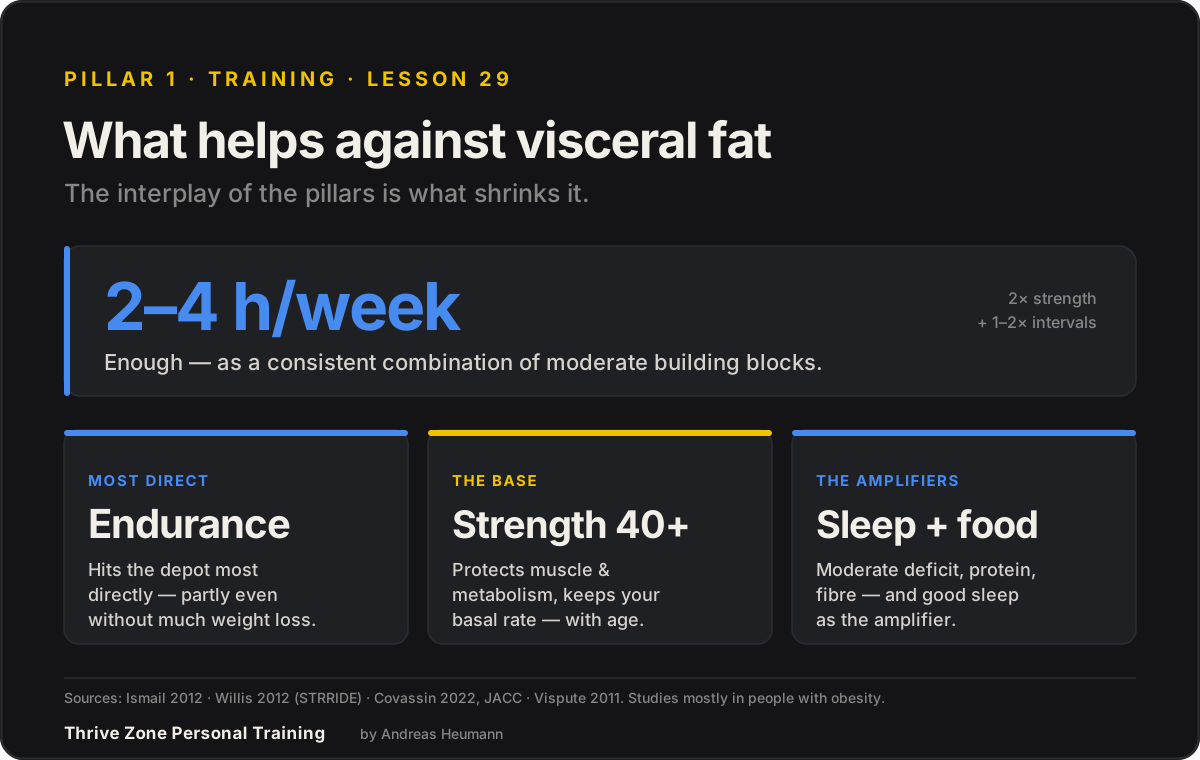
Belly fat responds to your whole body and lifestyle, not to single exercises in one spot. The overarching lever is a slightly negative energy balance over time, and the visceral depot responds to it especially readily. Endurance hits it most directly, strength protects muscle and metabolism, nutrition steers the balance, sleep and stress modulate the rest. Each building block carries its part — together they reinforce each other.
The most stubborn myth first: targeted ab training doesn't remove belly fat. In a controlled trial, participants trained seven different ab exercises for six weeks — with no measurable effect on body-fat percentage, waist circumference or belly skinfolds.
Vispute SS, Smith JD, LeCheminant JD, Hurley KS (2011). The effect of abdominal exercise on abdominal fat. J Strength Cond Res 25(9):2559–2564. DOI: 10.1519/JSC.0b013e3181fb4a46 · Controlled trial (RCT). Training off a single fat spot doesn't work.
Ab exercises strengthen the core muscles — valuable for posture and stability. It's just the fat on top that doesn't vanish from them. That comes from the levers below, partly through the energy balance, partly through independent metabolic effects.
1. Endurance — the most direct lever on the depot
If one single form of training hits the visceral depot most directly, it's endurance training. This is well studied:
In a meta-analysis, aerobic training was the most effective single modality for reducing visceral fat. In a head-to-head comparison there was a trend favouring endurance over strength training, though it wasn't statistically significant (P = 0.07) — so endurance tends to beat strength here, but not decisively.
Ismail I, Keating SE, Baker MK, Johnson NA (2012). A systematic review and meta-analysis of the effect of aerobic vs. resistance exercise training on visceral fat. Obes Rev 13(1):68–91. DOI: 10.1111/j.1467-789X.2011.00931.x · Systematic review + meta-analysis. Population: mostly adults with overweight or obesity — the direction transfers, the effect size applies mainly at a raised starting depot.
Notably, endurance training can lower visceral fat partly even without much weight loss — the depot responds directly to the movement, not just via the kilos on the scale.
In a controlled trial, exercise reduced visceral and abdominal fat even when little weight was lost. The training works on the depot, regardless of what the scale reads.
Ross R, Dagnone D, Jones PJ, et al. (2000). Reduction in obesity and related comorbid conditions after diet-induced or exercise-induced weight loss in men. Ann Intern Med 133(2):92–103. DOI: 10.7326/0003-4819-133-2-200007180-00008 · Randomised controlled trial (men with obesity; confirmed in women in 2004).

For time-pressed working people, the good news is that time-efficient formats like intervals fit here beautifully and are well supported for visceral fat. My own model is two short mountain-bike interval sessions a week — this exact pillar, in an everyday dose.
2. Strength training — non-negotiable, especially after 40
Strength training has an independent, moderate effect on visceral fat and improves insulin sensitivity. But its greatest value for this group lies elsewhere: in preserving and building muscle. Muscle fades with age (sarcopenia), and without strength training every diet adds muscle loss on top.
Why this matters most between 40 and 60: muscle is a central site of glucose disposal. More — or preserved — muscle mass improves the metabolic picture for good and counters what's called anabolic resistance. Strength training also protects your basal metabolic rate during a diet — it makes sure you lose fat, not the substance that keeps you strong and resilient.
Strength training works as medicine: it improves insulin sensitivity and the metabolic profile, and it's the central lever against age-related muscle loss — the foundation on which endurance and nutrition can work in the long run.
Westcott WL (2012). Resistance training is medicine: effects of strength training on health. Curr Sports Med Rep 11(4):209–216. DOI: 10.1249/JSR.0b013e31825dabb8 · Review · on sarcopenia see also Churchward-Venne et al. (2014), Biofactors 40(2):199–205, DOI: 10.1002/biof.1138.
More on strength as the base in the lesson Strength Training — the base that carries everything.
3. Combined training — the best overall effect
So which is better, endurance or strength? The short answer: it's the wrong question. For overall body composition — fat down and muscle up — the combination beats either one alone.
In a large training trial, endurance and the combination of strength and endurance reduced fat mass more than strength training alone. For the best overall effect on body composition (losing fat while keeping muscle), the combination was most effective. Worth noting: for pure fat loss the combination was not superior to endurance alone — at twice the time cost.
Willis LH, Slentz CA, Bateman LA, et al. (2012). Effects of aerobic and/or resistance training on body mass and fat mass in overweight or obese adults. J Appl Physiol 113(12):1831–1837. DOI: 10.1152/japplphysiol.01370.2011 · Randomised controlled trial (STRRIDE AT/RT). For visceral/liver fat, aerobic training was superior (Slentz et al. 2011).
That's exactly why ThriveZone goes with both rather than an either/or. For two to four hours a week, a realistic, evidence-aligned layout is:
| Building block | Dose | What for |
|---|---|---|
| Strength (full body) | 2× / week | protect muscle & metabolism, keep your basal rate |
| Intervals / brisk cardio | 1–2× / week | hit the visceral depot directly, time-efficient |
| Everyday movement (NEAT) | daily | break up sitting — the underrated steady worker |
No extreme programme needed. Low volume, high consistency, slow progression — that carries further than any short radical phase. More on everyday movement in the NEAT lesson.
4. Nutrition — the lever for balance and metabolism
Training opens the door; nutrition decides how far it swings. The key dials:
- A moderate, sustainable calorie deficit is the core — and visceral fat tends to go first.
- Enough protein protects muscle in a deficit and keeps you full (see the protein lesson).
- Fibre and resistant starch improve blood sugar, insulin sensitivity and the microbiome (see resistant starch).
- Less refined sugar and large amounts of fructose (soft drinks) — they feed liver and belly fat.
- Less alcohol — a direct driver of visceral storage.
- Down on processing, up on plant variety — more real food, more colours on the plate.
For lean but inactive people (the TOFI type from the hub article), the focus is less on a big deficit and more on quality, protein and fibre — plus the training that speaks to the depot directly.
5. Sleep — the often-overlooked factor
Sleep isn't a "soft" extra — it's a measurable factor in fat distribution. That's especially striking because it shows up even under controlled conditions in healthy people:
In a controlled crossover trial, healthy, non-obese adults slept either around 9 hours or only around 4 hours a night for two weeks. Under sleep loss they took in more calories, gained weight — and their visceral belly fat rose significantly.
Covassin N, Singh P, McCrady-Spitzer SK, et al. (2022). Effects of Experimental Sleep Restriction on Energy Intake, Energy Expenditure, and Visceral Obesity. J Am Coll Cardiol 79(13):1254–1265. DOI: 10.1016/j.jacc.2022.01.038 · Randomised crossover trial under inpatient conditions (n = 12, 14 days).
For stressed working people this is often the overlooked lever: fine-tuning nutrition and training while chronically under-sleeping means working against your own progress.
6. Stress and cortisol
The last building block is indirect, but real. Chronic stress and persistently raised cortisol are linked with abdominal, visceral fat storage — mostly through observational data and a plausible hormonal mechanism.
An established concept describes how sustained activation of the stress axis and raised cortisol preferentially favour visceral fat storage. It's a well-grounded association and mechanism, not causal proof from intervention trials.
Björntorp P (2001). Do stress reactions cause abdominal obesity and comorbidities? Obes Rev 2(2):73–86. DOI: 10.1046/j.1467-789x.2001.00027.x · Review (mechanism/observation).
Stress management — recovery, movement, good sleep — therefore acts on body composition indirectly too. Another reason a whole-lifestyle approach beats optimising a single thing.
The ThriveZone synthesis
Now it all comes together. No single lever "wins": endurance hits the depot most directly, strength protects muscle and metabolism (especially after 40), nutrition steers energy balance and insulin sensitivity, sleep and stress modulate the whole. They reinforce each other.
For working people with two to four hours a week, the message is a relief: you don't need an extreme programme, just the consistent combination of moderate building blocks — low volume, high consistency, slow progression. That's ThriveZone, and visceral fat is the best proof it works.
Your plan in one sentence: strength twice for preservation, one or two short interval sessions for the depot, break up sitting every day, with enough protein, fibre and a moderate deficit — and good sleep as the amplifier. All of it is moderate and doable. Together it works better than any single lever.
- Visceral Fat — what it is and why it matters (Lesson 28) — the hub: what the depot is, how you measure it, what drives it.
- Strength Training — the base that carries everything (Lesson 13) · VO₂max & Longevity (Lesson 16) — the two training pillars in detail.
- Resistant Starch (Lesson 27) & Protein in Practice (Lesson 15) — the nutrition levers.
Want the layout tailored to you?
You know the building blocks now — the fastest route to a plan that fits your body, your time and your everyday life is a trial session at the studio. Or sign up to the newsletter and get every new lesson first.
Request a trial sessionSources
Training & visceral fat
Vispute SS, Smith JD, LeCheminant JD, Hurley KS (2011). J Strength Cond Res 25(9):2559–2564. DOI: 10.1519/JSC.0b013e3181fb4a46 — targeted ab training doesn't reduce local fat (RCT).
Ismail I, Keating SE, Baker MK, Johnson NA (2012). Obes Rev 13(1):68–91. DOI: 10.1111/j.1467-789X.2011.00931.x — aerobic the most effective single modality; trend endurance > strength (P = 0.07, not significant).
Ross R, Dagnone D, Jones PJ, et al. (2000). Ann Intern Med 133(2):92–103. DOI: 10.7326/0003-4819-133-2-200007180-00008 — exercise lowers visceral fat even without much weight loss (RCT).
Willis LH, Slentz CA, Bateman LA, et al. (2012). J Appl Physiol 113(12):1831–1837. DOI: 10.1152/japplphysiol.01370.2011 — combination = best overall effect on body composition (RCT, STRRIDE). Visceral/liver fat: Slentz et al. (2011), Am J Physiol Endocrinol Metab 301(5):E1033–E1039, DOI: 10.1152/ajpendo.00291.2011.
Strength, sleep & stress
Westcott WL (2012). Curr Sports Med Rep 11(4):209–216. DOI: 10.1249/JSR.0b013e31825dabb8 · Churchward-Venne TA, et al. (2014). Biofactors 40(2):199–205. DOI: 10.1002/biof.1138 — strength: metabolism & muscle preservation against sarcopenia.
Covassin N, Singh P, McCrady-Spitzer SK, et al. (2022). J Am Coll Cardiol 79(13):1254–1265. DOI: 10.1016/j.jacc.2022.01.038 — sleep restriction → more visceral fat (crossover RCT, n = 12).
Björntorp P (2001). Obes Rev 2(2):73–86. DOI: 10.1046/j.1467-789x.2001.00027.x — stress/cortisol & abdominal fat storage (mechanism/observation).
A note on interpretation: most training and diet studies on visceral fat were done in adults with overweight or obesity or with metabolic issues. The direction of the effects transfers well; the exact effect sizes apply mainly to people with a raised starting depot. Observed associations (especially for stress) are not causal proof. With existing conditions, check with your doctor.