Carbohydrates in Practice
This macronutrient is debated more hotly than any other — and few are as misunderstood. Yet carbohydrates are above all one thing: fuel. The only question is which, how much, and matched to which day. Here's the practice — calm and without dogma.
Carbohydrates supply your body with glucose — the fuel your brain most likes to burn and the one your muscles reach for first under intense load. Unlike protein, there is indeed a store here: glycogen in muscle and liver. That changes the whole logic — and explains why the right amount of carbs depends far more on your training than on a blanket rule.
Carbohydrates are the main fuel for intense training and for your brain — unlike protein not a mandatory building block, but the tank that performance comes from. The decisive lever is two things: quality (whole and fibre-rich) and amount matched to your training volume. Get that and you can skip the diet camps. Everything else in this lesson rests on it.
What carbohydrates actually are
Briefly the foundation — because this is where most misunderstandings arise. "Carbohydrates" is an umbrella term for three things that behave completely differently in the body:
- Sugar (simple and double sugars) — glucose, fructose, table sugar. Quickly available, quickly in the blood.
- Starch (multiple sugars) — long glucose chains in potatoes, rice, grains, legumes. Broken down to glucose bit by bit.
- Fibre — also carbohydrates, but your small intestine can barely break them down. They provide almost no energy, but that's exactly why they're so valuable (a whole section below).
Except for fibre, almost all carbohydrates end up as glucose in the blood — whether from rice, bread or an apple. What differs is the speed at which this happens, and what else is in the food. One gram of usable carbohydrate provides around 4 kcal — just like a gram of protein.
And here's the point that surprises many: carbohydrates are, strictly speaking, not essential. Your body can make glucose itself in an emergency (from protein and parts of fat — gluconeogenesis). So there's no "you must eat them or something's missing" obligation like with the essential amino acids. But: your brain uses roughly 120 g of glucose a day at rest, and the in-house production is costly and limited. So the reference recommendation sits at around 130 g per day just for reliable brain supply — before training is even counted.
The official Reference Intake (RDA) for carbohydrates is 130 g per day for adults and children — derived from the average glucose the brain uses. A functional minimum, not an optimum for active people.
Institute of Medicine (2005). Dietary Reference Intakes for Energy, Carbohydrate, Fiber, Fat, Fatty Acids, Cholesterol, Protein, and Amino Acids. National Academies Press. DOI: 10.17226/10490 · Reference/standard table · Minimum against deficiency, not the training-related need.
Your fuel tank: glycogen
With protein: no real store, top up regularly. With carbohydrates it's the reverse — and exactly this difference steers the whole practice.
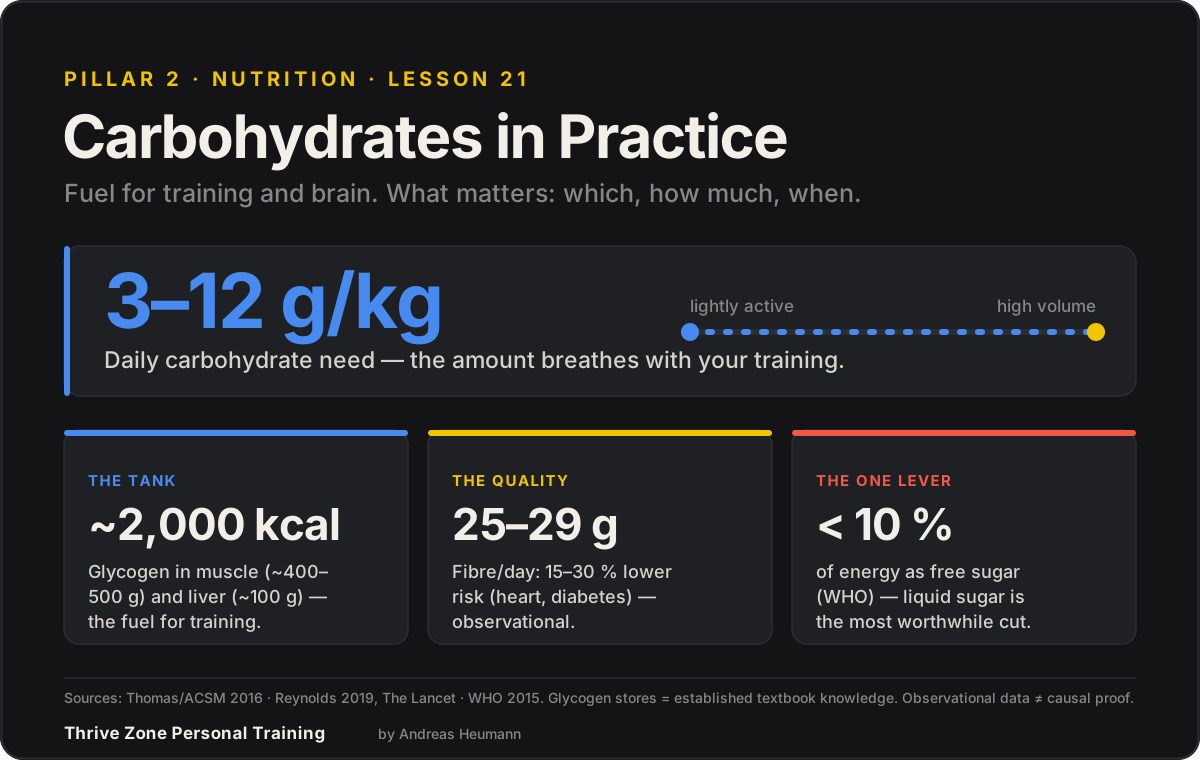
Surplus glucose your body stores as glycogen: long, coiled glucose chains, mainly in your muscle and liver. Roughly, about 400–500 g of glycogen fit in the muscles and another ~100 g in the liver — together about 1,600–2,000 kcal of immediately available energy. Muscle glycogen is the local tank for the working muscle; liver glycogen keeps your blood sugar stable, especially between meals and overnight.
Why this matters, sports science showed decades ago in a now-legendary experiment:
In a classic trial, muscle glycogen content was measured by biopsy and deliberately altered through diet — from around 0.6 g to 4.7 g per 100 g of muscle. Result: the fuller the glycogen tank at the start, the longer the endurance performance to exhaustion.
Bergström J, Hermansen L, Hultman E, Saltin B (1967). Diet, Muscle Glycogen and Physical Performance. Acta Physiologica Scandinavica 71(2–3):140–150. DOI: 10.1111/j.1748-1716.1967.tb03720.x · Controlled human trial (n=9, muscle biopsy). The mechanism holds generally; the extent depends on intensity and duration of the load.
From this follows the whole logic of this lesson: carbohydrates are a real lever where this tank is heavily used — that is, with intense or long training. Move little on a given day and the tank stays well filled anyway, and you simply top up less. That's exactly why there's no sensible blanket gram number for everyone — but one that breathes with your day.
How much do you really need?
Here research helps cut through camp-thinking. The big joint position of the sports and nutrition professional bodies grades the carbohydrate need not by "much or little" but directly by training volume:
The daily carbohydrate need is tied to the load and ranges from 3–5 g per kg of body weight at light activity to 8–12 g/kg at very high training volume. For moderate training (~1 h/day) the guideline is around 5–7 g/kg, for longer sessions (1–3 h) 6–10 g/kg.
Thomas DT, Erdman KA, Burke LM (2016). Position of the Academy of Nutrition and Dietetics, Dietitians of Canada, and the ACSM: Nutrition and Athletic Performance. J Acad Nutr Diet 116(3):501–528. DOI: 10.1016/j.jand.2015.12.006 · Position paper/guideline. The upper ranges are for competitive/endurance sport — for everyday trainees the lower-to-middle band is relevant.
That's the decisive liberation from the carb question: the right amount scales with what you actually do that day. A guide for orientation:
| Your day | Carbohydrates | Example 75 kg |
|---|---|---|
| Little movement, no training | ~3 g/kg | ~225 g |
| Moderate training (~1 h) | ~5 g/kg | ~375 g |
| Long/intense training (1–3 h) | ~6–8 g/kg | ~450–600 g |
| Very high volume (competition) | ~8–12 g/kg | 600 g+ |
Guide values for orientation, no weighing obligation. If you're losing weight, run at the lower edge of each row; if you train hard or are building, at the upper.
The rule of thumb without maths: let the amount breathe with your activity. On quiet days most of your carbs come from vegetables, fruit and a moderate side. On hard training days the side may be bigger — that fills the tank that performance comes from.
Your carbohydrate calculator
Please enter a weight between 35 and 250 kg.
Quality beats quantity — fibre
If you improve only one thing about your carbs, make it this: whole, fibre-rich sources instead of refined. That's the point where "carbohydrates" become either a health lever or a missed chance.
Fibre is the indigestible carbohydrate from plant food — from legumes, wholegrain, vegetables, fruit, nuts. It provides almost no energy itself but does several things at once: it adds volume and fills you up, it slows the uptake of glucose into the blood, and it's food for your gut flora. With heavily processed, "white" carbs exactly this falls away — fast glucose without the brake and without the substrate for the gut.
How strong this quality lever is, one of the largest analyses on the topic shows:
An extensive series of systematic reviews and meta-analyses (185 observational studies + 58 clinical trials) found: those who eat the most fibre have, compared with the lowest, a 15–30 % lower risk of all-cause and cardiovascular mortality, coronary heart disease, stroke, type-2 diabetes and bowel cancer. The greatest benefit showed at 25–29 g of fibre per day — rather more than less.
Reynolds A, Mann J, Cummings J, Winter N, Mete E, Te Morenga L (2019). Carbohydrate quality and human health: a series of systematic reviews and meta-analyses. The Lancet 393(10170):434–445. DOI: 10.1016/S0140-6736(18)31809-9 · Meta-analysis. IMPORTANT: most of the risk numbers come from observational data — a strong association, not final causal proof; supported by the included trials.
In practice, "good carbs" therefore almost always means: foods where the fibre is still in. Oats instead of cornflakes. Wholegrain instead of white flour. The whole fruit instead of the juice. Legumes as the secret star — they deliver carbohydrates, fibre and protein in one.
What this means for you: most people are well below ~30 g of fibre a day. There's more headroom here than at almost any other nutrition dial. You don't have to forbid anything — you just swap the source: same meal, just the whole version.
The blood-sugar point — why the whole meal counts
You've surely heard of "blood-sugar spikes" and the glycaemic index that sorts foods by how fast they raise blood sugar. There's something to it — but the usual story falls short.
The decisive point: you rarely eat a carbohydrate on its own. Once fibre, protein and fat are on the plate too, gastric emptying slows and glucose trickles more slowly into the blood. A slice of white bread on its own raises blood sugar differently from the same slice with egg, avocado and salad. So the whole meal is the relevant measure — not the single ingredient from a GI table.
And there's a simple, well-supported lever that works after the meal: light movement. The working muscle pulls glucose out of the blood even without much insulin — a short walk after eating noticeably dampens the blood-sugar peak. We go deeper in a separate lesson: The 10-minute lever after eating.
What this means for you: you don't have to memorise GI tables. Three things do most of the work: choose whole sources, combine carbs with protein and vegetables, and move for a few minutes after bigger meals.
Sugar — the one lever that really counts
If there's one place where the "carbs are bad" story has a kernel of truth, it's here: free sugars. Those are the sugars that manufacturers, the kitchen or you yourself add — plus those in honey, syrup and fruit juices. Not meant is the sugar naturally in whole fruit or in milk; that comes packaged with fibre, water and micronutrients.
The World Health Organization recommends reducing free-sugar intake to below 10 % of daily energy (strong recommendation) — and sees additional benefit in a further reduction to below 5 % (roughly ~25 g or 6 teaspoons a day) (conditional recommendation).
World Health Organization (2015). Guideline: Sugars Intake for Adults and Children. Geneva: WHO. PMID: 25905159 · Guideline. The 10 % threshold rests mainly on caries evidence; the 5 % recommendation is rated "conditional" (weaker data). A good direction for everyday life.
The biggest silent item is usually liquid sugars — soft drinks, sweetened coffee drinks, juices. They deliver a lot of fast energy with no satiety, because liquid calories barely dampen appetite. That's by far the most worthwhile starting point before you cut carbs anywhere else.
What this means for you: instead of "fewer carbs", the precise lever is "less free sugar, especially liquid". A short list with a big effect — and it leaves the carbs that fill you up and fuel your training completely alone.
Low carb? Where it actually stands
Now the section where most articles pick a camp. Let's do it differently — let's see what the data say.
The most stubborn idea is: carbs drive insulin up, insulin stores fat, so carbs make you fat. In that simplicity, the thesis doesn't survive scrutiny. What actually decides fat gain or loss is the energy balance — and, when losing weight, whether you eat enough protein and do strength training to protect the muscle (the core of the protein lesson and the body-recomposition lesson).
In a 12-month randomised trial with 609 adults, a healthy low-fat and a healthy low-carbohydrate diet led to no significant difference in weight loss. Both groups went for whole foods, cut sugar and refined starch, and ate to satiety — without a fixed calorie target.
Gardner CD, Trepanowski JF, Del Gobbo LC et al. (2018). Effect of Low-Fat vs Low-Carbohydrate Diet on 12-Month Weight Loss… The DIETFITS Randomized Clinical Trial. JAMA 319(7):667–679. DOI: 10.1001/jama.2018.0245 · Randomised controlled trial. Conclusion: not the macro camp decides, but food quality and a deficit you can sustain.
Does that mean low carb is pointless? Not at all. For some people a lower-carb diet is simply more pleasant and more filling — and what you enjoy and sustain is the best diet for you. There are also medical situations where a targeted carb reduction makes sense. What the data don't support is the claim that low carb is fundamentally superior when calories and protein are equal.
What this means for you: the carb amount is a dial for your preferences and your training day — not a moral verdict. Choose the amount that keeps you full, carries your training and fits your deficit or your build.
Carbohydrates around training — tank logic instead of stress
Here the glycogen logic from the start pays its dividend. Two simple principles, the rest is fine-tuning:
- Before long or intense training: fill the tank. If a long or hard session is coming, a carb-rich meal a few hours before helps — it ensures a well-filled glycogen store that performance comes from (see Bergström above). For a normal 45–60-minute session it's rarely critical: your tank is filled anyway, a normal pre-meal is enough.
- After hard training: refill — ideally together with protein. After intense or long load the glycogen stores are tapped. A meal of carbs and protein refills the tank and at the same time delivers the building blocks for the muscle. Timing is as relaxed as with protein — the next normal meal handles it in peace.
And this is exactly where this lesson meshes with the protein lesson: protein is the building material, strength training the build order — and carbohydrates are the fuel that makes the hard training possible in the first place. The three play together, not against each other.
What this means for you: if you train moderately two to four times a week, you need no elaborate carb periodisation. Eat whole carbs in normal meals, put the bigger side on the plate on your hard days, combine with protein after training — done.
Where from — food first
In the ThriveZone approach, most comes from real food. To give you a feel: here good carbohydrate sources, sorted by what they bring beside energy — above all fibre. The top ones are your workhorses.
| Food | Carbohydrates / 100 g | Good to know |
|---|---|---|
| Oats (dry) | ~60 g | ~10 g fibre, beta-glucan |
| Legumes (cooked) | ~18–20 g | Fibre + protein in one |
| Wholegrain bread | ~40 g | ~7 g fibre per 100 g |
| Quinoa (cooked) | ~20 g | Plus protein, gluten-free |
| Wholegrain rice (cooked) | ~25 g | More filling than white rice |
| Sweet potato | ~20 g | Plus beta-carotene, potassium |
| Potato | ~15 g | Very filling, cheap |
| Fruit (berries, apple) | ~10–14 g | Fibre + micronutrients |
Guide values per 100 g (grains/oats raw, legumes and rice cooked) — orientation values from common nutrition tables, not a lab analysis. What counts is the portion that reaches your plate.
Vegetables deliberately don't count in the table: they deliver little usable carbohydrate, but a lot of volume, water and fibre — the satiety and micronutrient engine that fits almost any meal.
Concrete, fully calculated dishes are in the ThriveZone Meals — many combine a whole-carb side with a protein anchor:
How to put it into practice from tomorrow
Knowledge that doesn't land in your everyday life stays useless. So here's your concrete plan — four steps, done:
1. Swap the source, don't cut it. Go to the whole, fibre-rich version of your carbs: oats, wholegrain, legumes, whole fruit. 2. Let the amount breathe with the day. Smaller side on quiet days, bigger on hard training days. 3. Melt off free sugar — liquid first. The most worthwhile cut is sweetened drinks and juices. 4. Pair with protein. Bring a protein source and vegetables to your carbs — it slows blood sugar, fills longer and refills tank and building blocks at once after training. That's all you need — carbohydrates are a handful of decisions, not a daily science.
- Protein in Practice (Lesson 15) — the building material to the fuel: how much protein you need and why.
- Body Recomposition (Lesson 3) — building muscle and losing fat at once: where calorie balance, protein and carbohydrates mesh.
- The 10-minute lever after eating (Lesson 7) — the simplest way to dampen the blood-sugar peak after carbs.
New recipes & lessons every two weeks
The nutrition pillar grows piece by piece — well-founded lessons and fully calculated recipes, built around real food. Sign up and you'll get them first.
To the newsletterSources
Need & fuel
Institute of Medicine (2005). Dietary Reference Intakes for Energy, Carbohydrate, Fiber, Fat, Fatty Acids, Cholesterol, Protein, and Amino Acids. National Academies Press. DOI: 10.17226/10490 — RDA carbohydrates 130 g/day (brain glucose need).
Bergström J, Hermansen L, Hultman E, Saltin B (1967). Acta Physiologica Scandinavica 71(2–3):140–150. DOI: 10.1111/j.1748-1716.1967.tb03720.x — muscle glycogen determines endurance performance.
Thomas DT, Erdman KA, Burke LM (2016). J Acad Nutr Diet 116(3):501–528. DOI: 10.1016/j.jand.2015.12.006 — carbohydrate need 3–12 g/kg by training volume.
Quality, fibre & sugar
Reynolds A, Mann J, Cummings J, Winter N, Mete E, Te Morenga L (2019). The Lancet 393(10170):434–445. DOI: 10.1016/S0140-6736(18)31809-9 — fibre 25–29 g/day, 15–30 % lower risk (mostly observational).
World Health Organization (2015). Guideline: Sugars Intake for Adults and Children. WHO, Geneva. PMID: 25905159 — free sugar < 10 % (strong) or < 5 % of energy (conditional).
Low carb vs. low fat
Gardner CD, Trepanowski JF, Del Gobbo LC et al. (2018). JAMA 319(7):667–679. DOI: 10.1001/jama.2018.0245 — no significant weight difference at equal food quality (RCT, 12 months).
A note on interpretation: glycogen store sizes (~400–500 g muscle, ~100 g liver), the 4 kcal/g, the digestive route of carbohydrates and the effect of fibre on satiety and blood sugar are established nutritional science (textbook knowledge). Risk numbers from observational studies show strong associations, not final causal proof. Recommendations apply to metabolically healthy adults — with diabetes, kidney or metabolic disease, check with your doctor.


