Protein in Practice
If you improve only one thing about your nutrition, make it this: enough protein. It's the building block for muscle, the strongest satiety lever on your plate, and one of the most important factors for healthy ageing. Here's the practice — with the reasoning behind it, calm and without dogma.
Protein supplies your body with the amino acids it uses to build muscle, tendons, enzymes, hormones and immune cells. Unlike fat and carbohydrates, the body can't store protein to any real extent — you have to top it up regularly. And this is exactly where most people eat too little without noticing.
Enough protein is the biggest and simplest lever in nutrition: it preserves muscle (especially when losing weight and with age), it's the most filling of all macronutrients, and it makes your plate balanced almost automatically. But: protein is the building material — the build order comes from strength training. Together they are the engine. Everything else in this lesson rests on that one insight.
How much do you really need?
Here research helps cut through the noise. A large meta-analysis looked at exactly the question of when more protein stops adding muscle benefit:
Across 49 randomised trials: for muscle growth in combination with strength training, the benefit rises up to about 1.6 g protein per kg of body weight per day — beyond that, more brought no additional effect on average. The upper end of the range (upper confidence interval) is around 2.2 g/kg.
Morton RW et al. (2018). A systematic review, meta-analysis and meta-regression… British Journal of Sports Medicine 52(6):376–384. DOI: 10.1136/bjsports-2017-097608 · Meta-analysis, 49 RCTs · Mostly healthy adults doing strength training. Transfers well to training adults.
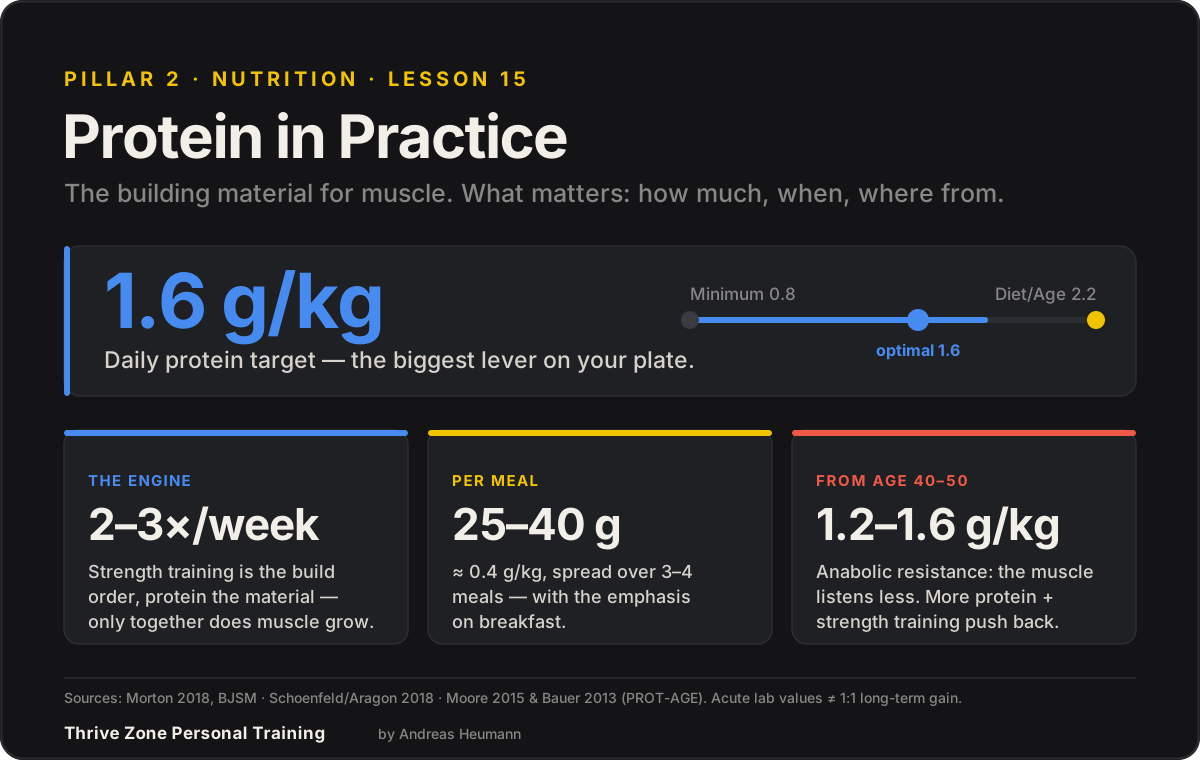
As a practical rule of thumb: around 1.6 g per kg of body weight if you train and want to build or keep muscle. At 75 kg that's about 120 g a day. If you're currently losing weight or older, the upper end serves you better, because protein then protects muscle (why exactly, see the age chapter below). And don't worry about the upper limit: for healthy kidneys, more is harmless — it just brings no extra benefit.
The rule of thumb without maths: a palm-sized portion of a good protein source at every main meal. Manage that three times a day and you're usually already in the right zone.
What you count on — your muscle, not your fat
Here's the point where most calculators get it wrong — and where it makes the difference for you when losing weight. The 1.6 g/kg applies to people with a normal body-fat percentage. If you're currently carrying more fat, the maths "1.6 × full scale weight" gives a protein amount your body simply can't put to use.
The reason is mechanistically simple: protein is turned over mainly in your muscle — not in fat tissue. Your body fat is essentially an energy store; its protein turnover is negligible compared with muscle. So your real protein need is governed by your fat-free mass (muscle, organs, bone, water) — not by the number on the scale that drags the fat along.
An analysis of around 1,400 people across three cohorts shows: recommendations based purely on body weight systematically overestimate the need in people with a higher body-fat percentage — the real driver is fat-free mass, not total weight.
Geisler C, Müller MJ et al. (2017). Inadequacy of Body Weight-Based Recommendations for Individual Protein Intake. Nutrients 9(1):23. DOI: 10.3390/nu9010023 · Cross-sectional analysis, 3 cohorts (~1,400 people, including patient groups). The principle — need follows fat-free mass — transfers directly to everyday people.
And there is a ceiling on the benefit: above about 1.6 g/kg, more protein brings no additional muscle on average (Morton 2018, above). Protein beyond what your muscles can use is metabolised and counts, at its 4 kcal per gram, toward your energy balance. Count on the full weight and you push your target straight into that surplus zone — the more fat you currently carry, the more so. When losing weight, that's needless ballast in your calorie budget. This is exactly why, in the ThriveZone approach, you count on your idealised weight — the weight you'd have at a healthy body-fat level with your current muscle mass.
For trainees in a diet (calorie deficit), protein is dosed directly on fat-free mass: about 2.3–3.1 g per kg of fat-free mass protects muscle best. The leaner you are and the harsher the deficit, the more it's the upper end.
Helms ER, Zinn C, Rowlands DS, Brown SR (2014). Int J Sport Nutr Exerc Metab 24(2):127–138. DOI: 10.1123/ijsnem.2013-0054 · Systematic review, 6 studies · Already-lean, strength-trained athletes in a deficit — the "worst case" for muscle protection. For normal dieters with more reserve, rather the lower end of the range.
The worked example: a man at 100 kg and 30 % body fat has around 70 kg of fat-free mass. His idealised calculation weight (healthy ~15 % body fat, same muscle mass) is about 82 kg. His protein target then works out to ~130 g — instead of the ~160 g if the fat is weighed in. The higher your body-fat percentage, the bigger that gap; the closer you are to a healthy value, the smaller. So you count on your muscle mass, not on the fat store.
The closer you are to a healthy body-fat percentage yourself, the smaller this difference becomes — and at some point you simply count on your normal weight. The calculator below does both for you.
Your protein calculator
What actually makes your muscles grow
Before we talk about per-meal amounts, the most important relationship in the whole lesson — because it decides whether your protein ends up in muscle at all.
Muscle growth needs two things at once: a stimulus and building material. The building material is protein. The stimulus is strength training. Protein alone builds no muscle — otherwise everyone drinking a shake would be muscular. And training without enough protein runs dry, because the building blocks are missing. Only together do they make the engine.
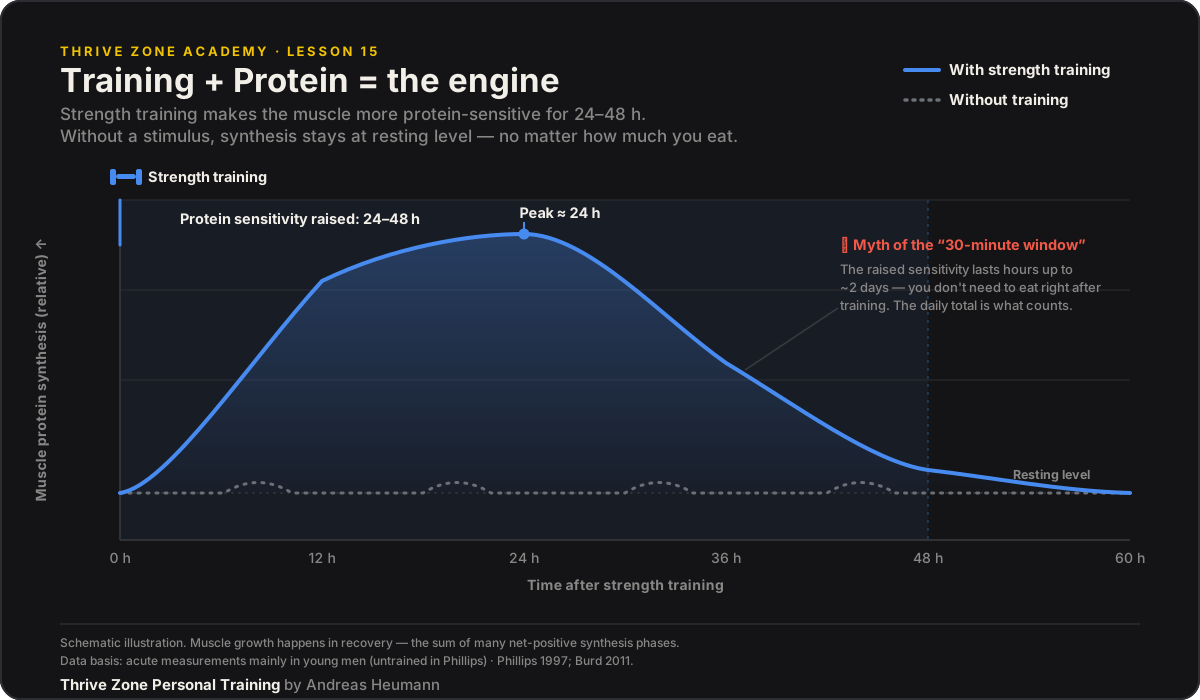
Strength training is the decisive signal. A training session "sensitises" your muscle: afterwards muscle protein synthesis (MPS — the process by which your body builds new muscle protein) is raised and responds far more strongly to protein than without training. And not for 30 minutes, as the old "anabolic window" myth claims — but over many hours.
After a strength session, muscle protein synthesis is raised for 24–48 hours. The heightened sensitivity of the muscle to protein demonstrably lasts at least 24 hours — a small protein portion 24 h after training works more strongly than the same portion without prior training.
Phillips SM et al. (1997). Am J Physiol 273(1):E99–E107. DOI: 10.1152/ajpendo.1997.273.1.E99 · Burd NA et al. (2011). J Nutr 141(4):568–573. DOI: 10.3945/jn.110.135038 · Young healthy men (untrained in Phillips), acute measurement. The mechanism (training opens a broad window) holds generally; in well-trained people the window tends to be shorter.
Two practical things follow, and they take the pressure off:
- No second-by-second stress on timing — but "sometime during the day" isn't the goal either. Right after an intense session your body is still in tension mode, driven by the sympathetic nervous system. Blood is distributed to where it was just needed: the working muscles and the skin (cooling). Your digestive tract gets far less blood flow in this phase, and digestion is largely on hold. A large protein portion straight after the last rep would just sit heavy in the stomach. So give your body 15–30 minutes to shift back into rest-and-digest (parasympathetic) mode and re-perfuse the gut — then it processes the meal cleanly. Your first protein meal or a shake therefore fits best in a window of about 30 minutes to 3 hours after training. Because the heightened sensitivity lasts many more hours (see graphic), you don't have to rush to the minute — but placing the first portion in that window is the sensible default.
- You don't grow during training, but in recovery. In training the stimulus arises (plus microscopic load traces in the muscle fibre). The actual build-up happens in the hours and days afterwards — whenever synthesis exceeds breakdown. Muscle growth is the sum of many such net-positive phases over weeks and months. That's exactly why sleep, rest and consistent protein intake aren't side issues but the place where the result actually forms.
One key distinction that often gets muddled: "What is the most important trigger for muscle growth?" and "What is the most important nutrition lever?" have two different answers. The most important trigger is strength training. The most important nutrition lever is the total daily protein intake. You need both — everything else (distribution, timing, source) is fine-tuning on top.
What this means for you: whether you're 25, 45 or 65 — the lever that builds and keeps muscle is strength training, not the next supplement. Two to three sessions a week are enough as a stimulus. Protein makes the work possible; training gives the order.
When a meal "switches on" growth — and whether there's an upper limit
You saw the recommendation above to put your protein at 25–40 g per meal. Here's the why behind it — and at the same time the all-clear against one of the most stubborn myths around.
The threshold: from when it counts
Your muscle protein synthesis responds to a meal with a clear threshold. Below a certain protein amount, little happens. Above a certain amount it's almost fully activated — and more protein in the same meal raises it acutely barely any further.
The actual trigger is mainly a single amino acid: leucine. It activates the central signalling pathway that kicks off muscle protein synthesis (mTOR). Once a leucine threshold of roughly 2.5–3 g per meal is crossed, synthesis gets going. That's why leucine-rich sources — whey, dairy, meat, fish, eggs, soy — are so effective. (The leucine threshold is an established concept, not a millimetre-precise single value — the order of magnitude holds.)
Acute muscle protein synthesis rises with the protein amount per meal and plateaus in young adults at about 20 g of high-quality protein (around 0.24–0.25 g per kg of body weight) — more in a single portion barely raises the acute synthesis rate.
Moore DR et al. (2009). Am J Clin Nutr 89(1):161–168. DOI: 10.3945/ajcn.2008.26401 · Witard OC et al. (2014). Am J Clin Nutr 99(1):86–95. DOI: 10.3945/ajcn.112.055517 · Young healthy men, acute synthesis measurement. IMPORTANT: the acute lab synthesis rate — an approximation, not a 1:1 measure of long-term gain. In older people the threshold is higher (see age chapter).
So the lab threshold in young adults sits at around 20 g (~0.24–0.25 g/kg). The practical recommendation for everyday life is a touch higher — around 0.4 g per kg of body weight per meal — to reliably reach the daily total across three or four meals and to cover individual variation. That guideline comes from the review by Schoenfeld & Aragon (2018, below). In grams: 0.4 g/kg lands a 80 kg person at about 32 g per meal. That matches the rule of thumb of 25–40 g exactly — a palm-sized portion of a good protein source gets you there almost automatically.
Spreading it over the day — sensible, but not a must
Because a single meal only drives acute synthesis up to this threshold, it makes sense to spread protein over the day — say 25–40 g across three or four meals — rather than all in one big evening portion. Research does show that an even distribution (e.g. four portions every three hours) makes slightly better use of synthesis over the day than very uneven patterns. The first meal is a particular lever: eat decent protein in the morning (instead of just coffee and toast) and you stay full longer, hit your total more easily over the day — and bridge the long protein gap of the night.
Over twelve hours after strength training, an even distribution (4× 20 g every three hours) was slightly superior for muscle protein synthesis compared with very uneven patterns (small frequent, or few large, portions).
Areta JL et al. (2013). J Physiol 591(9):2319–2331. DOI: 10.1113/jphysiol.2012.244897 · Controlled human trial · Young, strength-trained men, acute measurement. Practice: a moderate effect — distribution is fine-tuning, not the main driver.
But — and this is the key point — distribution is a mild optimisation, not a law of nature. It's also the pattern most people live anyway. If one day everything falls on two meals instead of four, nothing is "lost". Why not, the next section shows.
The upper-limit myth: "the body can only use 30 g per meal"
You've surely heard this a hundred times. It's wrong — because it confuses two completely different things: absorption (digestion and uptake) and use for muscle building (acute synthesis).
On absorption: practically all of the protein you eat is also absorbed. There is no 30 g limit at which the gut "shuts down". Here's how digestion runs: in the stomach, stomach acid denatures the protein and the enzyme pepsin starts cutting it up. In the small intestine, pancreatic enzymes (trypsin, chymotrypsin and others) break it into short peptides, and the gut-wall enzymes split those fully into single amino acids and di-/tripeptides. These are shuttled through the gut wall into the portal vein, via the liver into the blood — and are then available to the body almost in full.
The point is: your digestive system is limited mainly in speed, not in amount. A large portion is simply digested over a longer period. Absorption speed depends strongly on the source — whey is "fast", cooked egg protein rather "slow", casein clots in the stomach and is released very slowly. (The often-quoted figures — whey roughly 8–10 g/hour, cooked egg ~3 g/hour — are old, rough orders of magnitude, not exact values; the order fast→slow is well supported.) A mixed meal with fat and fibre slows gastric emptying further. Your body flexibly adjusts gastric emptying and enzyme output to the amount — nothing gets blocked.
There is practically no upper limit on the amount of protein the body can absorb — the only question is how much per meal stimulates muscle building. "Absorption" and "use for muscle building" are two different things.
Schoenfeld BJ, Aragon AA (2018). J Int Soc Sports Nutr 15:10. DOI: 10.1186/s12970-018-0215-1 · Review · Authors' practical conclusion: about 0.4 g/kg per meal across at least 4 meals — for a daily target of 1.6–2.2 g/kg.
On use: here comes the real surprise of recent years. For a long time the belief was: whatever exceeds the synthesis threshold gets "burned off" and is lost to the muscle. Newer, very carefully measured studies show a different picture — a large portion is not wasted. It simply keeps the anabolic response going longer while also suppressing muscle breakdown.
A Dutch research group (Maastricht) compared 100 g vs. 25 g of protein after strength training: the large portion produced a greater anabolic response that lasted over 12 hours — without the surplus simply being "burned off". A second study showed, with 70 g vs. 40 g in a mixed meal, a clearly better whole-body protein balance, mainly through reduced breakdown.
Trommelen J et al. (2023). Cell Reports Medicine 4(12):101324. DOI: 10.1016/j.xcrm.2023.101324 · Kim IY et al. (2016). Am J Physiol Endocrinol Metab 310(1):E73–E80. DOI: 10.1152/ajpendo.00365.2015 · Young, healthy, recreationally active adults (not specifically strength-trained), acute measurement. CONTEXT: this does NOT mean one giant portion a day is optimal for body composition — it means a large portion isn't "lost". The main driver remains the daily total.
The overall picture — and this is what makes this section, because 99 % of protein articles turn dogmatic here:
- Absorb you can almost any amount — there's no upper limit in the gut.
- Switching on per meal happens for acute synthesis from roughly 0.24 g/kg (lab) or practically ~0.4 g/kg; beyond that it barely rises acutely, but the response lasts longer and breakdown drops — so the large portion isn't for nothing.
- What's decisive for building and keeping muscle remains the total over the day. Distribution is fine-tuning.
What this means for you (and your clients): relax about "perfect distribution". The goal is the daily total. Three to four decent protein portions are a good, slightly superior pattern — but if life gets in the way and it becomes two big meals, nothing breaks. That takes off enormous pressure.
Protein with age: why "enough" grows over the years
This is no side topic — for most of us it's the topic. Because from around the age of 40 to 50, a phenomenon sets in gradually that shifts everything said above: anabolic resistance.
Anabolic resistance means: the same stimulus produces less effect. Over the years your muscle responds more weakly to the same protein amount — and to the same training stimulus. Mechanistically, several things combine: a larger share of amino acids is captured in the gut and liver before reaching the muscle (splanchnic extraction); add a low-grade, chronic tendency to inflammation and a dampened response of the mTOR pathway. The result: the muscle "listens less well".
Four very concrete consequences follow.
1. You need more per meal. The synthesis threshold from above shifts upward. Where young adults manage on ~0.24 g/kg per meal, older people need about 0.4 g/kg for the same response — in some up to 0.6 g/kg. In grams: rather 30–40 g per meal instead of 20 g.
In older men (~71 years) muscle protein synthesis only plateaued at 0.40 g/kg per meal — around two-thirds more than young adults (~0.24 g/kg). Professional bodies accordingly recommend for older people 1.0–1.2 g/kg per day (1.2–1.5 g/kg if ill) and 25–30 g of protein per meal with ~2.5–2.8 g leucine.
Moore DR et al. (2015). J Gerontol A Biol Sci Med Sci 70(1):57–62. DOI: 10.1093/gerona/glu103 · Bauer J et al. (2013), PROT-AGE Study Group. J Am Med Dir Assoc 14(8):542–559. DOI: 10.1016/j.jamda.2013.05.021 · Healthy older adults / position paper for the 65+. For the 40–60 group the trend already applies, in milder form.
2. The daily amount is higher. The often-quoted 0.8 g/kg is a minimum against deficiency — not an optimum, and for older people definitely too low. Anyone in middle age and beyond who wants to keep muscle and function does much better on 1.2–1.6 g/kg (on the idealised weight), especially combined with strength training.
3. Digestion and appetite change. Over the years, appetite and stomach-acid production often decline, fullness sets in earlier — it simply becomes harder to eat enough protein. Practical answers: protein first on the plate (before you fill up), choose easily digestible and leucine-rich sources, upgrade breakfast (older people in particular eat almost no protein in the morning), and use a shake as a bridge when needed.
4. Training beats everything. And now the good news: anabolic resistance is not a one-way street. Strength training makes the muscle sensitive to protein again — it's by far the strongest countermeasure to age-related muscle loss (sarcopenia). Enough protein plus regular strength training is, in older age, no longer an optimisation but health prevention: for metabolism, protection against falls, and the span of healthy, self-determined years.
An international expert group (ESPEN) recommends healthy older adults at least 1.0–1.2 g of protein per kg per day and explicitly the combination with regular exercise / strength training, to preserve muscle mass and function.
Deutz NEP et al. (2014). Clinical Nutrition 33(6):929–936. DOI: 10.1016/j.clnu.2014.04.007 · Position paper / guideline · Older adults. Practice: protein and training work together — neither replaces the other.
What this means for you — especially if, like many of my clients, you're between 40 and 60: this is exactly where the topic tips from "nice to have" to a real lever for your healthspan. Run at the upper end (1.2–1.6 g/kg on your idealised weight), aim for a solid protein portion per meal, and make strength training a fixed point of your week. That's the combination that carries you strong and mobile through the coming decades.
Where from — food first
In the ThriveZone approach, most of it comes from real food, not from a tub. To give you a feel for density, here are the best sources, sorted by protein per 100 g. The top ones are your workhorses.
| Food | Protein / 100 g | Good to know |
|---|---|---|
| Harzer cheese | ~30 g | Almost fat-free, very cheap |
| Tuna (in water, tin) | ~26 g | Ready to go |
| Turkey breast | ~24 g | Very lean |
| Chicken breast | ~23 g | The classic |
| Lean beef / trout | ~21 g | Iron / omega-3 |
| Salmon | ~20 g | Plus omega-3 |
| Eggs | ~13 g | ~6–7 g per egg |
| Quark (low-fat) | ~12 g | Filling, slowly digested |
| Skyr | ~11 g | Creamy, versatile |
Meat and fish values raw / ready-to-cook per 100 g. On cooking, the piece loses water — so cooked, the protein per 100 g rises slightly.
| Food | Protein / 100 g | Good to know |
|---|---|---|
| Seitan | ~25 g | Very protein-dense (wheat) |
| Tempeh | ~19 g | Fermented, fully available |
| Tofu (firm) | ~15 g | Versatile, neutral |
| Edamame | ~12 g | Complete amino-acid profile |
| Lentils (cooked) | ~9 g | Plus fibre |
| Chickpeas / beans (cooked) | ~8–9 g | Filling, cheap |
Legumes here cooked (as they reach the plate). Dry, e.g. lentils sit at ~24 g/100 g — which is misleading, as they take on three times their water when cooked. What counts is the portion you eat.
| Type | Protein / 100 g | Good to know |
|---|---|---|
| Whey isolate | ~88 g | Fast, barely any lactose, high leucine |
| Soy isolate | ~88 g | Best vegan profile |
| Casein | ~80 g | Slow — good for evenings |
| Pea protein | ~80 g | Vegan, good with rice protein |
| Whey concentrate | ~78 g | Cheaper, some lactose |
Reference values per 100 g of powder. A heaped scoop (~30 g) delivers ~22–26 g protein depending on type. Which quality really counts is in the Supplement Compass.
If you eat fully plant-based, combine different sources (e.g. legumes + grains, or pea + rice protein) to cover the full amino-acid spectrum — exactly the 9 essential building blocks from the start. And the practical tip: legumes and quark are cheap, filling and versatile — the underrated everyday heroes.
Concrete, fully calculated dishes are in the ThriveZone Meals — many are built around a protein anchor. A few that lift a meal to 25–40 g straight away:
And protein powder?
Food first — always. Your first goal is to cover your protein through real food. Real food brings fibre, micronutrients and satiety alongside the protein — everything a powder doesn't deliver. Protein powder is food made convenient: not a miracle, but a tool. And as a tool it makes sense in exactly three situations:
- As a top-up to close the gap — if you struggle to hit your protein target through food alone, a shake lifts you cleanly over the line.
- On the go — if you know today you won't make it to a proper high-protein meal, a shake beats the gap.
- In a calorie-reduced phase — here you can deliberately replace a meal with protein to keep your protein high while calories come down. Exactly the muscle protection discussed above.
The important counterweight: drinking only shakes all day is not an option. Powder delivers barely any fibre and no food matrix — and that's exactly what your gut needs. Fibre adds volume and feeds your gut flora; it's the substrate your digestion works against and stays in motion on. Take it away and the gut gets sluggish. On top of that you take in far too few micronutrients that only sit in real food. For overall health, body composition and enough protein, the same logic holds: shakes complement food — they don't replace it.
Which quality really counts is in the Supplement Compass. The whey I use in coaching — plus the one training supplement with the best evidence:
RheinNatur Organic Whey Protein Ad link
100 % organic whey protein, no sweeteners — my coaching standard for mixing and baking. ~24 g protein per 30 g serving.
Buy here: Vanilla · Cocoa · Neutral
Affiliate-free: directly at rheinnatur.de or at the health-food store.
ProFuel Creatine Monohydrate Ad link
Not protein, but the best-supported lever on top: the best-studied supplement there is — more strength, more training volume, more muscle. 3–5 g per day. More in the Supplement Compass.
Buy here: ProFuel Creatine Monohydrate (capsules)
Affiliate-free: any pure creatine monohydrate from the pharmacy or a specialist supplier works just as well.
Links marked (Ad link) are affiliate links — if you order through them, I receive a small commission, your price stays the same. You'll find an affiliate-free alternative for each product.
Why all of this together is so powerful you can see in one concrete case: enough protein plus strength training is the engine behind body recomposition — building muscle and losing fat at the same time.
How to put it into practice from tomorrow
Knowledge that doesn't land in your everyday life is useless. So here's your concrete plan — four steps, done:
1. Calculate once. Enter your numbers in the calculator above and remember one number: your daily target in grams. 2. Distribute, but loosely. Roughly across 3–4 meals of 25–40 g each — with the emphasis on breakfast. If a day runs differently: no drama, the daily total counts. 3. Set anchors. Pick 2–3 dishes from the ThriveZone Meals you enjoy and make them your standards. 4. Give the build order. Protein is the building material — the stimulus comes from strength training. 2–3 sessions a week are what let your protein land in muscle at all. That's all you need — protein is a handful of habits, not a daily science.
- Carbohydrates in Practice (Lesson 21) — the fuel to the building material: how much, which, when — and why the amount breathes with your training.
- Body Recomposition (Lesson 3) — building muscle and losing fat at once: where calorie balance, protein and strength training mesh.
- Supplement Compass — which quality really counts for whey and creatine, and what you can save yourself.
New recipes & lessons every two weeks
The nutrition pillar grows piece by piece — well-founded lessons and fully calculated recipes, many built around a protein anchor. Sign up and you'll get them first.
To the newsletterSources
Daily amount & requirement
Morton RW et al. (2018). British Journal of Sports Medicine 52(6):376–384. DOI: 10.1136/bjsports-2017-097608 — meta-analysis (49 RCTs), guideline ~1.6 g/kg/day (upper CI ~2.2 g/kg).
Geisler C, Müller MJ et al. (2017). Nutrients 9(1):23. DOI: 10.3390/nu9010023 — need follows fat-free mass, not total weight (3 cohorts, ~1,400 people).
Helms ER, Zinn C, Rowlands DS, Brown SR (2014). Int J Sport Nutr Exerc Metab 24(2):127–138. DOI: 10.1123/ijsnem.2013-0054 — 2.3–3.1 g/kg fat-free mass in a deficit (lean athletes).
Training stimulus & recovery
Phillips SM et al. (1997). Am J Physiol 273(1):E99–E107. DOI: 10.1152/ajpendo.1997.273.1.E99 — MPS raised 24–48 h after strength training (untrained men).
Burd NA et al. (2011). J Nutr 141(4):568–573. DOI: 10.3945/jn.110.135038 — heightened protein sensitivity ≥24 h (young men).
Per-meal threshold & leucine
Moore DR et al. (2009). Am J Clin Nutr 89(1):161–168. DOI: 10.3945/ajcn.2008.26401 — acute synthesis plateau ~20 g / ~0.24 g/kg.
Witard OC et al. (2014). Am J Clin Nutr 99(1):86–95. DOI: 10.3945/ajcn.112.055517 — whey dose-response, plateau ~20 g.
Macnaughton LS et al. (2016). Physiol Rep 4(15):e12893. DOI: 10.14814/phy2.12893 — after whole-body strength training 40 g > 20 g (trained young men).
Distribution, absorption & upper limit
Schoenfeld BJ, Aragon AA (2018). J Int Soc Sports Nutr 15:10. DOI: 10.1186/s12970-018-0215-1 — absorption ≠ use; ~0.4 g/kg per meal across ≥4 meals.
Areta JL et al. (2013). J Physiol 591(9):2319–2331. DOI: 10.1113/jphysiol.2012.244897 — even distribution slightly superior (acute).
Trommelen J et al. (2023). Cell Reports Medicine 4(12):101324. DOI: 10.1016/j.xcrm.2023.101324 — 100 g vs. 25 g: greater response lasting >12 h, no upper limit.
Kim IY et al. (2016). Am J Physiol Endocrinol Metab 310(1):E73–E80. DOI: 10.1152/ajpendo.00365.2015 — 70 g vs. 40 g: better whole-body balance, mainly via reduced breakdown.
Protein with age / anabolic resistance
Moore DR et al. (2015). J Gerontol A Biol Sci Med Sci 70(1):57–62. DOI: 10.1093/gerona/glu103 — older: plateau ~0.40 g/kg/meal (~two-thirds more than young).
Bauer J et al. (2013). J Am Med Dir Assoc 14(8):542–559. DOI: 10.1016/j.jamda.2013.05.021 — PROT-AGE: 1.0–1.2 g/kg/day, 25–30 g/meal with 2.5–2.8 g leucine.
Deutz NEP et al. (2014). Clin Nutr 33(6):929–936. DOI: 10.1016/j.clnu.2014.04.007 — ESPEN recommendation on protein & exercise with age.
A note on interpretation: many mechanism studies on per-meal synthesis measure the acute synthesis rate in mostly young, healthy men right after training. That explains the "why" well, but isn't a 1:1 measure of long-term muscle gain in everyday life. For building and keeping muscle, the daily total remains the main driver. The safety of higher amounts applies to people with healthy kidneys — with existing kidney disease, check with your doctor. Protein values per 100 g are orientation values from common nutrition tables (raw / ready-to-cook, legumes cooked), not a lab analysis. Idealised calculation weight = fat-free mass at a healthy body-fat reference (~15 % male / ~24 % female); a pure calculation figure, not a body goal.


