Bulgarian Split Squat
The back foot sits up on a box behind you; the front leg does the work. It all comes down to the distance — get that right and there isn't much left to get wrong.
My favourite exercise for legs and glutes. Each leg works on its own, which makes it the first choice when one side works differently from the other. You feel that difference straight away.
What makes it work is how securely the position sits once the set-up is right: box at kneecap height, sit on the edge, other foot placed just in front. That gives you the distance, and the rest of the position falls into place. The rest is two things — your weight stays over the front heel, and the back leg is only there to steady you.
Starting position
The box should come up to about the top of your kneecap — no higher, and not much lower either. Sit right on the edge of the box, weight on your sit bones, knees at 90 degrees. From there, step the working foot directly in front of the other — that's your distance. Now lift the back leg onto the box, ankle right at the edge.
For the second side you don't have to find the distance again — put the other foot in the same spot, swap legs on the box, done.
The set-up, step by step
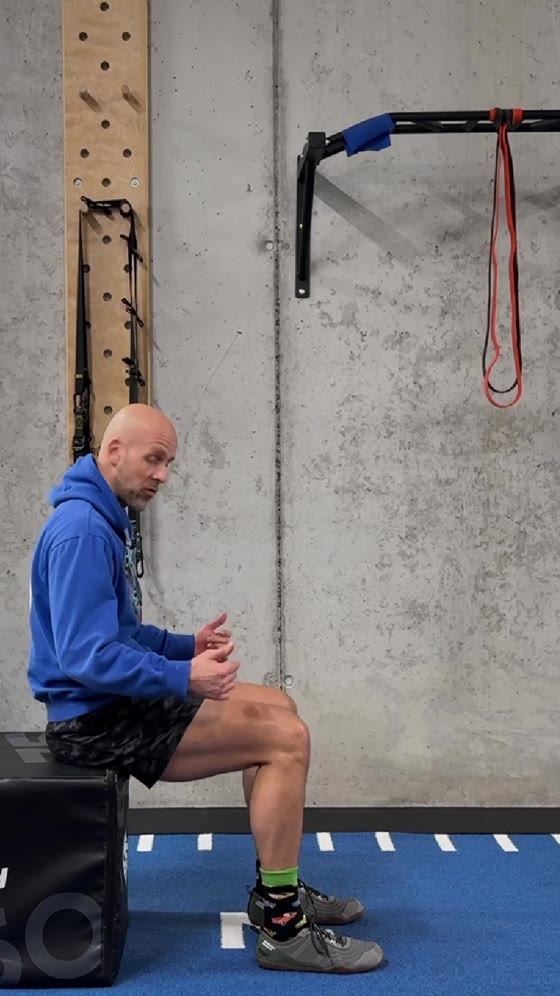
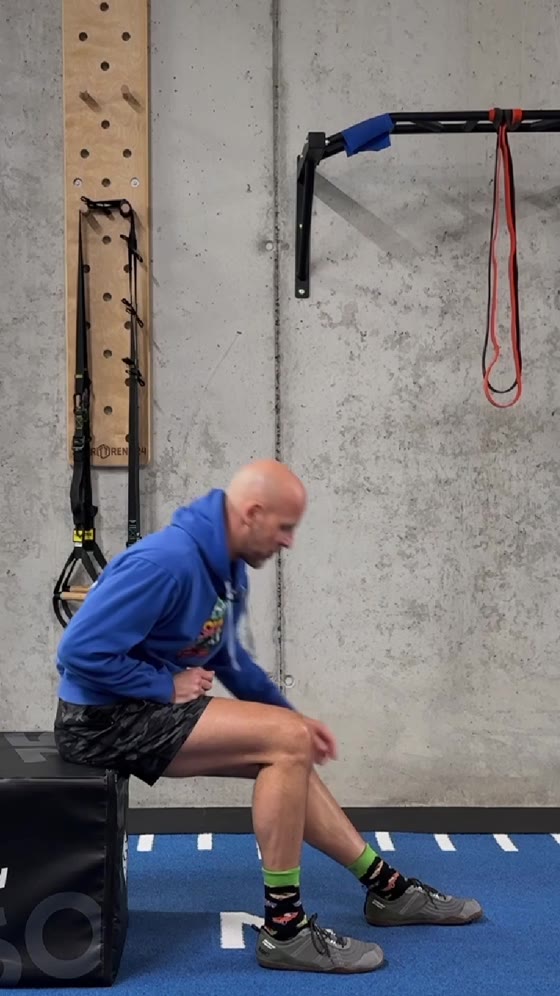
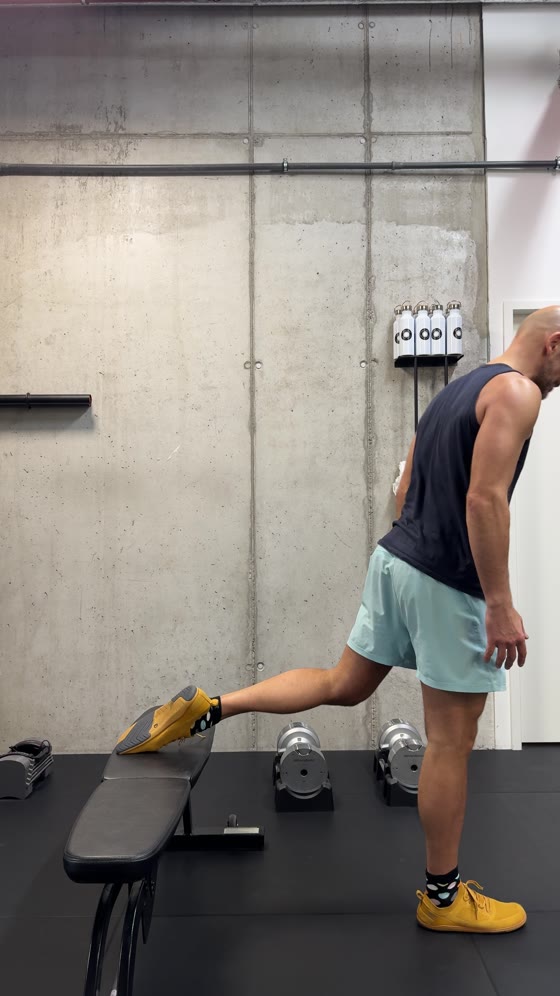
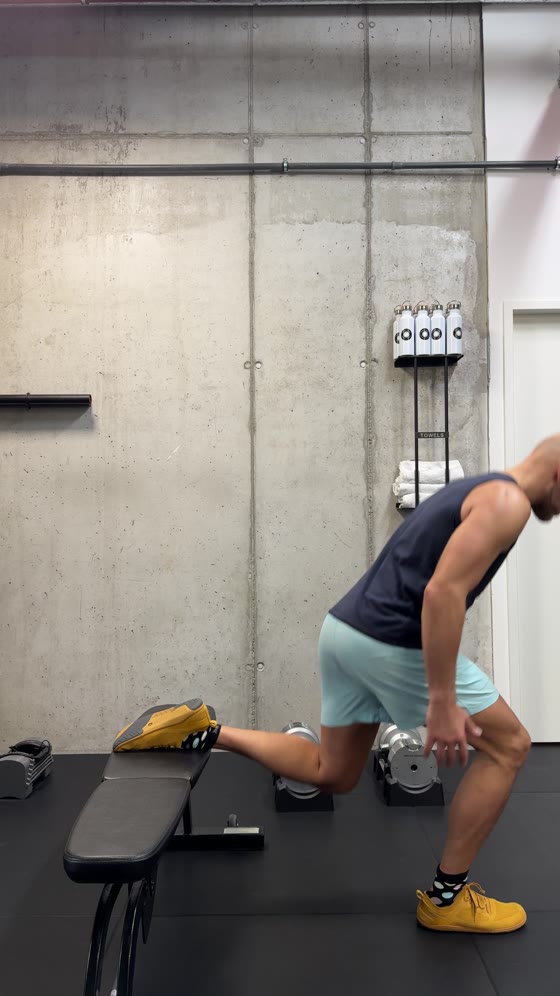
The three cues
- Your weight stays over the front heel — feel that heel and the glutes switch on by themselves
- The back leg is there for balance, not for drive — don't push off the box with it
- Lower slowly, then drive up with intent; keep a slight forward lean through your torso
Common faults
| Fault | How to fix it |
|---|---|
| The back leg pushes as well | It's only there to steady you. The moment it drives, the work spreads across two legs and the point of the exercise is gone. |
| The distance is off | Set it up again: sit on the edge, 90 degrees, step the working foot directly in front of the other. Get the distance right and the position usually follows. |
| Your weight sits on the ball of your foot | Shift back onto the heel, whole foot down. Up on the ball of the foot, the quads do all the work and the glutes barely fire. |
| The upper body stays upright | A slight forward lean is part of it — look at your front foot or just ahead of it. That keeps your weight over the heel. |
| The front knee travels too far forward or back | It rocks gently over the foot. A useful cue: drive the back knee down towards the box, and your weight stays where it should. |
| Too wobbly for clean reps | Steady yourself against a wall, on something solid beside you, or with a training partner — until the movement feels solid. |
Variations
| Variation | When to use it |
|---|---|
| With support | If you're wobbling — a wall or something solid, until it runs clean |
| Bodyweight, free standing | What we do in the studio |
| With dumbbells | Dumbbells at your sides, same set-up — sooner or later you'll need the extra load |
| Step up | A different single-leg option if the bottom position is still too much |
Reps and load
Set-up first, then reps: once you've found the distance, the rest largely takes care of itself. Down slowly, up with intent — and your weight stays over the front heel throughout. Added weight comes later, dumbbells at your sides, same set-up.
Which muscles do the work
| Muscle | Role | What it does here |
|---|---|---|
| Quads M. quadriceps femoris | Prime mover | Extend the front knee, control it on the way down |
| Glute max M. gluteus maximus | Prime mover | Extends the hip of the front leg — that's why the weight sits on the heel |
| Hamstrings M. biceps femoris | Prime mover | Work noticeably harder here than in a back squat |
| Glute med M. gluteus medius | Stabiliser | Keeps the pelvis level on one leg |
| Obliques Mm. obliqui | Stabiliser | Resist rotation — the split stance asks a lot of them |
| Adductors Mm. adductores | Stabiliser | Keep the front knee tracking |
| Calf and foot M. triceps surae, foot muscles | Stabiliser | Keep you steady — the whole foot stays active |
| Hip flexors (back leg) M. iliopsoas, M. rectus femoris | Synergist | Stretched out on the back leg — that's part of the exercise |
The difference from a back squat isn't so much in the thigh as in the hamstrings and the trunk: both do considerably more. And because the legs are staggered, the trunk works against rotation throughout.
Explained in full
The full set-up: what height the box should be, how to find your distance in two steps, why the heel is what matters, and what the back leg should and shouldn't do. · 5:31
Seeing it done right is not the same as doing it right
Video, cues and variations take you a long way. What they cannot give you is an outside eye at the moment the movement isn't quite there yet. That is what training with me is for — in the studio or in a workshop.
See the workshopsNew exercise pages are added all the time — the newsletter keeps you posted.
Sources
Andersen V, et al. (2014). Int J Sports Med 35(14):1196–1202. DOI: 10.1055/s-0034-1382016 — At matched relative load (6RM), the Bulgarian split squat produced 63–77% more biceps femoris and 58–62% more external oblique activity than a back squat, but 16–21% less rectus femoris (n = 15 strength-trained men). Gluteus maximus was not measured in this study. (Evidence type: EMG)
Collings TJ, et al. (2023). Med Sci Sports Exerc 55(4):650–660. DOI: 10.1249/MSS.0000000000003091 — Of eight hip-focused exercises, the loaded split squat ranked in the top tier for gluteus maximus force (495–688 N), but not for gluteus medius (n = 14 female footballers). These are forces calculated from an EMG-driven model, not directly measured values. (Evidence type: Modelling)
Liao KF, et al. (2022). Biol Sport 39(3):485–497. DOI: 10.5114/biolsport.2022.107024 — Unilateral strength training improves single-leg jump height clearly more than bilateral training (ES 0.89), while the meta-analysis found no difference for straight-line sprinting, bilateral jump or change of direction (14 studies, n = 392). The Bulgarian split squat was not studied in isolation. (Evidence type: Meta-analysis)
Aygun-Polat E, et al. (2025). BMC Sports Sci Med Rehabil 17(1):251. DOI: 10.1186/s13102-025-01306-z — Leaning the trunk slightly forward measurably increased gluteus maximus, biceps femoris and rectus femoris activity (n = 21 trained female athletes). An acute measurement, women only. (Evidence type: EMG)
A note on context: EMG studies show which muscles an exercise recruits — that is a good reason to pick it, but it does not replace adjusting things to the person in front of you. See a doctor for persistent or severe pain.