Defuse your day
Training offsets a lot. But if you then sit in the same position for twelve hours, you're working against yourself. The last part is about the real ongoing load — and what you can do about it.
The whole series builds to a single insight: the overarching trigger for neck tightness isn't too little training, it's your day. The way we deal with technology — computer, smartphone, sitting in the car, the workplace — pulls us into the same positions for hours. Some people sit at a screen for twelve or fourteen hours.
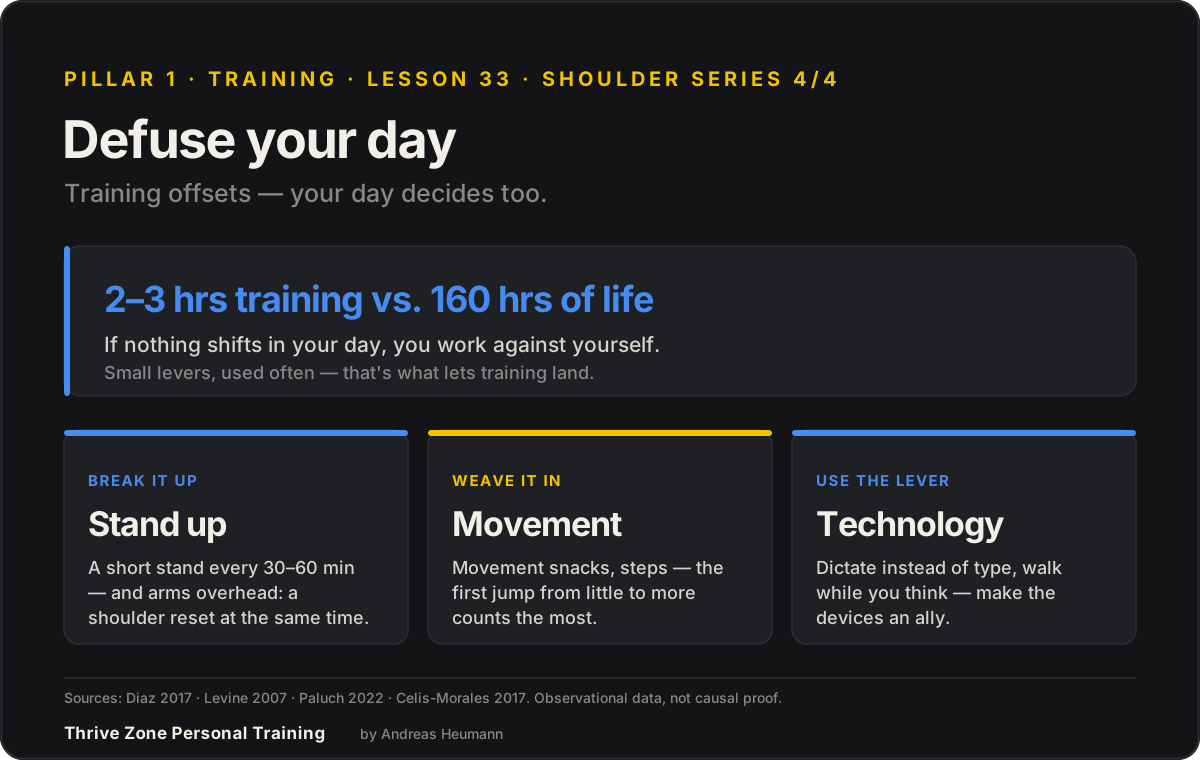
Training is a powerful counterweight — but a counterweight, not a substitute. Two or three focused sessions a week are worth a lot. But the other hundred and sixty hours of the week shape you too. If nothing shifts in your day, you're working against your own progress. The good news: the same technology that creates the problem becomes a lever — if you know how.
1. Break up the sitting
The most important lever isn't to sit less — a working day often won't allow that. It's to break up the sitting regularly. It isn't the total sitting time that's the real issue, it's the long unbroken blocks.
In a large observational study, it was less the total sitting time that came with higher risk than the long, unbroken bouts of sitting. People who broke up their sitting more often — a short stand every 30 minutes or so — did better.
Diaz KM, et al. (2017). Patterns of Sedentary Behavior and Mortality in U.S. Middle-Aged and Older Adults. Annals of Internal Medicine 167(7):465–475. DOI: 10.7326/M17-0212 · Observational study (association, not causal proof).
In practice: stand up briefly every 30 to 60 minutes. And when you stand, take your shoulders with you — reach your arms overhead, roll the shoulders, open the chest. That turns the break into a shoulder reset at the same time, interrupting exactly the pattern this whole series has been about.
2. Weave in movement — movement snacks
Between waking and sleeping there are plenty of small openings that don't have to feel like training: two to five minutes of movement, a few times a day. The idea is simple: everyday movement beyond formal exercise — it adds up over the day to a surprising amount.
The energy we burn through everyday movement outside of sport (NEAT) can differ between two people by many hundreds of calories a day — through standing, walking and fidgeting rather than sitting.
Levine JA (2007). Nonexercise activity thermogenesis — liberating the life-force. Journal of Internal Medicine 262(3):273–287. DOI: 10.1111/j.1365-2796.2007.01842.x · Review (physiology).
And the steps count, especially the early ones. You don't need to hit a magic number — even going from very little to a bit more gives the biggest jump.
More daily steps go with lower mortality — the benefit rises steeply at the low end and then flattens. The first jump from little to more counts the most.
Paluch AE, et al. (2022). Daily steps and all-cause mortality: a meta-analysis of 15 international cohorts. Lancet Public Health 7(3):e219–e228. DOI: 10.1016/S2468-2667(21)00302-9 · Meta-analysis of observational studies (association, not causal proof).
3. Make technology an ally
Here's the twist that matters to me. The devices that pull us into a seated posture can just as easily make movement possible — if you use them deliberately.
- Dictate instead of type. A lot of what you type at a screen with your neck bent, you can also say. Voice input frees you from the fixed position.
- Walk while you think. My own example: I take an easy walk and dictate the ideas that come to me along the way — the ones I want to work out later — and then let my digital assistant (Cowork) knock them into shape. A seated task becomes a walk, without the work piling up.
- Turn the commute into movement. Where you can, use the bike or your own feet instead of sitting in the car — an active commute is one of the most reliable pieces of everyday movement.
In a large prospective study, an active commute — cycling especially — came with a lower risk of cardiovascular disease and mortality. Building movement into your day works — without costing you extra time.
Celis-Morales CA, et al. (2017). Association between active commuting and incident cardiovascular disease, cancer, and mortality: prospective cohort study. BMJ 357:j1456. DOI: 10.1136/bmj.j1456 · Observational study (association, not causal proof).
The twist in one line: you don't have to rebuild your life. You break up the long sitting, weave in movement, and make technology an ally instead of the driver of a seated posture. Small levers, used often — that's what lets your training land in the first place.
That closes the arc of the shoulder series. Part 1 explained the pattern, Parts 2 and 3 built the shoulder — and Part 4 makes sure your day pulls in the same direction as your training. The two together, in balance, are the way to a free shoulder and a calm neck.
Part 2 — Centre and open: the cuff, the front, shoulder-blade control.
Part 3 — Learn to pull: the pulling progression to a strong shoulder overhead.
Part 4 — Defuse your day (this piece): what actually helps against a sedentary, tech-driven day.
- Your day decides, not your workout (Lesson 21) — everyday movement and NEAT in detail.
- The 10-minute lever after eating (Lesson 07) & The Daily Structure (Lesson 12) — how to build movement into your day.
Knowledge becomes habit — and it happens fastest with a person
You know the levers now. But here's what I see in training again and again: the real step is the one between "I know it" and "I do it every day" — and that comes more easily with someone who stays on it, answers your questions and reads your situation. In a world where almost everything runs through a screen, that's my deliberate counterpoint: the workshop and personal training are the safest, fastest and most human way to bring knowledge into your day for real.
See the workshopThat's the shoulder series — the newsletter brings you new lessons first.
Sources
Diaz KM, et al. (2017). Annals of Internal Medicine 167(7):465–475. DOI: 10.7326/M17-0212 — long unbroken sitting bouts are the issue, not sitting time alone (observational).
Levine JA (2007). Journal of Internal Medicine 262(3):273–287. DOI: 10.1111/j.1365-2796.2007.01842.x — NEAT: everyday movement as a major energy factor (physiology).
Paluch AE, et al. (2022). Lancet Public Health 7(3):e219–e228. DOI: 10.1016/S2468-2667(21)00302-9 — more steps ↔ lower mortality, the first jump counts most (meta-analysis, observational).
Celis-Morales CA, et al. (2017). BMJ 357:j1456. DOI: 10.1136/bmj.j1456 — active commuting ↔ lower risk (observational).
A note on interpretation: the studies here are mostly observational — they show associations, not causal proof. The direction is consistent and the measures are low-risk. With existing conditions, check with your doctor.