Herbs and Spices, Not Flavour Enhancers
When your own cooking tastes flat and the snack from the bag tastes of everything at once — two things are going on, and you can take both of them back. A short story about flavour, a lost craft, and the fact that the best spices don't just season your food. They do something in your body.
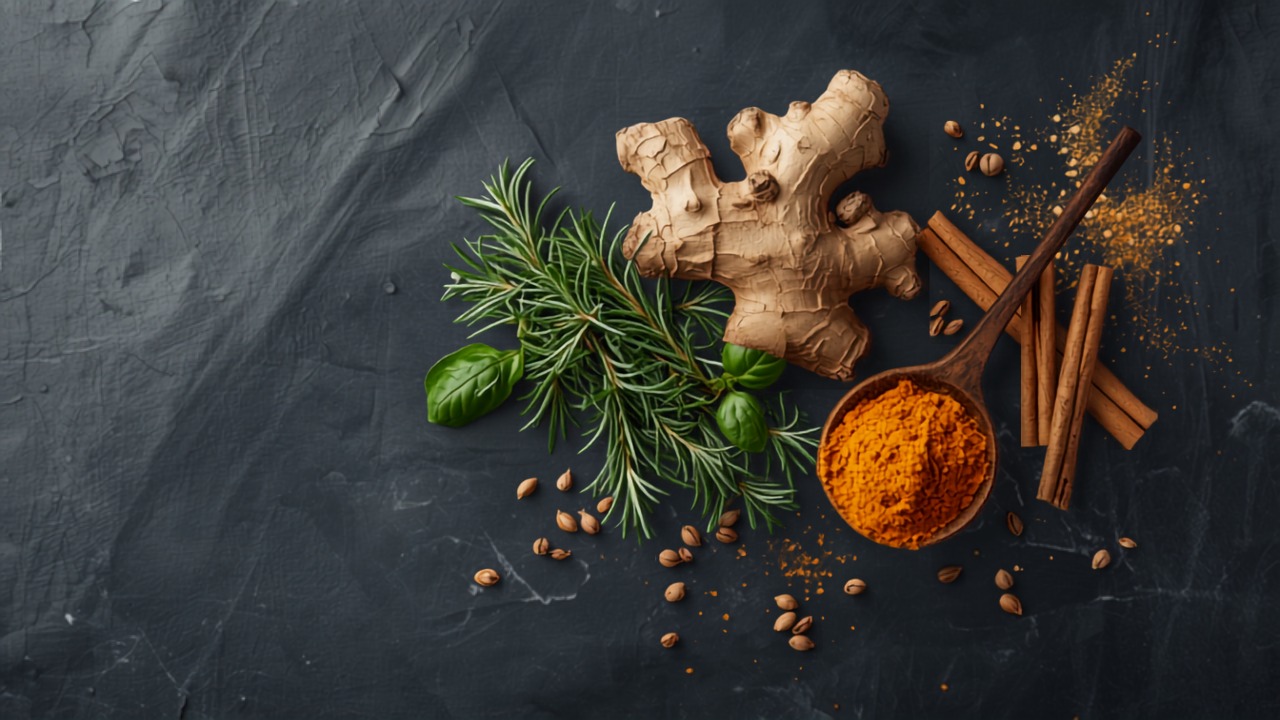
Picture the scene. You decide to eat better. You buy fresh vegetables, fry them up, add a little salt — and then you sit there and it tastes like… well. Like steamed obligation. Two hours later you reach for a bag of crisps, and that hits instantly — no effort, and it tastes of everything at once.
Most people draw one conclusion from this: "healthy food just doesn't taste good." Wrong. What's happening here has nothing to do with the vegetables. First, we in the West have largely lost the ancient craft of seasoning — the know-how people used for thousands of years to turn plain ingredients into something that tastes incredible. And second, the food industry has spent years training your palate on a flavour profile that barely exists in nature — one built, on purpose, to make you eat more.
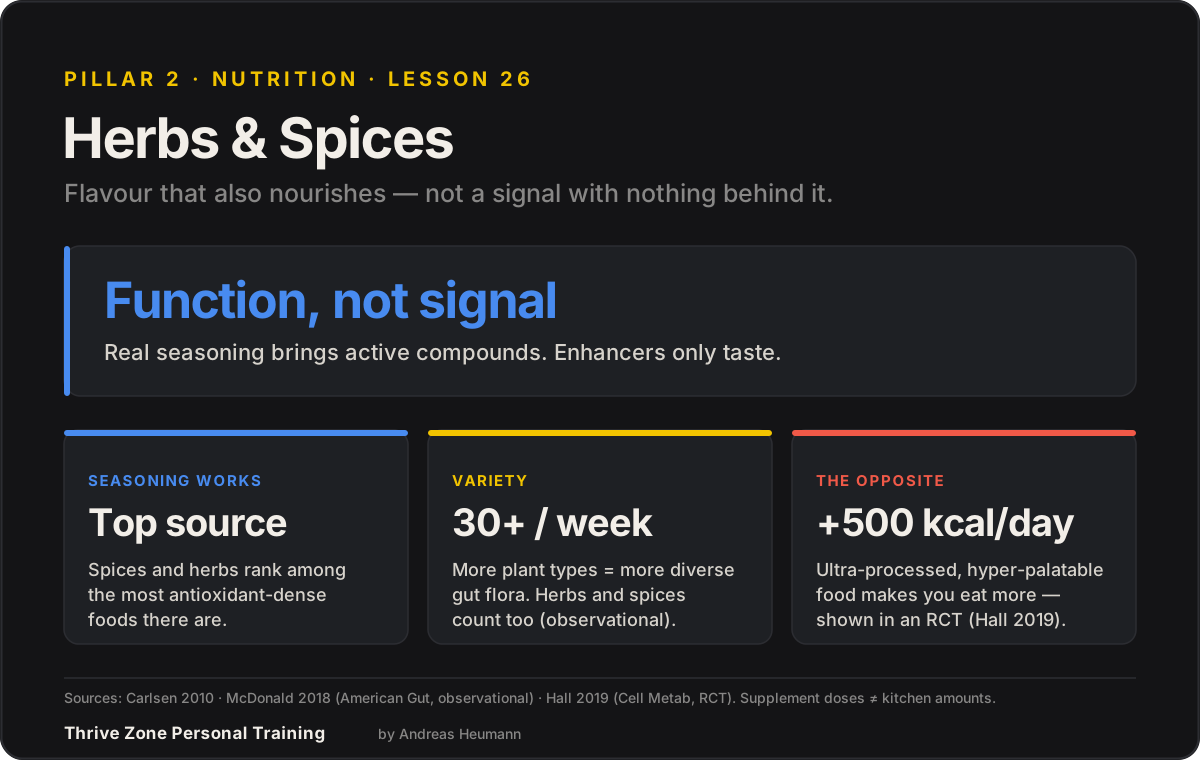
Real seasoning does something. Industrial flavour is only a signal. Herbs and spices bring taste and active plant compounds — antioxidants, digestive help, food for your gut bacteria. Flavour enhancers fake a richness that the food doesn't actually deliver, and they're one part of a recipe engineered to keep you eating past the point of being full. This lesson shows you the difference — and hands you the tools to cook on the better side of it.
How I first noticed this
When I started taking my nutrition seriously in my early twenties and cooking for myself, one question kept nagging at me: why does the food at a good Asian place taste so incredible — and the stuff I make at home taste of almost nothing? I fried my vegetables, I tried hard, and something was always missing that I couldn't name.
There were two answers, and both changed how I think about food.
The first: the cheap takeaway around the corner often leaned on MSG — a flavour enhancer that gives the brain a savoury, almost meaty fullness (chefs call that taste umami). A shortcut. A signal.
The second answer is the interesting one. Walk into a genuinely good traditional kitchen — a real Chinese, Thai, Indian or Persian one, an unpretentious Italian trattoria — and the food is built from an astonishing range of herbs and spices, layer on layer. And here's what took me years to grasp: nearly every one of those spices and herbs carries, alongside its flavour, an actual effect in the body. That's where the two roads split.
MSG isn't your enemy — but it isn't your friend either
A lot of people tell themselves a story about this that simply isn't true — so let's set it straight. MSG is not poison. It's a naturally occurring substance — it's in tomatoes, in parmesan, in mushrooms, in human breast milk. The famous "Chinese restaurant syndrome" — the claim that MSG gives you headaches and a racing heart — traces back to a single letter to a journal in 1968 that later turned out to be a hoax. Controlled studies never managed to pin the effect down, and food safety authorities classify MSG as safe.
What this is really about: the case against flavour enhancers isn't "poison." It's that they're a signal with nothing behind it. They make something taste of more than it delivers — and they're one building block in products designed so you can't stop.
There's a distinction that tends to get lost here, and it matters: a flavour enhancer never acts on its own. It's one building block — what actually matters is what it's built into: the ultra-processed food, assembled from fat, sugar, salt, starch and amplified flavour so that you struggle to put down what you've started. And that this whole build drives you to eat past hunger is about as cleanly demonstrated as nutrition science gets.
A team led by Kevin Hall at the US National Institutes of Health had people live in a clinic for four weeks, feeding them an ultra-processed diet for two weeks and an unprocessed diet for two weeks — matched for calories, sugar, fat, salt, fibre and macronutrients. People could eat as much as they liked. On the ultra-processed food they ate about 500 calories a day more, without trying, and gained weight — on the same nutrition, just unprocessed, they ate less and lost weight.
With nutrients carefully matched, ultra-processed food drove roughly +500 kcal a day of extra voluntary intake and weight gain — within two weeks. It's the first randomised controlled trial to show the driver isn't only the macros, but the way the food is built.
Hall KD et al. (2019). Ultra-Processed Diets Cause Excess Calorie Intake and Weight Gain. Cell Metabolism 30(1):67–77. DOI: 10.1016/j.cmet.2019.05.008 · Randomised controlled trial (cross-over), 20 inpatient adults · Causal evidence: because the nutrients were matched, the degree of processing itself is the driver. Small sample, short run — the effect is large all the same.
There's a name for what makes these foods so easy to overeat: hyper-palatable. Food engineering combines fat, salt, sugar and starch in ratios that almost never occur in real food — the so-called bliss point, the peak of reward. An analysis of the US food database found that more than 60% of the products there fit that pattern. Flavour enhancers are one tool in exactly this kit: they lift the reward signal without putting more substance behind it. No study isolates how much any single enhancer contributes — what's proven is the effect of the whole build. The enhancer raises the reward signal inside it; it isn't the lone culprit.
"Hyper-palatable" foods can be defined in numbers — as combinations of fat, sugar, salt and carbohydrate above thresholds that don't appear in natural food. In the US food database, 62% of products met the pattern.
Fazzino TL, Rohde K, Sullivan DK (2019). Hyper-Palatable Foods: Development of a Quantitative Definition… Obesity 27(11):1761–1768. DOI: 10.1002/oby.22639 · Definitional / database analysis (US data) · Describes the build; the prevalence figure is the US market, the principle travels wider.
This is where it loops back to evolution. Our reward system is built to seek out energy-dense, salty food — in a world where that was rare and kept you alive. Industry reverse-engineered that ancient system and now feeds it on a loop. The signal that once led us toward nutrient-rich food now misfires: it leads to the bag, where very little of value is left.
The other road: seasoning that works
Now for the flip side, the part that fascinated me back then. The herbs and spices of traditional kitchens aren't only flavour carriers. Botanically they sit among the richest sources of plant compounds we have. In a large analysis of more than 3,100 foods, spices and herbs ranked right at the top for measured antioxidant density — with over a thousand-fold differences between individual spices.
In an analysis of the antioxidant content of more than 3,100 foods, spices and herbs (clove, oregano, ginger, cinnamon, turmeric, rosemary, thyme and others) were among the densest sources of all.
Carlsen MH et al. (2010). The total antioxidant content of more than 3100 foods… Nutrition Journal 9:3. DOI: 10.1186/1475-2891-9-3 · Analytical database (antioxidant capacity measured in the test tube). CONTEXT: high lab antioxidant values point to a wealth of plant compounds — they don't yet prove a specific effect in the body. The direction holds; the case for each effect is below.
Let's look at a few of the classics — and I'll keep a clean line between what's actually proven and what's tradition.
Turmeric and ginger — the inflammation calmers
Yellow turmeric, with its active compound curcumin, is the most-studied kitchen spice there is. Across many controlled trials it measurably lowers inflammatory markers in the blood. Ginger, its sharp cousin, points the same way and is also one of the few home remedies with genuinely solid evidence against nausea.
Turmeric/curcumin: in seven of ten meta-analyses reviewed, curcumin lowered the inflammatory marker CRP; IL-6 and TNF-α also fell across several.
Ginger: across 109 randomised trials it shows an anti-inflammatory effect (including CRP) and a well-established effect against nausea.
Turmeric: review of meta-analyses, Tabanelli R et al. (2024). Nutrients 16(11):1728. DOI: 10.3390/nu16111728. · Ginger: Anh NH et al. (2020). Ginger on Human Health: A Systematic Review of 109 RCTs. Nutrients 12(1):157. DOI: 10.3390/nu12010157. · IMPORTANT CONTEXT: these effects were measured with concentrated supplement doses (often 1–3 g and up, sometimes with absorption boosters) — not the pinch in your curry. The kitchen amount brings plant compounds and flavour; it isn't a therapeutic dose. That distinction matters.
Coriander and the detox question — here it gets interesting
You'll often hear that coriander (cilantro) helps "flush" heavy metals out of the body. This is exactly the kind of claim I look at twice — because it sounds good and gets repeated everywhere. The clear read: there are signals in the test tube and in animals, but in humans there's no solid proof.
A hypothesis, not a finding: coriander extracts have bound heavy metals in lab work and in rats poisoned with lead. There's no high-quality human study showing that a coriander smoothie lowers metal levels in people. Major health authorities don't list coriander as a detox agent. Eat it because it's a brilliant, versatile herb — not as a cleanse.
Savory — the story that says it all
My favourite example comes from my own kitchen, and it took me forever to work out. I tolerated beans far better when my mother cooked them than when I cooked them myself. One day I asked her why. Her answer, completely matter-of-fact: "Well, when you cook beans you put savory in. Then you can digest them." In German the herb is even called Bohnenkraut — literally "bean herb."
So I looked it up — and there's something to that old kitchen rule. Beans cause gas because they contain certain complex sugars (the raffinose family) that we lack the enzyme to break down. They travel undigested into the large intestine, where bacteria ferment them — hence the gas. Savory has been used for centuries as exactly that: a digestive companion to pulses.
Worth noting: the biggest lever against the gas is still proper soaking and thorough cooking (a pressure cooker in particular breaks down a good share of those sugars). The savory is the traditional partner on top — and it tastes wonderful with them. But the real point is something else entirely: here was knowledge passed down across generations that I had nearly lost. My mother still had it. I had to learn it again.
The cultural amnesia — and what it costs us
That's the pattern. For thousands of years people were remarkably skilled at preparing food so it tasted superb — and from experience they knew that certain herbs and spices also do something. In Ayurvedic and traditional Chinese cooking, seasoning is to this day half flavour, half application: some things are meant to warm you in winter, some to cool you in summer, some to wake up digestion.
Those last claims are traditional systems, not biomedical proof — I'm not selling them to you as trial data. But they reflect an attitude we've largely lost in the West: food as something you understand and shape, rather than just consume.
We barely hold that knowledge any more. Traditional cooking lore gets passed on less often — there's no time, the link between generations frays, and in the end you reach for the ready-made thing that "just works." That's understandable. But it has a price: grow up on the hyper-palatable profile and your expectation of flavour shifts. Real vegetables then taste "of nothing" — and not because they have nothing to give, but because the yardstick has shifted.
The good news: taste is trainable — in both directions. Just as your palate adapted to the over-sweet and over-salty, it adapts back. After a few weeks of real seasoning, fresh vegetables suddenly taste vivid — and the old bag often tastes oddly artificial. You're simply resetting the standard you measure against.
Variety on the plate — and in your gut
There's one more reason the spice drawer earns its keep, and it concerns your microbiome — the community of trillions of bacteria in your gut. A rule of thumb from the research: the more different plants land on your plate each week, the more diverse your gut flora. And the lovely part: herbs and spices count as plants. Every fresh herb, every kind of spice is a point on the board.
In the largest citizen-science microbiome project to date, people who ate more than 30 different plant types a week had a markedly more diverse gut flora than those eating 10 or fewer.
McDonald D et al. (2018). American Gut: an Open Platform for Citizen Science Microbiome Research. mSystems 3(3):e00031-18. DOI: 10.1128/mSystems.00031-18 · Large observational (cross-sectional) study. IMPORTANT: this is an association, not proof of cause and effect — people who eat lots of plants often live differently in other ways too. The direction is consistent and plausible all the same.
And spices specifically play a part here too — a trial shows it. In a controlled feeding study, deliberately adding herbs and spices over four weeks shifted the make-up of the gut flora — with more of the bacteria that produce short-chain fatty acids (helpful by-products that the cells lining the gut feed on).
Adding herbs and spices to a typical diet shifted the gut flora over four weeks and enriched producers of short-chain fatty acids — with a trend toward greater diversity at higher spice amounts.
Petersen KS et al. (2022). Herbs and Spices Modulate Gut Bacterial Composition… Journal of Nutrition 152(11):2461–2470. DOI: 10.1093/jn/nxac201 · Randomised, controlled, cross-over feeding study, 54 adults at elevated cardiovascular risk · Strong design; the endpoint is gut-flora composition, small group — a good signal, not the last word.
How I season — and what's in our recipes
Enough theory. Here's how it looks day to day at ThriveZone: we build flavour in layers rather than pulling it from a sachet. Aromatics as the base (onion, garlic, ginger), then the herbs and spices that set the profile, then something fresh and a hit of acidity at the end. Look through our ThriveZone Meals and you'll find that same principle:
- Ginger & garlic carry the Asian dishes — the Asian veg pan with salmon, the bone-broth soup, the chicken satay salad.
- Turmeric, cumin & coriander give the chicken & chickpea tagine its depth — and run through the chicken bone-broth soup.
- Oregano & Mediterranean herbs shape the Mediterranean line: roast vegetables with chicken legs, Mediterranean lentil salad.
- Cinnamon rounds out the sweet anchors — protein pancakes, overnight oats, the nut & seed mix.
Your starter spices — what belongs in every kitchen
Build a small core collection and you get surprisingly far. Here are the ones I'd call essential — each with the reason why:
One practical tip that makes the biggest difference: buy spices in small amounts and actually use them. Aroma fades — a two-year-old jar at the back of the cupboard tastes of little. Fresh and often beats big and old.
- Carbohydrates in Practice (Lesson 21) — why "empty" carbs from the bag are a different thing from real fullness, and what quality actually means.
- The Supplement Compass (Lesson 06) — if you do want curcumin or ginger at a therapeutic dose: here's the clear frame for what counts and what you can skip.
- Protein in Practice (Lesson 15) — well-seasoned real food is also the easiest way to eat enough protein with pleasure.
- Active Time and Hands-Off Time — good seasoning costs almost no time; why cooking from scratch is less work than it sounds.
Meals that fit
From the ThriveZone Meals — real macros and hands-on times.


New recipes & lessons every two weeks
The nutrition pillar grows piece by piece — fully calculated recipes and grounded lessons, many built on exactly the seasoning principle from this article. Sign up and you'll get them first.
Go to the newsletterSources
Processing, flavour enhancers & overeating
Hall KD et al. (2019). Cell Metabolism 30(1):67–77. DOI: 10.1016/j.cmet.2019.05.008 — RCT: ultra-processed food → ~+500 kcal/day, weight gain with matched macros.
Fazzino TL, Rohde K, Sullivan DK (2019). Obesity 27(11):1761–1768. DOI: 10.1002/oby.22639 — quantitative definition of "hyper-palatable" foods; 62% of US products.
On MSG safety: US FDA, "Questions and Answers on Monosodium Glutamate (MSG)" (GRAS status). fda.gov — official classification as safe; "Chinese restaurant syndrome" not confirmed in controlled studies.
Spices & herbs — plant compounds and effects
Carlsen MH et al. (2010). Nutrition Journal 9:3. DOI: 10.1186/1475-2891-9-3 — spices/herbs among the most antioxidant-dense foods (lab capacity, not in-vivo proof).
Tabanelli R et al. (2024). Nutrients 16(11):1728. DOI: 10.3390/nu16111728 — review of meta-analyses: curcumin lowers inflammatory markers (supplement doses).
Anh NH et al. (2020). Nutrients 12(1):157. DOI: 10.3390/nu12010157 — ginger across 109 RCTs: anti-inflammatory, well-established against nausea (supplement doses).
Variety & the microbiome
McDonald D et al. (2018). mSystems 3(3):e00031-18. DOI: 10.1128/mSystems.00031-18 — >30 plant types/week ↔ more diverse gut flora (observational).
Petersen KS et al. (2022). Journal of Nutrition 152(11):2461–2470. DOI: 10.1093/jn/nxac201 — herbs & spices shift the gut flora, more SCFA producers (RCT, cross-over).
A note on context: the anti-inflammatory effects of turmeric and ginger come from studies using concentrated supplement doses and absorption boosters — the kitchen amount delivers flavour and plant compounds, but not a therapeutic dose. Lab antioxidant values show a wealth of plant compounds, not automatically an effect in the body. The coriander heavy-metal claim rests solely on lab and animal work; human proof is missing, so it's flagged as a hypothesis. The microbiome-diversity figure is an observed association, not proof of cause. "Warming/cooling" are descriptions from traditional medical systems (Ayurveda, TCM), not biomedical evidence.